Quarter life crisis – finding church

Straight out of university I moved to London, I had a year placement all set up and I was ready to start my life. I registered a new email address with pretensions to drop the Danny and become Daniel. I was ready to be a grown up.

I’d moved away from home to go to university, I’d settled swiftly and part of that was finding a church. I’d grown up in Southampton, lived in the same house my first eighteen years and been a part of the church from the day I was born. Church was a place I knew people and where I was known. It was not a small church, but by virtue of a countless Sunday, fundays and games of hide and seek I had a place I belonged.

Moving to university created a rift, suddenly the known nature of church was replaced with a void of choice and novelty. But when you have organised tours of churches in your new home town, life is made a whole lot easier. There were some churches which with the greatest respect to them and friends who were and are part of them were simply never going to be the place I called home. And when I settled upon where a place to be a part off, integration was facilitated by special events, teams and a group of people in the same situation as I was.

All of this is a way of very briefly sketching the ease with which I transitioned from a church that I loved and felt a part of to another where I felt the same. When it came to searching for a church in London there was no such custom built process or teams prepped over the summer for my arrival. I was on my own. One Sunday before I moved I travelled up to London, with my sister for company, and went to a couple of churches, it was a surreal experience. You are on your own in the mist of people who know each other. When I moved I tried out a few more and chose a church to make my own. And for a year I went fairly diligently, went to a small group slightly less diligently, and when my year was up and I moved back to Southampton I faded out of the church without effort or notice. The last Sunday I went was like the very first.

Movement is a defining fact of life for many people in their twenties. Something happens, and then the next, life moves on, priorities change, home is a moveable concept, and church becomes a convenience store. It becomes something static while we are mobile so we drop in and out and our relationship with it becomes more like a consumer and a provider than a church made up of people.

And the problem only gets worse when the church responds to this attitude. It’s sees people wanting church for what they can get out of it and they seek to provide that. Now I don’t go in for all this self-flagellation nonsense, I’m not saying we should make church boring and hard work and painful just so we are not appease our more sensual appetites, but we shouldn’t change just because we think it will make people like us more.

Four years go I returned to London and aside from visiting other churches for baptisms, christenings and the like I’ve stayed with the church I went to the week I arrived. And now is the place for very carefully crafted confession: I don’t agree with everything, and I don’t like everything. Just step back and imagine what a church would look like if you did agree and like everything. You would be preacher, worship leader and serving the tea, and doing it all to yourself.

There’s a crisis with people in their twenties leaving church, but I don’t think the answer is to serve them the church that they want on a plate. I think that church needs to challenge the presumptions and attitudes that we hold and ask why it is we hold them. Maybe when the church is clear about what it is and what it is for it will find the authenticity so sought after.
Anatomy of the quarter life crisis

When the sports car turns up on the drive, or the order goes in for the new Harley Davidson, or the letter of resignation is tendered in order to start up an Alpaca farm, or the man who has loved his wife for the past 25 years finds his affections wandering. It’s the mid-life crisis.

Well known, frequently observed, caricatured across popular culture it’s a phenomenon that hits at a certain point in life. Usually sometime in their late forties a person wake up one morning and wonders what they are doing with their life. They have gone through the phases of life set out in the manual, they’ve climbed the rungs of the career ladder, they’ve got married, had kids, those kids have grown and are becoming more independent. And they realise the things that have anchored their life for so long do not provide satisfaction.

It’s the reach for something to provide the thrill which they have suddenly realised is missing that is most notable. Whether it is the fast car, the off beat adventure, the marital infidelity, it is the desire for something greater which gets the attention. But that desire does not emerge out of thin air.

The search for something more, something to bring satisfaction, give meaning, provide fulfilment is not restricted to middle aged men. And maybe I’m imagining it, but the dissatisfaction seems to be coming earlier in life. The disappointment that things are not the way they hoped they would be; that the promises they lived for turned out to be illusory. This is the quarter life crisis.

Frustration that life hasn’t worked out how we want is not enough by itself to spark this crisis, what is needed is the opportunity and the capacity to do something about it. So the mid-life crisis came at a stage after the busyness of life has subsided and due to increased time and resources living with the apparent inadequacies of life was not unavoidable. What enables the mid-life crisis to occur is dissatisfaction and the capacity to choose something different.

And for many people the same two things now exist at a much earlier age. Maybe life is, as was suggested to me, just lurching from one age related crisis to the next, but I think there is something specific that hits people in their mid to late twenties.

Maybe I need to add a caveat or two. No one is the same as anyone else and the life experiences we have will vary. So what I’m saying is a generalisation, it may will apply to some people and not others. You may think I’m speaking precisely to you or think I’m spouting nonsense. The second caution is that there are many different causes that lie behind any particular action or train of thought. So my analysis of dissatisfaction and opportunity is simplistic and of course misses the many personal goings on that will be at play.

But there is a conveyor belt that pushes us through life for the first twenty or so years. There’s childhood when you’re dependent, there is adolescent when we strive for independence but with the safety net of family and community reigning us in. There is the freedom granted when we leave home, head to university but there is a purpose that under-girds that free form explosion of individuality. We leave university for the world of work with ideas of changing the world, of hopes and dreams and a complex assortment of desires to make something of ourselves. And it’s easy to get to 25 without having thought very hard about why we are doing what we do.

This is not new, the progression of life has always had templates and norms to follow. What is novel is the absence of the constraints in this next phase of life. Some people still get married at this stage in life, have kids, and are in a chosen way constrained. Yet for many people the choices are kept open and the options remain on the table.

The promises of changing the world do not always turn out the way that we hoped. The people we imagined living our life with do not fit the form we choose. The jobs that we do pay us a wage but do not provide the satisfaction we think we want. It is the sudden overflow of options that creates a crisis. As Don Miller says in the film Blue Like Jazz “You wake up everyday lost in a sea of individuality”. We want to make something of ourselves and we feel like we should be able to. With the time, the flexibility and the disposable cash we want to attain something that is missing, something that will make our life more worth living. But it doesn’t, so we hit a crisis.

All this week I’ll be writing about how this plays out in various areas of life. I’d love your input, have you hit such a crisis point? What causes it and what does it look like? How can it be resolved?

Breaking up is hard to do

Dear readers,

Thank you for your time, attention, comments and shares over the past few months. It feels like I’ve thought and wrote more about relationships in these weeks than I have, well since last summer.

And like on that occasion it gets to a point when I have to step away from the keyboard. When I have to let the hum of keystrokes fall silent and the words pause their progress across the screen. There are times for creativity, there are times for searching out wisdom. There are times for humour, and times for the shedding of tears. I have felt all of these while writing these past few months.

There are times when tearing back the covers and exposing the frailty of the your soul is the strongest thing that you can do. And there are times when you need to rest, recuperate and recover the longings of your soul.

Because I am tired. I am spent from exerting the energy it takes to write words that comprehend what I have spent most of my life ignoring. I am exhausted from embracing the honesty that I have adopted as my trademark, an ever incremental appetite that is not quenched by the post that tells of more than you ever thought you would tell.

It was one day at work when I had been asked to write for a new site called threads (going live soon, sign up to learn more). ‘What should I write’ I inquired, ‘something like your blog’ came back the reply, the ping pong went on, ‘what is it about the blog you like’, I was hoping for direction and clarity to make the writing easier. ‘Your honesty’ she confirmed.

I’ve always set out to write as honestly and bravely as I could, I never wanted anything to be off limits. But in some of the early throws last year I wrote with a shield of abstraction cast around me. Everything was general, projected onto others, with carefully calculated asides into my own thoughts and processes to dust my writing with authenticity.

The more I thought about it, the harder it became, I was trying to manufacture authenticity, I was aiming to write in a way that would ease people into my story but only on terms I choose, which in turn I was plucking out of the air. So instead of authenticity I aimed for integrity. I wrote what I felt, and when that helped me clarify the turbulent waters of my emotions and thoughts, and shone light on the segue between my plans and my dreams, and the oceans that stood between them: I acted how I knew I must.

I write early in the morning, it’s when I think most clearly with the first waves of caffeine rushing through my veins. Before work a couple of times a week I’ll sit and find words to convey what I want to say, grateful for the delay not given when I try to speak the same thoughts which often end up in a muddled, confused, sometimes abrupt tone. I’ll head into work exhausted from the emotional energy I have expended on the words I schedule for display later in the day.

I’m taking a break. At the moment I’m off work, I’ve had a long weekend away from twitter, apart from the odd snap posted from Instagram. And tomorrow I head off again. It is good for my soul to disconnect because I don’t always manage my relationship with the online world particularly well.

This is a season for rest. I’ve got a few bits of writing to do, some long promised articles which have slipped below the bottom of the pile, so I won’t be entirely silent. But there will be nothing new on this blog until September. After a constant progression of growth in readership from February until now, August will be a fallow month. A time when the ground is cleared and left without manipulation or exertion. A time when abiding in what already is comes before seeking out what is to come next.

I want to cut off the need to check how many people have read the blog today. I want to remove the frustration when a post I have thrown my all into languishes in double digits.

I want to take an axe to the root of the jealousy when a beautifully crafted and impeccably timed post goes viral. I want to disconnect my worth from the attention I receive.

So this is not a good bye. And I value your words more than you can imagine. In the cliched words of most televised high school break ups, ‘it’s not you, it’s me’.

I need some time alone, some time to gather my thoughts and to recharge. To find emotional security away from affirmation. And to learn the lessons that my desire to be honest has uncovered in myself, and to address the weaknesses I’ve seen displayed as an excuse for bravery.

Until the autumn, you are my friends. And I’ll still be tweeting now and then.

Danny

Finding Wonder

Tonight the Olympics begin. And they begin with the spectacle of the opening ceremony grandly titled ‘Isles of Wonder’. From what I’ve heard it’ll be quite a show, around 160 000 people have seen the two rehearsals this week meaning enough has seeped out to wet the appetite, explanations of scenes that can probably only be seen to be appreciated, all no doubt part of a clever marketing strategy. Glimpses of grandeur hidden behind calls to #savethesurprise. A couple of moments, so I’ve been told, that will make the hairs on your arms stand on end.

It’s not only the cold that gives you goose-pimples. My old drama teacher used to refer to that as his measure of whether a performance was hitting the high notes he was looking for. It happens with scenes taut with emotional suspense, it happens when things occur which defy expectations. Or when someone goes above and beyond. The three men who stood in front of their girlfriends as the shooter spewed bullets and death into the Aurora theatre last week. Such goodness defying such madness.

Wonder.

We find it in landscapes that speak of God the great artist. And in constructions and paintings that display his hand behind ours. It’s there in the laws that we use to explain how the universe sits in its fine balance. In the equations that come together out of mind boggling complexity. I once declared that a proof was pretty. My friends mocked my choice of words and my teacher was complicit in their reproof. Beautiful, elegant perhaps, but she had never heard a mathematical proof described as pretty.

My life is too crowded with notifications and appointments, demands and deadlines, responsibilities and expectations. I schedule activity to the most infinitesimal degree, even when I have nothing to do. I plan and scheme and orchestrate. And often I miss these moments of wonder.

But sometimes things go wrong. That’s what lies behind the ‘broken cameras’ part of this blog’s title. I was in Vienna on the second day of a break on my own escaping it all and my camera broke. No more pictures of European cathedrals. No record of my travels across the cities of central Europe.

I didn’t want to break my camera. I generally don’t like it when things go wrong, but it serves the essential purpose of reminding us that we do not live in a perfect world. In short: things go wrong.

A different trip abroad took even less time to go wrong. I had only just picked up the car from the rental agency in Portugal when while fiddling with my wing mirrors I managed to take one off another car. This little adventure underlined the truth of the well worn phrase,’less haste, more speed’. I was just trying to get on my way, but ended up shaken up, with a lighter wallet and it slowed me down.

Ironically that was exactly what I was trying to do.

Escape the rush of life, the busy diaries. The need to feel like I was busy when really I was not. Contrast the guilty pleasure of a quiet day with the faux contentedness of continual nights in. The pressure to seem like your life is full can be quite a draining exercise, leaving room for little else.

And then the real contrast. The village with seven inhabitants. The nearest shop a service station on the motorway that passes by without a sideways glance. The goat bells ringing their very own dawn chorus. The gnarled olive trees that litter the landscape. From the shops on the street corner that simply do not ever close transported to a world where a loaf of bread is unobtainable in the early evening setting sun.

Even on a last minute trip to the Portuguese wilderness there is the temptation to set agendas, daily reading targets, plans for action. So perhaps it was better that I got a bit of trouble early on to remind me that the perfect break is not going to happen quite yet. Each time I have to learn to stop.

And relax.

And watch.

The world go by.

Even if it is the distant hum of traffic or the crickets in the trees.

And watch the sun as it stoops low in the sky before titling below the horizon. The long shadows it cast vanish and all that is left is a gentle hue of colour where the sun once hung. And as the colours turn to dark and the sky lights up with countless stars, those names and unnamed.

Because that”s the other part of this blog’s title. I’m not particularly well versed in art and its appreciation. When I was in Vienna I thought I was going round a grand old house and it turned out to be an art gallery. Being the philistine I thought I might be I set to walk away but I saw it housed a collection by Gustav Klimt so instead pressed on. I stood before ‘The Kiss’ and gazed in wonder. This painting should not work, it is a catastrophic mix of colours and forms, with oils and gold leaf and other materials overlapping in a chaotic collage.

But it is beautiful. Somehow the wonder transcends the mechanical list of compounds. I want to be overcome with wonder more. I want to look at the world and fall to my knees. I want to see in those around me the reflection of the love of God. I want to see in myself the unending grace of God as he finds ways to surprise me.

I’m beginning to think that disruption is at the root of wonder. Only when we break from the normal, stop our routine, step out of the comfortable, do we see the wonder of God that surrounds us.

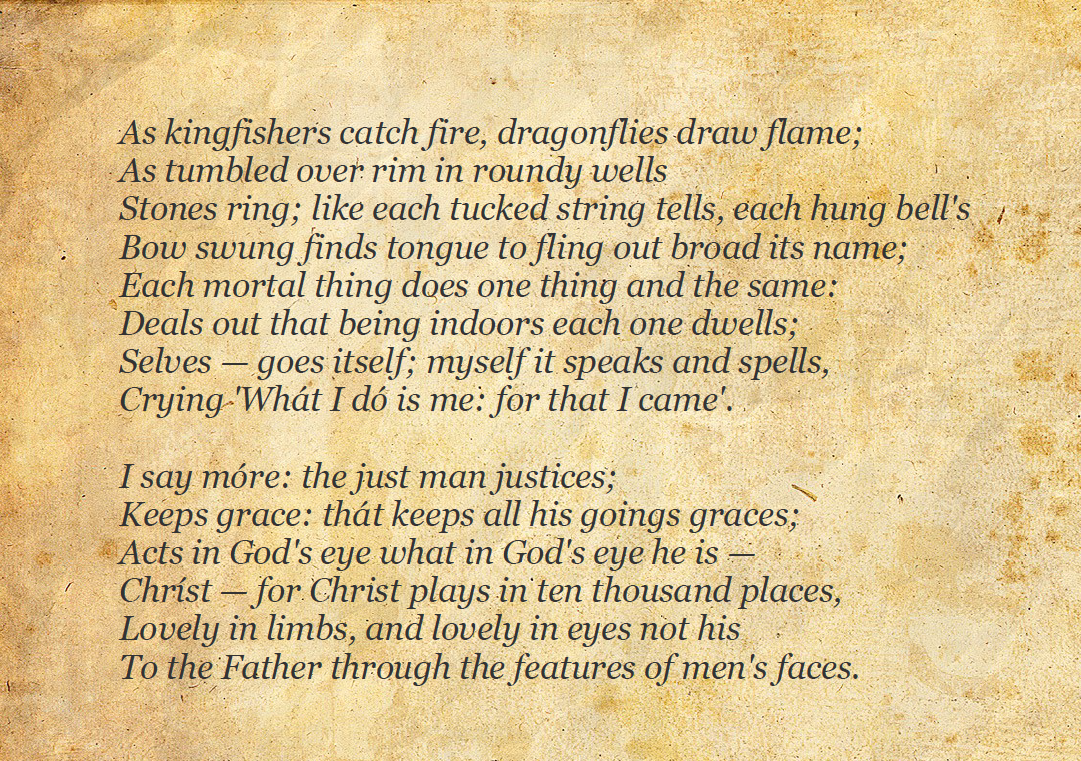
To close, a poem from Gerard Manley Hopkins, and from whence comes the title of a book by Eugene Petersen that I’ll be rereading this summer.

Today I write for Prodigal: Never Been Kissed

Today I share the story of my single life over at Prodigal:

There are awkward conversations. And then there are conversations you would do anything to avoid. There will be a whole tranche for each of us that fit into this latter category. For me they start something like this:

“Danny, what’s your worst ever dating experience?”, or maybe, “When did you have your first kiss?”

I can’t answer them.

This week I had one that ended up along similar lines, but I didn’t see it coming. For some absurd reason I started a blog last summer and choose relationships as my specialist subject. I had opinions and I wanted to share them. Whether anyone was listening was comparatively unimportant, and if they were I planned on ignoring them. That illusion was shattered the moment I walked into church and saw the people who had shared my post or commented on the blog.

… read more over at Prodigal Magazine

If you’ve ended up here after reading my post take a look around, you’re welcome to linger a while or stay for as long as you want. I’m always interested to hear what you think, whether you passionately disagree or find words that echo your story.

Let go, trust and forgive

I was walking down the road I trod in a puddle. Or a bus passed too close to the curb and drenched me from the waist down. Every moment in life is crowded with details that point to things not working how we might like them to.

I hear that someone I love is ill. I see carnage across the sea. I hear men who should know better suggest reasons for the chaos. All I want to do is cry.

And in my heart I flit between tortured indifference and unbridled anger knowing that brokenness and pain, and frailty and heartache are a normal feature of yours and mine and everyone’s life.

Whether it’s as I try to untangle my attraction to a girl from my insecurity to feel needed, or my rejection as others head to watch the Dark Knight Rises as I am left at home. Things do not work out how I would like them to. It is never as simple as it should be.

And we can fret and we can plan, and we can hope and we can dream. We can long for love to conquer all, we can read the books that claim to guide us. We can have all the answers to our questions and still stand adrift in a sea of chaos.

The final part of the puzzle does not slot into place like a jigsaw, it works in exactly the opposite way. It’s not a solution that makes things easy. Nor even one that tells you after a rocky ride everything will be okay.

Instead the answer is to raise your hands, loose your grip on what is in your hands. And let go.

Ruin is the starting point of transformation, but that doesn’t mean it’s a downhill ride after we’ve scaled the heights of suffering. Ruin requires surrendering, letting go and trusting in God. It means that we know that we cannot sort everything out, that plan B and C and all the way to Z may do us no good.

We trust in God and we hold tighter to him than to any of our hopes and dreams.

And there’s another thing. We forgive, which let’s us enter into the acts of redemption that work through the darkest of niches. Somehow, in the most challenging of situations light starts to shine. When things are wrong it is not the end.

When conflict reigns in a relationship. When pain gnaws away at the loneliness that follows break up. Or the isolation that surrounds singleness. When you do your best to solve whatever problems punch you in the face and they come back with a viscous left hook.

Let go, forgive, trust God. Not easy, never easy, but somehow it is the right thing to do. And even if you don’t, God is still there and he still loves you and redemption comes in the most unusual of places.

Make love not war

I’m a firm believer that conflict is a healthy part of any relationship. Not because I’m a glutton for hard times but because if it’s not there you’re either lying or repressing the inevitable disagreements beneath the surface.

When conflict, and even anger, is not properly managed it is allowed to linger and fester and at some point, especially in close relationships, it will boil over. In the final sermon in ChristChurch London’s Love is a Verb series this was the topic of conversation, so in this post I’m going to run through the first seven ideas for handling conflict given. In a follow up post I’m going to write about the final one in more detail and with some reflections added.

  1. Decide to resolve conflict.This is the tough one, it might sound simple, even superfluous, but if you don’t take a decision to deal with things then they won’t be dealt with. I know from my experience that once I have taken the decision to do something the challenges of following through with that fade away. They don’t disappear altogether, and I often take longer than I should in getting round to having that hard conversation, but I have it. This is about clarity of communication, regardless of what we think we have said it is vital to pay attention to what the other person has heard, and how they have taken that.

    Our natural instinct is to run away from conflict, but if we just move on we will experience the same friction in a new place, and if we continually shift away from discomfort nothing will ever be dealt with.

  2. Take your time.This is an interesting one. I’ve been brought up under the mantra of don’t let the sun go down on your anger, and consequently I’ve always wanted to resolve issues as soon as they flare up, that’s once I let them flare up.

    But maybe it is sometimes wiser to wait, and acknowledge the conflict, and to allow passions to calm before addressing what lies beneath. When we come under attack, whether physically, verbally or emotionally we freeze, and our knee jerk response is very rarely a good one.

  1. Win hearts not arguments.I like a good argument. I like the chance to best my foes with my wit and wisdom. I like the haggling and scheming, the tactics and the strategy. I don’t mind losing the odd battle as long as I stay ahead in the war.

    This is not a very good way of building relationships. I’m sure my tendency to want to win is shared by plenty of others, the dismay at being thought wrong, when you know you can set the record straight.

    But who really wins in this situation? Certainly not the relationship. I need to learn to prioritise the relationship over what I think is right, and in my case not only the answer but the method. Too often I want things done my way, because I have the best, most efficient solution. It’s okay not to win the argument, it’s more than okay to put the other person first.

    In the end most short cuts are diversions.

  2. Get perspectiveI’m very often right. And I’m more often also wrong. And sometimes I can be both of those at the same time. This is not some relativistic hogwash but instead the acceptance that there are almost always multiple perspectives to any situation. If we’re obsessed with our point of view, our interests, our rightness, then we will miss so much of what is going on. Likewise, if we think that everyone else is against us and become defensive we will end up wallowing in self pity.

    In the talk on Sunday Andy Tilsley gave a pretty stiff challenge to see the other person’s perspective, and to think about how if we do this we could cut out gossip. The point being that gossip is usually when one person’s position is advanced without consideration of how others involved, think, feel or react.

  3. Take responsibility for what you can take responsibility forIt’s not my job to change the world. There are a lot of things that don’t work out the way I would like them to work out and some of the time I will have to live with that. If I spend my life fretting over problems that I have little or no control over then I will work myself into a frenzy and into a spin of stress and disappointment at the futility of it all.

    Whereas if I focus on what I can change, on my behaviour and my relationships, of the way that I think about myself, then I will not only have a greater chance of success but I will also be dealing with the issues that are closer to the heart of the problem. Otherwise I’ll spend a lot of time on displacement activity, trying to get things done, change things, make things better, but all the time remain the frail shell with the same problems as before.

  4. Tell the truthSimple, tough, and essential. We avoid telling the truth because of where we fear it will take us. We worry that if we say something people will think less of us, or be disappointed. Or no that we are interested in them. Or know that this relationship isn’t going to work out. Not only do I need to tell the truth but I need people around me who will tell the truth to me, who will call me out on the nonsense that I spout and the lies that I live.

    It was on this issue that a little query popped into my mind: how do we balance telling the truth with not always trying to win the argument? Because if we know that something is right then we have a responsibility to tell that truth, don’t we? Maybe, but we also need to balance a few other things as well, we can take time in our relationships to draw light onto problematic situations, and we can have grace to understand that things going wrong will not derail our life.

  5. Get helpOur problems are not just our own, and likewise the solutions will often be shared. It’s not an excuse to go gossiping to everyone about the problems someone else is experiencing, but the very real acceptance that we need help to navigate the tricky waters of our relationships. Help from other people can also shine a light onto the extent of the problem, sometimes it will be apparent that in the light of day things are really not that bad. But in others the extent of pain will only become clear with an outside perspective. Sometimes in the midst of a relationship we can forgive and forebear, and then excuse what we should not. There are relationships where the most loving thing we can do is walk away.

Effectively what I’ve presented is my extended notes from Sunday’s sermon along with a bit of commentary and reflection along the way. There is a lot we can do to handle conflict, but the most important part of this post is that we handle it. Something more important than that will come in the next instalment.

What is this thing called love?

© Emily Martin

Love is a mystery, it is foreign, alien, far from understanding. But it is elemental, it is at the beginning and the end. Of what remains, the greatest is love. Mark Twain said: “when you go fishing for love, bait with your heart, not your brain”.

When we talk about romance, we talk about being in love. When we see someone who takes our breathe away, we fall in love. And when things don’t go so well we can now fall out of love with the one to whom we had given our all. After one of this week’s posts a friend sent me a link to an article about the reasons marriages split up, and all too frequently it is simply that they got bored with each other. And it lead me to wonder, do we put too much store by love, or is it that we just don’t understand it?

I can think of no better book on this topic than CS Lewis’s The Four Loves. Love is not always the same, it takes different forms in different relationships, from affection, through friendship, to the eros of romance and the all consuming unconditional agape love from God. I probably should have reread it before writing this post.

CS Lewis’s point, if I recall correctly, is that the other forms of love only work properly when subordinated to the unconditional love from God. We can love because we have already been loved. When we turn we find that he has already turned.

Am I a reprobate romantic to say that love can conquer all? That our problem is not that we put too much trust in love, but that we give it too little. We hedge our bets, and we take our chances, we mitigate against things going wrong. We build structures of reliance that defend our cause and protect our pet projects. We don’t want anything to fail so too often we just do not try.

We think that if love is the answer it will solve our problems. We think that such a wonderful thing will make life easy.

I was at a wedding yesterday and the during the address the pastor said, “I hope this is the worst day of your married life.” It was a cute point, a good way of saying that marriage is not summed up by the celebrations on the wedding day but of a life lived growing together, that there are far better days to come.

But was it too saccharine? Because marriage will not always be defined by happiness and joy. Because while the wedding day is hopefully not as good as it gets, it is also unlikely to be the worst. There will be sadness and troubles, there will be heartache and agony; maybe that wasn’t a message for the wedding day. I’m sure that if I’m married I’ll wake up on some mornings and wonder what I’m doing there, I may regret falling in love, I may regret trusting in love. Wherever I am, whomever I am with, there will be crappy days.

And on these days, like when I’ve had enough of my friends or my family annoy me, is the answer is to walk away or to recommit? Last year I read McCloud & Townsend’s book Safe People, and one of the most challenging things was the need at times to draw a line under some relationships, and to walk away rather than to expend all your energy on trying to redeem and rescue the other person, or your relationship. I found this hard because I often operate as though the love I am supposed to have for all people is translated into a one-size-fits-all relationship.

But love does not mean I try and have the same relationship with everyone I know, and by extension, everyone I don’t know. It means that I love them in whatever relationship we have. So I love my friends in a way that is different to my family, and one day I hope to love my wife in one way and my children in another.

At my church we’re coming to the end of a series called ‘Love is a Verb’. And for a series titled so there’s been remarkably little discussion of love, with the focus instead on the relationships that provide the context for love to be demonstrated. Love is a thing, it is an emotion, it is a state that we abide in. But it is also a verb, it is something that we do, and must do over. It is something that we cannot ever complete. We cannot be done with love and we cannot do without it. It remains.

And now these three remain: faith, hope and love. But the greatest of these is love.” 1 Cor 13v13

Love is all around us. It is in the papers, on the screens. It is in our hearts, and on our mind. It lets us dream and it stops us sleeping. And too often it is sequestered in pursuit of happiness. Love becomes the thing which gets us what we want. We love because we want relationship. We love because we want sex. We love because we want company, or status, or security.

How rarely do we let ourselves love and beloved for the sake of nothing but that one thing which remains.

Too often we view marriage as the end point of a road of love, but surely it should be the other way round? Should not marriage open the door to a path that is paved with love both given and received, both the end and the means? Love comes in and flows from the relationship as much if not more than being the force which brought it to life. Love is not the answer to all of your or my problems. But maybe it is what helps us live without the answers.

What do you think? Am I getting carried away with my hopes and dreams for love? Is love enough?

Married to wanting more

One of the things about writing in public is I’ve got to be careful what I say. Careful so I don’t offend those who I know as well as those I don’t. But also careful I don’t get the sack by saying controversial things or in any other way bringing my employer into disrepute.

And this might tread the line pretty tightly. Sometimes at work I get bored.

I was thinking about this following a post from Ally Vesterfelt about how the idea of a perfect day is perhaps so because of its very scarcity. The same thing, if we had to do it every day would become mundane.

So I love my work, it’s interesting, challenging and most of all for me, it is varied. But occasionally I get bored of it. I look at the things that I need to do and turn and think something else would make my life more exciting. I imagine a roller-coaster adventure where no day is every the same, and when the challenges are just hard enough to tax me but not too hard to give me nausea at the stress I sometimes feel on a Sunday morning.

My mum used to teach me that boredom was a state of the mind. That something was only boring if you let it be so. Maybe, but that doesn’t mean exciting things won’t become normal and the exhilarating mundane. It’s the adrenaline rush affect of life, it’s the incremental desire for more. For something that will lift us out of the situation we are in and onto a better plane.

And as I reflect on this I’m reminded of a few words from this week’s talk on marriage and family as part of ChristChurch London’s Love is a Verb sermon series. I wasn’t intending on writing a piece specifically on it but a few things stood out and resonate as I ponder this idea of something exciting becoming mundane.

I cannot begin to speak for couples who are barely back from their honeymoon, never mind those who have worked through decades of marriage. But I hear the excitement of being together lasts eighteen months to two years. Considering plenty of couples are together that long before they tie the knot it means marriage will quickly drift into normal rather than novelty.

If we are always after novelty we will never be content. If we allow our boredom with how things are to provoke us to change tack we will always be on the move. Sometimes settling down is the hard thing to do. Sticking to a course regardless of the obstacles in your way.

So sometimes I get bored at work. Sometimes I get bored with the friends around me. If I was in a relationship I guess I’d get bored with the person I was going out with, if I was married I’d probably get bored then too.

Maybe boredom is a state of the mind, but that doesn’t make it any less real. Our default response to boredom is change, whereas if I dare suggest, recommitting and accepting that things will never be picture perfect is a more productive way forward. It allows us to step off the hamster wheel that promises something better, but that better thing always ends up disappointing.

Whether it is marriage, a job, or the need for excitement, if we change at the whim of our needs we are within a hairline of turning that desire into an idol. If we think that marriage will answer our problems we place it in a position it cannot retain. If we think a job will satisfy all of our demands it will always let us down. If we put the very experience of adrenaline rushing through our veins as our goal we will never have enough.

What do you think? Should boredom provoke us to change or encourage us to dig deeper? Have you ever tried so hard to get something you think will make you happy and it let you down?

Learning from Jennifer Lopez

It was one of those evenings. When you get in, picking up your small chips and battered sausage on the way home, grab the bottle of Bulmers which has been lurking in the fridge for an occasion such as this and swiftly fade into the folds of the sofa and absorb whatever the screen before you has to offer.

I could blame it on working all the way through the weekend, meaning I’m a little over halfway through this nine day week. Or I could blame it on a bout of lethargy that stopped me from getting that overdue piece of work completed. Either way I watched back to back films, beginning with Monster-in-Law, a pretty shocking Jennifer Lopez vehicle that weaved its way through her travails with her soon to be mother-in-law.

But like much inspiration it came out of nowhere. And this most unexpected of cultural landmarks offered up something to critique and something to appreciate. Jennifer Lopez’s character was sat shooting the breeze with a couple of friends wistfully describing her ideal man. He would be strong, but gentle, rough but in touch with his emotional side. It was a wish list that soon came true in the hands of Hollywood scriptwriters.

The inspiration came because it more or less echoed a conversation I had on Sunday, I’d rushed back for church from the conference I was at and lingered in the pub for a little while afterwards. Slightly in shell shock from the fallout from my previous post, it was a difficult time for me to be in company, the dissonance between my online writings and my face to face relationships abundantly apparent. The conversation was a critique of what girls look for in guys, wanting the best of both worlds, wanting the strength and the sensitivity. And I apologise because I wasn’t fully engaged in the conversation, but something stuck. And Jennifer Lopez’s words brought it back to mind.

We have wish lists. They can be long and they can be short. They can focus on the minutiae or the grand. When I was looking around houses my wish list was fairly short, I was flexible. Mostly, I had decided what I was going to do and that was the most important step. When it comes to relationships we have ideals and hopes and dreams. We manufacture edifices of imagination of what life will be like if it all comes to pass.

We want the strong and the sensitive, the fun and the focused. Whether it is a guy who will be unbreakable until he meets her charms, or the girl whose frivolity fades before the one true guy. We want to have it all.

But what if the most important aspect is not the marks out of ten that we ascribe but the decision that we take to engage in relationships.

This morning before I sat down to write I had my regular check of twitter and top of my feed was this from Lauren Dubinsky:

Whimsical? Probably. Profound? I think so too.

It is about the purpose and not the process. And that’s the part of Monster-in-Law that I appreciated. Amid the candy floss storyline that was always going to come good there lay a overriding decision that she was going to marry this guy. The details of the wedding, the disaster of the engagement party and rehearsal dinner faded before what was in her sights.

Maybe, just maybe, the first step is to decide to engage. There’s a lot of talk about waiting, and I’ve had my fair share. But I’ve also used waiting as an excuse for disengaging. A bit like that conversation after church on Sunday. I was there, but I wasn’t.

Where we end up may be less important than taking that step and deciding to make relationships, of whatever form, a priority. What do you think? Is it too much to just decide one day that it’s time to find a girlfriend/boyfriend, or even husband or wife?