Should we judge those who judge?

Judge not, that ye be not judged, at least that’s how the Authorised Version puts it.

Words followed words today, tweets followed tweets, judgement followed judgement. All in an oscillating cycle between being right and in being right, or thinking you are right, being wrong.

It was Mark Driscoll’s tweet that set the cat among the pigeons:

I took a moment to take in my shock. But only a moment. I thought I was managing to stay above the fray by tweeting a link to his without any judgement.

But who am I kidding? There was judgement in those words, bucket loads. And predictably it got the retweets I thought it would. And the responses from those agreeing and adding their disdain that he could say such things.

One response, however, stood out from the crowd. It was not an affirmation that I’d backed the right horse, but a gentle prod that perhaps I shouldn’t have got on my high horse.

I cannot do anything other than speculate on the motives Mark Driscoll had for his tweets. I can only comment with any certainty on those driving mine. I was confident I’d get support from those perpetually outraged by his statements. I thought it might even earn me a little kudos in the twitter world.

What I was really doing was looking for support in me being right and someone else being wrong.

I was judging. I could build a defence, I could argue that Jesus saved his harshest words for the judgemental Pharisees, I could say he was representing a view of God that is flatly contradicted by the man Christ who called us to take the plank out of our own eyes before pointing out the speck in another.

That’s what I’m doing now. Publicly taking the plank out of my eye. My tweet was based on wanting to serve my own purposes and rubbish another. And the sneering tone that lay beneath my words made that worse.

But it also leaves me with a question: when and how should we respond to those who judge? Do we let their words go unquestioned, do we let them paint a picture of God that is not who we worship? I simply do not know. I think there’s a space for criticism, there is a space for rebuke: I think that can be healthy. I even think that can happen on twitter and blogs, but I know for me it’s not a forum where that is easy.

I think it’s all too easy to write things in order to provoke a response, words that inflame and do not inform. It is too easy to build an audience, too easy to like attention, too easy to judge the wisdom of your words by the hits or retweets. I know that I have to be immensely careful of my motives when I write. It is also easy to see criticism as an affirmation that you are saying something worth being said.

For now, I simply apologise to Mark Driscoll for judging him this afternoon.

Update:

I like to think that this blog is a place where I think out loud. I do my best to be as honest and open as I can. It’s also been pointed out by Annie Carter in the comments that her tweet to me was actually referring to Mark Driscoll’s original tweet. Yesterday’s post caused a bit of a stir, was I trying to stop people disagreeing? Was I saying to deny what you thought? What role is left for anger?

Simply, I wanted a better tone of conversation. I think it is possible to disagree without judging, and I think there is a place for rebuke. It’s just in my case I was judging and I am not convinced that twitter is the best place for rebuking someone. I think this opens up a much wider conversation as to how Christians do disagreement in public, and my hunch is that we should do it a whole lot less than we do. And I think in a context such as twitter were conversations get confused and responses are short, the potential for perceiving something that wasn’t quite meant is manifold.

I think Anger can be a good thing, I think it highlights things that are not how they should be. But anger unmediated and detached from a relationship can be harmful, and that’s where I think we have to act with care.

I found Mark Driscoll’s comments objectionable but what I had missed until it was pointed out to me was Cornel West’s objection to Obama swearing the oath on MLK’s Bible. So here’s a thought to ponder: why did they provoke such different responses?

Legal rights and religious wrongs

Yesterday’s European Court of Human Rights judgement on Eweida, Chaplin, Ladele and McFarlane didn’t get the attention it might otherwise have received. For the mainstream media this was the news story getting all the coverage with Steve Chalke relegated to a small sidebar. But within the Christian world the cases got a distinct shove to the sidelines.

In response to the cases I want to make two legal points as best as I feel able to from a layman’s perspective. And then two theological reflections about where the cases and the judgement leave us.

Summary of judgement

Firstly, what did the court decide? It determined that one of the four claimants, Nadia Eweida, had been subject to an unlawful restriction of her freedom to express her religion. In the other three cases it found no unlawful restriction, and refused a claim for direct discrimination on grounds of religious belief for Lillian Ladele.

Legal view

Nadia Eweida should have been allowed to wear her cross to work but Shirley Chaplin, a nurse, was reasonably prevented from doing so. The crucial legal point affirmed by the judges in Strasbourg was that this was not dependent on whether wearing a cross was a necessary, or even generally recognised, aspect of Christian belief. Rather, and importantly, what matters is whether the action arising from belief is important to the person in question’s religious belief.

The desire to wear a cross for both Eweida and Chaplin passed the manifestation test that I set out last week, and the actions of their employers was deemed to be interference with that expression of belief. The key question was whether that interference was justified. This is where I think the court took a very simple to understand common sense stance. In the case of Chaplin health and safety concerns were considered justified while for Eweida the desire for British Airways to maintain their brand image was not. Added to this, British Airways were inconsistent in their accommodation of religious belief and had allowed the uniform code to be modified to satisfy other religious beliefs.

The second interesting and important point that comes from the judgement comes in the case of Lillian Ladele. Both she and Gary McFarlane requested an opt out from certain duties in their work because of their beliefs about homosexuality. For several reasons I consider Ladele to be the far more interesting and valid case, not least because she was employed by Islington Council prior to the introduction of civil partnerships and her job was changed to include their registration as well as marriages. In both cases no users would have been restricted from accessing a service, but their employers refused the request for an opt out because it would go against their equal opportunities policies.

In the case of McFarlane, he choose to change the remit of his role by training in psycho-sexual counselling, in doing so he raised the prospect that he might be unwilling to provide this service to gay and lesbian couples. In doing so he showed intent to restrict the service he provided on the basis of sexual orientation. A further point in his case was that his scruples applied only to gay and lesbian couples and not to heterosexual couples outside of marriage, which strikes me as an inconsistent application of biblical sexual ethics, although following the reasoning above the court accepted his stance constituted a manifestation of belief. For these reasons, I am satisfied that the court reached the correct decision in finding that Relate acting fairly.

The European Court of Human Rights allows the relevant authorities, in this case the employers and the UK courts and wide margin of discretion when determining how to protect convention rights. Therefore in both these cases the court found that the actions of the employers in their equal opportunities policies, and the courts in backing them, were reasonably because they were in pursuance of protecting the rights of others on the basis of their sexual orientation.

The question that arises following the decision to place the actions of Islington Council in the case of Ladele within this ‘margin of appreciation’ is what would be needed to fall outside of this margin? The court has acknowledged that there is a need to balance the protection of different convention rights, but in its decision leant heavily towards protecting sexual orientation rights without any guide to how religious expression would be equally protected. I am not sure, if this judgement is confirmed by the Grand Chamber, whether there is any action that an employer took to protect sexual orientation that would be deemed an unjustified interference in the manifestation of belief.

Theological reflection

Both the pairs of cases, raise theological as well as legal issues. And these come into play layered over rather than in conflict to whether or not they should have won. For what it’s worth I think both Eweida and Ladele should have won, but I think sometimes we can get caught up in the legal rights and wrongs of specific cases that we detach it from the our faith.

On the cases of the crosses, I don’t wear a cross, I don’t think it’s important to my belief. But I accept that for some it might be, a friend coincidentally wore a pair of rather large cross earrings yesterday. But that wasn’t a statement of faith. And I think it’s a mistake when we make a big deal of things that aren’t a big deal. And whether or not we can wear a cross is not a big deal.

That’s the first theological point. The second is bigger, and harder to define. It’s the question of whether cases such as these are helpful or a hindrance to public Christian witness. I think when cases are brought that are unlikely to ever win but instead used to promote the perspective that Christians are being discriminated against they are a poor weapon which leads to a culture war which leaves far more loses than winners.

The Clearing the Ground report issued by Christians in Parliament last year commented: “The cyclical strategy of generating-fear-to-fuel-funding-to-fight-cases (cases that are often doomed from the outset) is a recognised part of the culture war situation in North America. Although such an approach can have the effect of giving Christians a sense of ‘taking a stand’ against a tide of secularism, with protest as a primary mode for political engagement, it is clear that it simply reinforces a victim mentality, polarises society, and does not work.”

But sometimes there are legitimate grievances, and how do we respond in those cases? What of Lillian Ladele who was pushed into a job she never applied for, doing something that conflicted with her deeply held belief, in a situation that could have been resolved without anyone deprived from getting a civil partnership, and the only cost Islington Council’s equal opportunities policy?

I think in these cases we have to act with humility, we have to exhaust all possible options. And I think sometimes we need to turn the other cheek.

It’s a thought I can’t get away from at the moment, that when faced with a situation when we are sure we are right how do we prioritise relationships without giving up on what we believe. And how in it all do we live out the reality that we are created in the image of God, how can we be attractive to the world that needs to know God in whose image we were created?

It’s been one of those days

FNT compassionIt was one of those days when I all I could find to take down details of a voice mail message was a paper plate.

I suppose today started at 10.30 last night. I got an email. The Times had the story: Steve Chalke supported active monogamous gay relationships, you can read all about it in Christianity Magazine. I knew a day destined to be busy because of the European Court of Human Rights judgement on four religious freedom cases was about to get a whole lot more hectic.

And through the day one thing turned over and over in my head. If we’re to call for civility in society and civility in dealing with situations where Christian beliefs rub up against differing prevailing views in society, then we need to model civility

Civility doesn’t ignore difference, but it seeks a way for us to live together despite our differences.

I work for the Evangelical Alliance (I might as well be honest about my affiliation) and that put us at the centre of today’s storms. When the role of faith in public life is under question, and potential legal coercion, it is a subject of interest – we want to articulate in a calm and reasonable manner what the upshot of these cases is, and also what it might not be. And when a figure with huge profile in the evangelical world makes statements such as Steve Chalke’s today, then it is something requiring a response.

But how to respond? How to speak honestly and thoughtfully on an issue such as homosexuality which carries with it such depth of personal experience and highly charged emotions. This answer is patently not to ignore it and hope it will go away. The answer is to search once again for that balance that lies at the heart of the Christian life: truth and grace.

It sounds trite, it sounds simple, it also sounds like a way to take a swipe at someone while parading Christian credentials. But I cannot think of two things that are needed more, in either of these discussions. But it is still how we should try and respond. In neither case would everyone be pleased, in neither case would everyone think the content or the tone was correct.

Disagreement might not always be nice. And in fact it rarely is. But conflict is also part of life and we cannot ignore it. I’m not going to set out the theological issues in play here, because I am both ill equipped and I think Steve Holmes has provided a strong but careful critique of Steve Chalke’s position. What I am going to float is that having a view about what is or is not the best way for a Christian to live does not stop Christianity, or any particular church from being inclusive.

Because if you take the opposite argument to a logical conclusion it makes it hard if not impossible to promote any values within the life of the church. This is not what Steve Chalke was saying, but the critique of the church for holding a certain view of homosexuality does not hold water if to change it is solely in pursuit of inclusion. The church believes in discipleship towards the likeness of Christ, and that means there are things we should do and others we should not. And it promotes a way of life in accordance to those goals. What this is definitively not is a threshold of moral achievement that allows us to call ourselves Christian or a ticket into heaven.

Instead it is building a community where we live in full acknowledgement of our frequent ability to get things wrong, but also set our sights on something else.

How the church can be more welcoming, more inclusive, is a challenge that cannot be ignored, and it is vital if we are ever going to get close to civility. But it cannot mean that the church just changes its teaching so not to risk alienating those who disagree. It is also where the difficult task of speaking truthfully comes in, being prepared to speak when we disagree, and most of all not forsaking our relationships with one another for the sake of being right.

That’s a tough gig. But it’s one the church has to rise to.

To the head or to the heart: a pair of reviews

Recently Updated

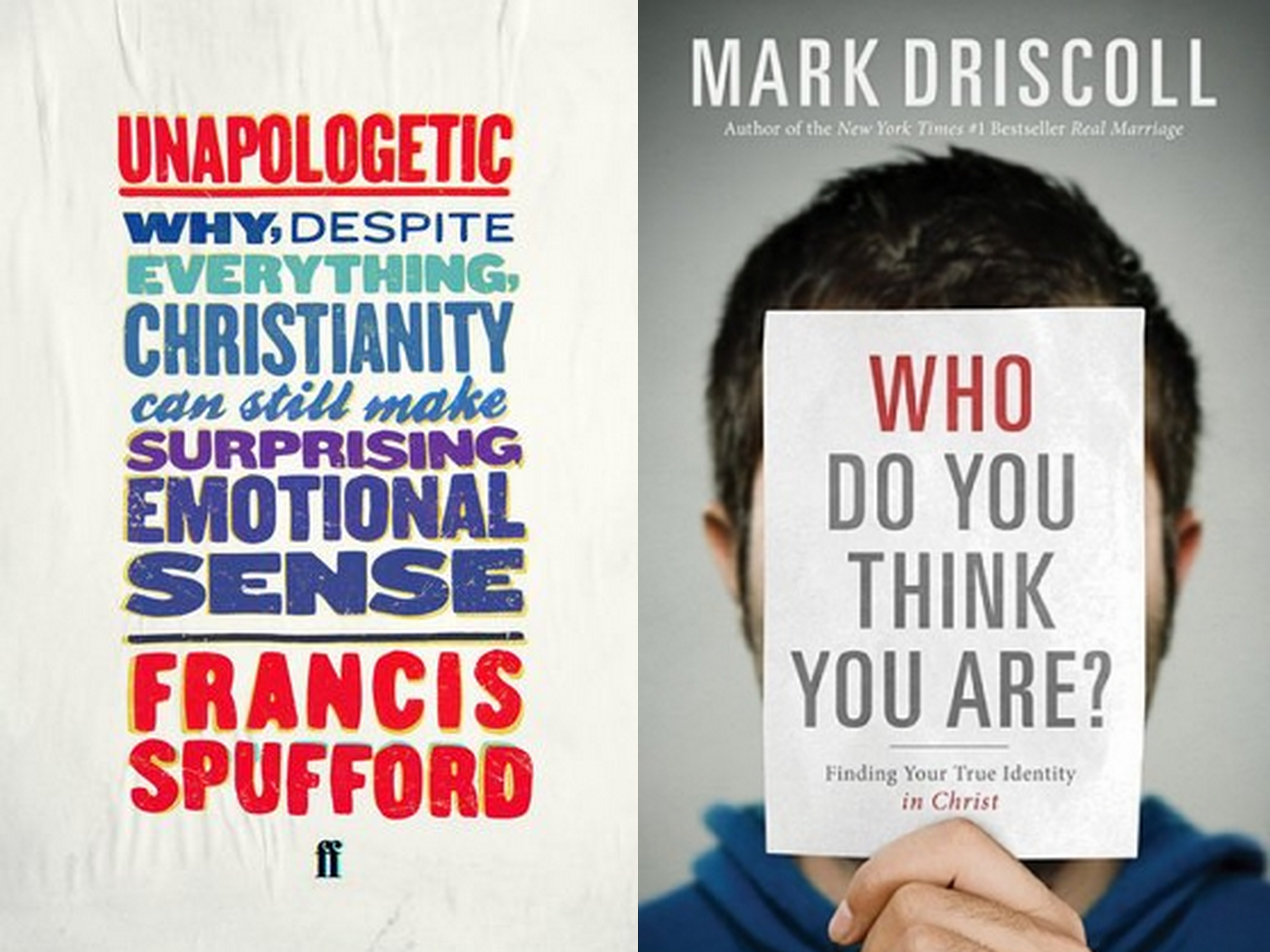
‘Unapologetic’ by Francis Spufford

‘Who do you think you are?’ by Mark Driscoll

On Friday afternoon I wanted something to read over the weekend, I was approaching the end of ‘Unapologetic‘ and knew I had plenty of time to get some reading done. I was handed a copy of Mark Driscoll’s latest book ‘Who do you think you are?‘, and read it fairly swiftly.

These are two very, very, different books, and it might seem a little odd to review the two together. But I think they present two different approaches to a common problem, and while Driscoll’s book does so explicitly, Spufford also provides plenty of material for the formation of Christian identity.

Unapologetic is one of the best books I have ever read. The writing is among the most beautiful I have come across and a few parts are simply stunning. Last Saturday I sat in Starbucks in Greenwich reading the chapter on Yeshua and there was a sharp hint of tears in my eyes as I read the words describing with such painful beauty the journey to the cross. They were words that reminded me why He deserves all that I have to offer, and of why all of that would still not be enough were it not for what He did two thousand years ago.

Who do you think you are? is not in the same league, it’s not in the same ballpark. What Spufford’s work is to good writing, Driscoll’s is to bad. That’s not to say in and of itself that it is a bad book, just that the writing is poor. And in parts it is really shocking. I’m a snob about writing I know.

When the use of quotation marks around a word is used to pejoratively describe someone it is a bad sign. The description of a liberal bible scholar is not given more power by putting quotation marks around the word scholar. You can disagree with the scholarship, you can think it is poor scholarship but using quotation marks not for grammatical propriety but to aid an insult is lazy.

Who do you think you are? could be good, it could be a simple and effective guide to forming your identity in Christ. And in parts it does that: some of the sections are clear and sometimes they provide a useful starting point for thinking about different aspects of the Christian life. But as one reviewer said, this book has been written thirty thousand times before.

When it is not simple, this book is simplistic. And unfortunately that is most of the time. I could pick at some of his theological positions which reach toward the extreme of the reformed part of evangelicalism, but when I picked up the book I expected to disagree with more than I did. Each of the chapters, which are based around an ‘I am…’ statement drawn from Ephesians as part of understanding Christian identity, contain at least one story to illustrate the point. Some of these are engaging and powerful, and they get better as the book goes on, but while purporting to have a more pastoral emphasis all the stories do is present case studies of people who have succeeded in finding a stronger identity in Christ.

The problem, and this is what lets the book down the most, is there is virtually no acknowledgement of the ongoing challenges of becoming a disciple of Christ. That sometimes it doesn’t always work out. That for every story of success there will be others of recidivism. So for a book that is supposed to be pastoral it barely offers any advice as to how to handle the ebb and flow of growing closer in likeness to Christ. It presents a victorious life as too victorious, and unreality doesn’t provide a good basis for constructive discipleship.

Spufford’s book is unlike any other I have read, it was apparently written without research, and that shows. It is stream of consciousness writing, and in this case that makes it very good. In effect it is Francis Spufford telling everyone why he is a Christian. And it inspires me, and it enthralled me. His premise is to avoid the academic arguments often used to justify Christian belief, but to instead for why, despite everything he believes it to be true. He uses rhetoric to inspire and prompt you towards knowing Christ more deeply and more beautifully. It was a book that made me fall in love with God again.

If you are looking for a doctrinally tight book then Unapologetic is probably not for you, he certainly doesn’t tick all the boxes of evangelicalism. Francis Spufford also swears quite a lot, including in his relabelling of sin as HPtFtU (the Human Propensity to F?#! things Up). If you know exactly what doctrine you want then Driscoll’s book will do it for you, but then if you know exactly what you want then there is little reason to read the book except for to confirm your own rightness.

Spufford appeals to your heart while Driscoll speaks to your head. This is the fundamental incongruence in Driscoll’s book, it is a book about identity, and about how we need to have our identity in Christ. And yet it does not affect the heart, it tries to tell the head what to do. If you digest everything in Who do you think you are? You will have acronyms to avoid idols, (IDOLS) and to help your prayer life (yes, PRAYER). You’ll also have a list of things to help you develop gifting and understand salvation.

Counter productively a book written in this way gives us 16 different things to do to understand your identity is in Christ and not what you do.

Unapologetic gets one big thing right, this is an unfinished process. “We’re the league of the guilty after all, not the league of the shortly-to-become-good. We are a work in progress. We will always be a work in progress. We will always fail, and it will always matter.”

A bit like my reading of the book. I haven’t finished it. Almost not wanting to close the back cover on a book that cuts to the heart of the relationship between us and God. A beautiful account of who we are and who God is. When I do finish I am sure it will not be the last time that I read the words between the covers. I’ve taken my time over it, reading it in chunks, and slowly at that. Ironically Driscoll’s book did not take long to get past my reading eyes. I wanted to get it finished quickly. I was disinterested in truths that should be life changing, so frustrated with empty prose that barely warrants the label – almost justifying the use of quotation marks around the word prose.

If you want to know that what you believe is correct then read Who do you think you are? (as long as you believe everything he does). It’s not a particularly bad book, it did not plummet to the depths of my expectations. But the more I thought about it, the more I felt it was one that didn’t need to be written.

Unapologetic, on the other hand, is a book I would recommend everyone to read.

Religion in the dock: navigating the legal landscape of religious discrimination

Jan Feb 2012 008On Tuesday the European Court of Human Rights will issue its judgement on four cases concerning religious discrimination. The cases, brought together against the UK government are the culmination of several years of progress through the layers of courts and together represent a significant moment for understanding the role of religion in public life in the UK. The cases of Eweida, Chaplin, Ladele and McFarlane have all attracted headlines at multiple points during their consideration, and this will certainly be true next week.

Ahead of the judgement I wanted to explore the contours of the cases and the legal landscape, in an attempt to clear some space for a considered and thoughtful response. I intend to write a more opinionated piece soon in which I may venture some predictions as to how I think the cases might be decided. But I also might not. Also, big caveat required, I’m not a lawyer, so I may have got all of this analysis wrong, or it might be over simplistic.

The judgement will be poured over in considerable detail in the days, weeks and months to come, and it could establish important precedent for future cases before UK courts. The judgement could also be couched in very narrow terms which mean it doesn’t set precedent and the applicability is limited to the specific cases in question. It is also possible that the judgement will not be universal for all the four cases, so one may win and the others lose, or any other variation on that theme.

The legal analysis is unlikely to matter much for the immediate press response which will be either: “Christians are marginalised”, or “vital victory for freedom of religion”. Call me a cynic if you wish.

It is not just the mainstream media that will jump to immediate and potentially generalised conclusions, the same can sometimes be true of Christian as we respond to the news. I think it is therefore important to understand what is going on, both with the cases in question and in the legal processes involved. I was going to put a profile of the four cases up, but Gillan over at God and Politics has put up the summaries from the hearing in September last year. At this point anything further I have to say would be editorialising as to the relative merits of the four cases, something which for now I will refrain from.

As well as understanding the facts of the cases it is also help to know what the courts are adjudicating on. The cases have been brought under Article 9 of the European Convention of Human Rights which protects freedom of religious belief, with Article 14 – freedom against discrimination – also in play. Article 9 is split into two sections, the first provides for the freedom of thought, conscience and religion and the second the manifestation of said religion or belief. The first is without restriction, the latter is open to limitation “as are prescribed by law and are necessary in a democratic society in the interests of public safety, for the protection of public order, health or morals, or for the protection of the rights and freedoms of others.”

In assessing the cases the courts take a four step process to consider whether unlawful restriction of religious belief and its manifestation has taken place. Daniel Whistler and Daniel Hill have published a paper considering philosophical perspectives on religious discrimination and symbolism, and outline this four step process. Their paper most closely relates to the cases of Eweida and Chaplin, but there is also a broader applicability.

(i) Belief test: Initially, claims are judged to engage Article 9 only if the beliefs that are purportedly manifested meet certain criteria. These criteria are ‘a certain level of cogency, seriousness and importance’ as well as being ‘worthy of respect in a democratic society and not incompatible with human dignity’. In short, such beliefs must be ‘a coherent view on a fundamental problem.’

(ii) Manifestation test: Secondly, the judges ask whether the rites of worship, observances, teachings or practices that allegedly manifest such beliefs can, in fact, be properly designated ‘manifestations of belief’, rather than (for instance) practices which are merely motivated by such beliefs.

(iii) Interference: Thirdly, it needs to be established that the claimant’s right to manifest his or her beliefs was in fact interfered with. It is at this stage that questions surrounding the claimant’s ability to resign or transfer schools (or be educated at home) in order to manifest his or her beliefs freely is considered.

(iv) Justification: Finally, the judges consider the extent to which the State was justified in interfering with the claimant’s rights in line with the limitations on freedom of religion and belief set out in Article 9(2). For instance, was the prohibition of the manifestation necessary in a democratic society?

(pp 16-17 Religious Discrimination and Symbolism: A Philosophical Perspective full paper available online)

This extensive quote from the paper, which is worth reading in full if you’ve got a couple of hours to spare, casts light on the complex process the court takes to decide if religious freedom has been unlawfully restricted. The paper looks in significant depth at the manifestation test, which in public discourse is sometimes referred to as the necessity test, but the authors contend that the court’s record does not support such a reading of the law. They suggest that beliefs which are manifested but might not be necessary still engage Article 9 protection. This seemingly technical legal point is important when considering the status of Christian belief and action before the law because very few, if any, practical out workings of belief are mandated.

In the hearing before the European Court of Human Rights in September the government lawyer incurred considerable ire for suggesting that religious belief was not infringed because, in reference to the cross cases, they could get another job. This is part of the third test, that of whether interference took place. If the court finds that the option of getting another job is sufficient to avoid passing the interference test, then this has wide reaching consequences. It is possible that the cases may fail under Article 9 but still engage Article 14 protecting against discrimination.

One final point to consider is the apparent inconsistency between a government lawyer defending the finding against the claimants and David Cameron saying he would legislated to ensure workers are allowed to wear religious jewellery. The case is the claimants versus the United Kingdom, and the government therefore respond to the European Court of Human Rights on the basis of the judgements reached by the national court. These judgements all found against the claimants which is why in both the written submission and the hearing the government lawyer argued that religious freedom had not been infringed. It is therefore feasible, and in this case apparently so, that the government defending in court a position which if upheld by the European Court of Human Rights they would legislate to change. Likewise, the Equality and Human Rights Commission (EHRC) has said the courts may have interpreted Article 9 too narrowly in regards to Eweida and Chaplin.

The government (wearing both its legal and political hats), and the EHRC, have both suggested the courts reached the correct conclusion in Ladele and McFarlane. The EHRC initially suggested it might support all four cases, but following a public consultation back tracked and only supported the cases involving religious symbols.

While I have focused on the legal dimension and not the individual cases, it is worth noting that each case is complex with a variety of aspect in play, and taking position before a wide variety of pieces of law, employment regulations and individual employment policies and practices. Likewise, it is also possible that a finding against any of the claimants might not mean that public expression of Christianity is being restricted: an employer could have been within their rights to take the action they did irrespective of religious belief or action. Further, Article 9(2) allows for limitations on religious manifestation, and in a democratic society sometimes these limitations are justified, it is possible that they could be in one or more of these cases. All of which goes to show that great care will be required in responding to the judgement next week.

Tinker(bell), tailor, soldier, spy: the great #bakedgoodsmystery is solved

I had expected 2013 to start slowly, without any surprises. If you’ve followed the great #bakedgoodswhodunnit over the past few days you will know that thought turned out to be a pipe dream. I became embroiled in, no, the victim of, the greatest conspiracy this year that I’m aware of.

I therefore took some time in the kitchen yesterday between enjoying the last vestiges of Christmas joy at Hyde Park’s winter wonderland and a guys’ film night. I baked some brownies with a slight variation on the traditional recipe tried and tested over several years and they turned out a bit more squidgy than usual. But seen as I didn’t know who I was out to impress that mattered far less.

Several people suggested that this might be an elaborate ploy by a lady trying to get my attention. And some brownies. Not an eventuality I had given any thought.

After hours of analysis and investigation I had narrowed the field of possible suspects to a quartet of mischief making fiends. Early suspicions cast on my colleagues turned out to lack credibility – so apologies to those libelled on twitter. They go by the monikers: Tinker(bell), Tailor, Soldier, and Spy.

Soldier was initially under significant suspicion, I knew he was off work on Friday and only lives around the corner from work.

Tailor has form in these sort of activities. As does Tinker(bell), all the others are male, but Tinker(bell) was described this evening as the only woman funny enough to pull this off.

Spy was also not working on Friday, and I knew had just changed phone contracts so thought there might be a new number floating around. However, all the others could easily access an unknown number to use so that didn’t count for too much.

I made my way into church this afternoon. I thought I saw a suspicious looking chap with a red scarf and sunglasses as I exited London Bridge station, so I weaved through some back streets and ducked into a coffee shop to lay low for a few minutes. I managed to get over Millenium Bridge unobserved.

It was 16.02 when I slipped into church as the service during the first song. I spent most of the worship time scouting out the suspects, I’d got a read on Tailor, Soldier and Spy but it wasn’t until the middle of the service that Tinker(bell) turned up and sat right next to me.

The service ended and I waited. I made small talk and glanced around the room. I was expected to be pounced on with password – which I can now disclose was ‘munches’ which was supposed to be ‘munchies’. Nothing happened. I got a cup of coffee.

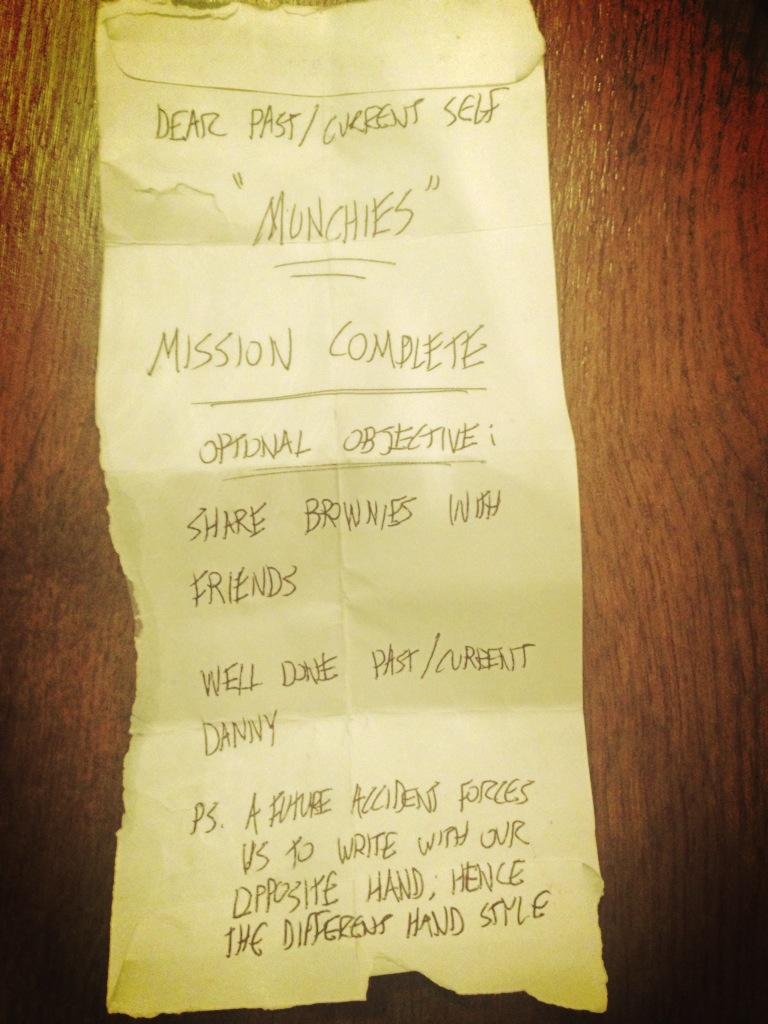
Munchies noteAnd then several people asked if I’d checked my pockets to see if I’d been passed a message, at first I did so with very casual effort, but then I started examine my coat more rigorously until a friend – kindly helping me out – plucked a folded side of a gift envelope from the inside pocket.

But still I did not know for certain who was responsible for this confluence of conspiratorial acts. Tailor had been ruled out because he had been on and overseas mission and only returned yesterday. Tinker(bell) was also looking unlikely because she’d been at her sister’s wedding yesterday.

Soldier was still a possibility and was keeping his distance. I refused to handover the brownies to the three co-conspirators who had encouraged me to check my pockets until they named their puppet master. The brownies would be appreciated at work tomorrow. Spy’s resolve broke first, he swung round the corner and with the word ‘munch[i]es’ the brownies came out of my bag and were swiftly consumed by the gathered crowd.

I suppose it would be too much to end it there and not tell you about the identities of Tinker(bell), Tailor, Soldier and Spy. For those of you who this might mean anything…

Tinker(bell) is Catherine Warren, Tailor is Jason Taylor, Soldier is Ed Boyd. All of these were innocent and subject to my unfair suspicion. (although Tinker(bell) was somewhat proud to be thought the only woman funny enough to do this).

And the spy was Nathan McCall. Who had never intended to pass any message to me at 13.12 by a post box near work. He was, at the time, enjoying his lunch without a thought to my agents and I loitering halfway up Kennington Park Road.

For now this is the end of the tale. For now.

Baked goods and the mystery texter: a whodunnit **updated**

Today has been a surreal day. I thought it would be a fairly ordinary Friday, perhaps slightly gentle as everyone is easing into the new year. But it was anything but. For my colleagues, or agents as they will henceforth be referred to, and I we ended up on quite an adventure.

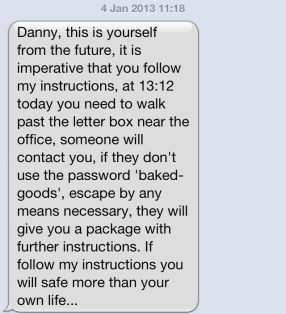
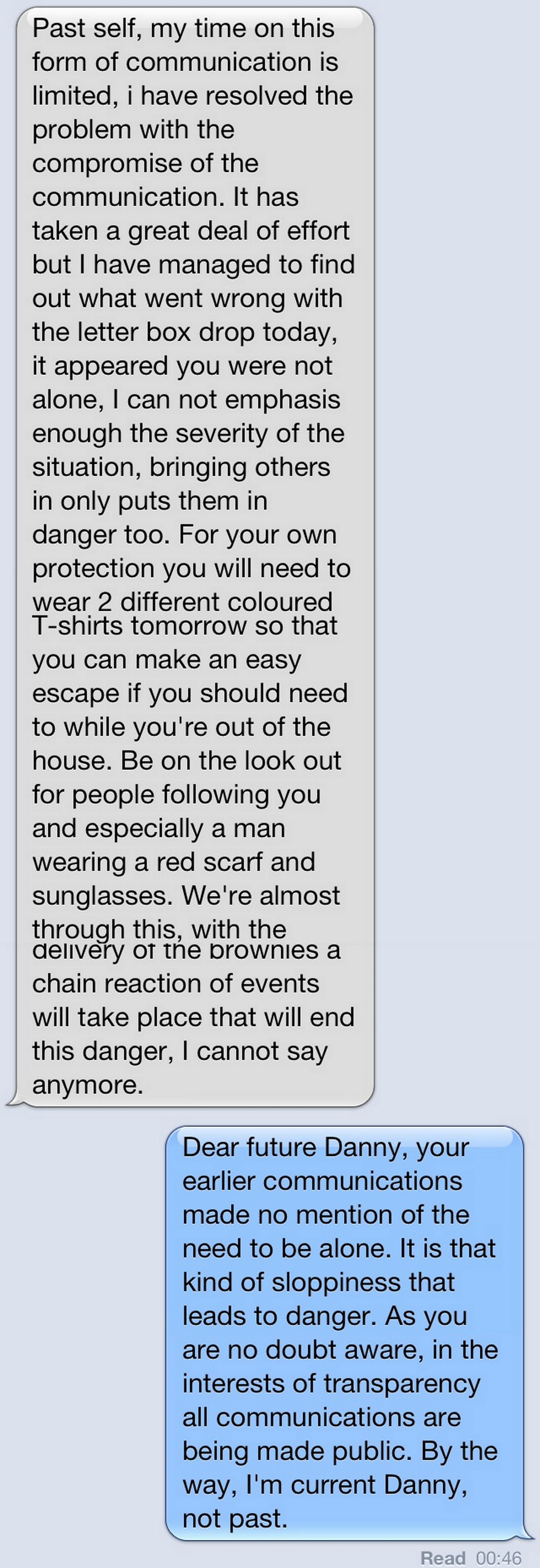
At 11.18 I received the first communication from mystery texter:

Text 1

I was curious, as I’m sure you would have been. I hesitated for a moment, sizing up the likelihood that those in my company were in fact the originators of this curious edict, but then told them, and co-opted them into my fun as fellow agents.

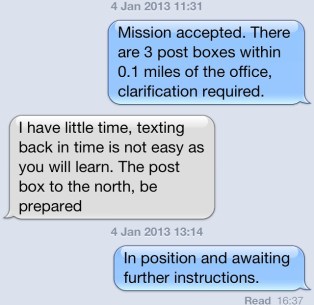
We needed some clarification as there are several post boxes in the close vicinity of the office:

Text 2

At a little after 13:00 my agents and I left the office and proceeded to the proposed rendezvous. They were wearing high coats and carried magazines to read so as not to arouse undue attention. We loitered as inconspicuously as possible beside the post box for a while, alerted our interlocutor of our presence and glanced suspiciously at everyone who walked by. But nothing. We checked the other post boxes in the vicinity, and then returned wondering if it had been a ruse to get me away from my desk. There was nothing awaiting my return.

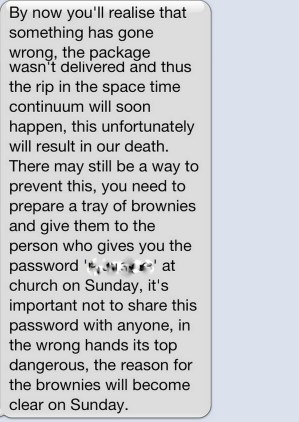
I took my fellow agent’s advice and shared the exchange on twitter and facebook, wondering if any light would be shed, or if the perpetrator would own up. Various amused comments, and some concerning suggestions that this might by a identity theft type thing. But then towards the end of the afternoon this further missive entered my inbox – the password has been obscured for obvious reasons!

Text 3

Further updates will be provided as evidence emerges. Anyone willing to come forward with clues as to the identity of the mystery texter, or what their purpose is? I will treat all information in the strictest confidence, although I am afraid I cannot guarantee your safety.

**Newsflash: instant update**
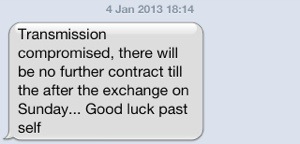
Incoming communiqué from mystery texter:

20130104-181835.jpg

**Newsflash #2**

Future self has been in touch. Apparently the disruption to this afternoon’s transaction was due to the failure of my agents to sufficiently disguise themselves. I believe this chronicling of the activities is being monitored from the future.

Test 5


**pre church update**
20130106-145507.jpgI slaved away over the stove for hours yesterday to prepare my baked goods. It feels a bit like meeting a ransom demand, except nothing had been taken hostage. Well, maybe my future self. I’ll be off to church shortly, watching over my shoulder, doubling back, with a couple of changes of identity in my bag should the need arise.


** The mystery is solved, read how it all unfolded.

Affection, ambiguity and Anna Karenina

I had planned to read much of Anna Karenina over Christmas. That didn’t happen: between being ill, cooking food, playing with my nieces and defending the ending to Downton Abbey’s Christmas special, I managed a scant 60 pages. However in those early pages of this Russian masterpiece I came across a line that struck me with considerable force.

“But Levin was in love, and therefore Kitty seemed to him so perfect in every respect, so transcending everything earthly, and he seemed to himself so very earthly and insignificant a creature, that the possibility of his being considered worthy of her by others or by herself was to him unimaginable.”

Anna-Karenina-Poster-–-Pure-Love-460x650Two things immediately strike me from this passage, firstly, the early throws of affection limit our ability to think clearly. And secondly, sometimes when we like someone so much we find it hard to conceive that they might feel the same way.

It’s that moment when you meet someone and suddenly they become everything that matters. All else fades away. Except it doesn’t, it just retreats into a corner of your self which you allow to go untended for a while. They capture your imagination with an unreal sense of importance, you are for a short period of time infatuated. You see only their positives, only the things about them you want to be true. As Levin did with Kitty you see them as perfect. If you know the story of Anna Karenina you’ll know it’s not quite as simple as this, in fact, if you know anything about the interaction between any two people you will know it is never as simple as this. Continue reading

Moments and movements: the big hitters of 2012

I wrote this in two chunks, one in February, and the other in June, and then rediscovered it today. I thought it summed up 2012 pretty well. It is very long for a blog post, I’m almost sorry about that!

They say that sometimes there is a moment between when the dice is cast and when it lands. At least, it was quoted on the West Wing so I assume it’s true.

They say that there are moment when if missed the chance is gone for good (for more on this one see the Romans, the empire not the book of the Bible, Carpe Diem and all that). Moments that last but an instant but whose impact lasts a lifetime.

Maybe there are such pivotal moments. Times when a decision is made at a fork in the road. The choice to turn back or plough on ahead. Maybe these moments matter more than I think. But perhaps each individual moment only matters as part of the movement it lies within. Rather than a beautiful note sounded on its own, the whole symphony within which so much more makes sense.

Movements matter more than moments. Because moments are just an instant. They come and go, they can be good or bad, or somewhere in between. They can stand on their own, they can be disconnected from reality. It can be a good time or a bad time, it can be the best of times. But movements are reality, the heights and the depths, and the life that strings them altogether.

Take the bride and groom standing at the alter on their wedding day. It is a day of joy and celebration, a day into which so much planning and preparation has gone. But it is only the end of the beginning – marriage is about much more than a day of flowers and dresses and table plans and speeches.

For the single person much thought and attention goes into deciding who you like, trying to decipher whether they like you as well, and plucking up the courage to ask them out. The infatuation that so often forces you past your own hesitancy to seek something greater. It is just the beginning.

Moments seem vital in their own time. It feels as though destinies will stand or fall on a pinhead. When you turn and see that a chance has passed, a girl you like is attached to another, the role you seek already taken, the deadline for a job application past.

I’ve never quite got all the fascination with New Year’s Eve and the desire to have a night that will trump all others. Likewise the focus on days obscures our need to celebrate and enjoy things all year round. Too often birthdays, Valentine’s day, anniversaries and all the other days designed in a greeting card marketing department are just there to encourage us to part with our cash. Because if something is worth celebrating it is worth taking the time and effort to do so all year round and not just when the display stands tell us it is time to do so.

The same can be true of our spiritual life. We look for the excitement and ecstasy of a moment that will lift us out of the drudgery of our daily life. We think that if only we can see something of God alive in our lives then everything else will be fine.

And sometimes that is what happens. Sometimes we have an experience of God that profoundly changes us. We see God in his glory and majesty and that causes us to worship. We see him work wonders in our lives and those around us and we are reminded of his power. We see how far short we fall of his perfect way and it forces us to our knees.

Yet too often these moments pass. Too often we forget the enthusiasm we once had. We doubt that the God we saw heal can do it again. And we live our lives with faces set against God, the God we claim to love but so often offend.

Because we are weak, and we are frail, and we forget. Because although God is great, we are not.

Because the moments that we long for are the products of God and not God himself. If all we want are signs and wonders then what is the God that we are worshipping? When we pray so desperately for a moment, even for a specific thing, there is a risk we end up wanting that thing more than we want God. Whether it is a job or a wife or healing, all good things in themselves, they can run the risk of becoming idols.

Moments are not wrong, often they can be very good. I want to turn and be overawed as my bride walks down the aisle. I want to experience God in my life in a tangible way. But I cannot just want these things alone.

There is a movement of relationship in both these scenarios that takes time and effort. It means me working hard to love another, and it means me falling on my knees in worship of the Other. It means that there are times of triumph and times of tears, of easy joy and painful resolution. Of love and forgiveness, of sorrow and joy.

Because what effort would it take to worship a series of moments that answer to my whim?

Moments are not just the highlights of life, they can also be times of intense disappointment and tragedy. Of times when our heart aches and our soul cries. And these moments never seem so fleeting as the passing joy we wish would linger longer to soothe our spirits and calm the turbulence of our mind. Too often the moments of sadness follow each other in a haunting litany of escalating sorrow that build to a crescendo that overwhelms. Too often it is in these moment that we most recognise the movement we are a part of. And it’s not a movement that seems to rise and fall, it’s not a cyclical process that we take in our stride but a path that becomes gilded by our frail emotions. All the time it offers some false comfort in the familiarity of our stride, mixed together with fear of what we know lies ahead.

Life is not just a set of staccato moments that we string together, hoping that one fuelled by sadness will be followed by another sown in joy. And this means maybe we don’t look for that experience that will exhilarate, or a single time with God that will change us forever. Perhaps it is instead as Eugene Peterson titles his book, a long obedience in the same direction. About knowing the bigger picture surrounding each moment, which whether great or dreadful or simply mundane is just one part. Where we see the cost of the climb, and the boredom of the valley as part of the same life and same movement as the instant we pull ourselves over the final crag and stand and pause atop the mountain as we gaze awestruck at the world around.

The movement is a mixture of our dreams and our desires, and all of that which lies outside our control. It is the effect of people around us in the way that we resent their presence or pine in their absence. It is society we live in, it is our neighbours and our friends. It is the actions of a God in Heaven who even when I am plagued with the deepest of doubts loves me more than I could know.

And they are not just our own. That’s often what I get so very wrong. It is an intricate dance of interlinking actions, sometimes coming together, other times tearing at the seam. It is the movement between two movements, responding to the effect of each, showing that life is never, despite our frequent desire, lived alone. It is always played out in company. It is always about us and not me. And when I do not realise this I strike a discordant note that separates me. But it does not leave me unaffected. As I withdraw, the movement in which I dance takes a different turn, I spiral out of control in the absence of others to temper the excesses of each twist and turn. And it affects others too. They are not the same if I am not a part of their movements.

Now that is what I struggle to believe.

It is where my doubts and weakness surface in their pathological splendour. They try and convince me that my dance is only ever my own. That no one would assent were I to take the steps across the room to ask her to join me in the next dance.

I cannot believe that others are ever affected by my absence as I am changed by theirs.

Worth. That’s what I doubt. I doubt that I have any worth, anything valuable to contribute. And what I might plausibly consider as my strengths and qualities are barely more than functional abilities which detached from me could be replicated with ease. I am not sure what I bring, what special talent or trait which without any group or person would be poorer.

I think I can live my movement on my own, without needing to condescend to compromise, or alter course to fit within the scope of another.

But then I do. I change my plans. I allow them to shift and morph according to someone else. My frenzy becomes focussed around making space for them – even if this is never an acknowledged condescension. I alone do not dictate what matters most, my inclination towards another means they force a different hue onto my priorities and desires. No longer is time alone so attractive, or even living a life of active friendships without their particular presence.

Movements are interconnected, they rise and fall, they take us on a journey with a place to work towards. They are the product of a sophisticated and complex interplay of many other separate waves of life that weave in and out of the movement we walk through.

They are lived out loud. Too often I dream of grand plans, I imagine myself in some colossal context of winning the day with my wit and wisdom. I conjure thoughts of what my life might be like.

And the next time I move on from my daytime slumber I drift with the flow. I do not act on my dreams. I do not forge reality out of my desires. Instead I leave them in their halcyon undisturbed state where they cannot disappoint.

I like temporary things. Like the cinemas that pop up for a few days in the summer and then vanish. Like the moments of attention when something significant happens. Like the early throws of infatuation when each moment spent together is the very thing that could make you complete. Like the thrill of completing something after working like crazy to meet a deadline.

Or the passion of worshipping God in an ecstatic moment. Or the almost involuntary rising to your feet when they ask who want to recommit their lives to God and serve him with all their heart.

I like those temporary things. They offer enough of a hint of an exciting future without the need to engage with the realities of making it happen.

But the next morning. Or when we arrive home. Or if the project is completed, or the girl has hooked up with someone else. The dull ache of dejection and disappointment is assuaged by the subconscious recognition that it was only ever a moment of excitement. Not anything more. Not anything that would require hard graft.

Sometimes the short term moments of excitement can set off a chain reaction. They can spark and segue into a larger movement, they can provoke you towards a long term vision. Sometimes the opening notes of a movement are framed in the the explosion of an instant clash of cymbals. When the risk that is attractive in the immediate is the very commitment to the ebbs and flows of a movement that swiftly winds out of view.

When you act in a way that is counter intuitive. When you do things that don’t really make sense, the thrill of the moment that pushes you past your inhibitions and allows them to fade. Could that be what lets you embrace something bigger which otherwise you would shy away from. Could it be what pushes you off a cliff?

It is not the heart overwhelming the head, it is the heart giving voice to your desires. It is putting steel in the spine of the thoughts that alone your wouldn’t allow yourself to entertain. It lets you imagine the way that things could be. It brings hope into darkness, joy into despair.

The power of moments to play their part in a movement. The frailty of our hearts to be moved to action at the whim of some wanted attention. The fortitude it takes to detect when we are being led a merry dance by our emotions.

The ability to say yes to what is good. And no to what is not.

And take the jump when we don’t know, learning to know consequences and not fear them.

Learning to hold our dreams and desires loose enough to let them go. But close enough not to forget.

And we watch the dance that unfolds before our eyes. We see the interaction, the complex and the confused. The intended and the accidental. We see the love and the loss. We see the hope and the fears. And we wonder. We embrace wonder like a child and we let ourselves wonder what might it be like if our dreams and fears existed in the same place?

We let ourselves run riot with dreams of faith, of the way that things could be.

We gaze in sorrow at the wretched failures we so often are.

But we know that failure is not the end.

Ecclesiastes and Emmanuel: God with us in all times and seasons

The time when love came to earth. Love not in gifts of gold, frankincense or myrrh. Love not in the adoration of the angels, or the presence of the shepherds. Love not even in the parental pride at a new born son.

But love in a God who came to be with us. It feels like that is the only refrain you can hear this year. Maybe it is the horrific shooting in Connecticut that lingers in the shadows, casting doubt on any joy that could be shared. Maybe we have lost our own loved ones in unpublicised tragedy. Perhaps it is the difficult relationships, awkward lives we lead. Maybe we have been rejected from jobs we wanted. Maybe life is harder than we ever hoped it would.

The message of Emmanuel. A constant refrain that does not fade.

The first time I ever spoke in any kind of church service was my Granddad’s funeral. It was a few years ago, and like now it was the run up to Christmas. This tragedy, an expected one unlike the Newtown shootings, was tinged with similar sadness. Someone who you loved dearly would no longer be with you.

My Granddad had lived a long life, and senile dementia had made his last few years especially hard. When I spoke with my Mum of plans for the funeral I had the sudden and definite sense that I wanted to speak. I had never done anything like this before, my sister was the prodigy preacher in our youth church.

When I moved house a couple of months ago I found the typed text interspersed with scribbles of red biro telling the tale of last minute edits. It was Ecclesiasties and Emmanuel. The times that come and go and the God that is always with us.

I was nervous as I spoke. A Methodist chapel in South Yorkshire is not my normal church environment. A congregation of family some of whom are not Christian, and members of the local community with whom he had attended each week until his final years made it too hard.

There was a cycle of reinforcing theology that pushed me forward. God was with me as I spoke of God being with us.

Speaking in public isn’t something that comes naturally to me. I am not confident in my voice, I am reluctant with my words, unsure if people will like or agree with what I say. I am always hesitant when I have to do it, even when I choose to the reluctance does not go away.

Unsurprisingly many of life’s challenges come with such a hesitancy, an uncertainty of whether to proceed, whether the goal is worth the cost.

But sometimes there is also a knowledge that this is what you need to do. So you get on and do it. There are moments in life when you are able to push aside the rationality and reason and do what you know you have to do.

My wrong turns do not become any righter, but I slowly learn that I have a God and a Father who does not abandon. Not even in the hardest of times. Not even in my most recalcitrant of ways.