Girl Guides, promises, and restarting the crusades

Crusades“You’re out to restart the crusades!” I haven’t listened to the interview so I’m quoting from memory and may have missed some suitable nuance in the original, but this was the charge that came against me on 5live earlier this week.

I’ve done quite a lot of media work, especially radio, over the past few years, but this was the first time I’d done a live national radio phone-in chat show, and it was on whether the Girl Guides were right to drop god from their promise. There was a healthy bit of banter between me and Stephen Evans from the National Secular Society before callers came onto the line. I was also presented by Nicky Campbell with sections of Baden Powell’s writings citing reverence for Mein Kampf and asked if this was part of the Christian foundation for Scouts and Guides I wanted to maintain.

I should say this all began within 30 seconds of running into the office after chaos on the Northern Line. Yes, I can be at my office phone by 9am, I said confidently 40 minutes before. I threw my bag and jacket on the seat, grabbed some water and some hand towels to mop my sweating brow and picked up the phone. “We’re putting you straight through to the on air discussion, Nicky Campbell will come to you next.” Apparently you couldn’t tell I’d missed the opening seven minutes of the segment, but perhaps a lesson never to rely on London Transport when you need it most. Continue reading

Faith in the Community: we need more than tolerance

FITC cover

“Building strong working relationships between local authorities and religious communities should not be based on mere ‘tolerance’. It should be about talking, listening, and growing together. Together, working in unity of spirit, we are stronger than when we try to do things in isolation.”

Tolerance is not enough. That’s what Archbishop of York, Dr John Sentamu, says in his forward to the Faith in the Community report out today. Produced by Christians in Parliament and the Evangelical Alliance it follows a survey of more than 150 local authorities detailing their relationships with faith groups.

The report finds that faith groups provide a vast quantity and range of activities and services for and with their community. They are valued partners and they are achieving results in part of the country where the formal structures of local government struggle to reach. Preston City Council commented that faith groups are “close to the ground to the communities they serve, have access to ‘hard to reach’ communities, and have a better understanding and knowledge of communities and their needs.” In (almost) the words of Heiniken, refreshes the parts others cannot reach. Continue reading

A portrait of pain: words from before the blog

This morning I remembered something I wrote about two years ago about friendships, relationships, and isolation. It was before I started writing in this space. The style is different, it’s really a journal entry, not something written for publication. It is also rather maudlin in places. For that I don’t apologise but ask that you understand it is a portrait of a moment in time. Is it true? No, in that it contains a lot of lies I told myself. Yes, in that it is how I felt. I was interested in a girl and she was not in me, I had had some struggles with my friends. And I was alone for a day in Spain. I have not edited it apart from grammar and spelling, it is what it is, it is a portrait of pain.

The words that would soothe this troubled mind, The ones I hunt for, search for, long for. The words I think will take away the pain, all the hurt. The words that will bring clarity out of confusion. The form of letters brought together in phrases and fragments and rarely, carefully, composed sentences that stop short of extended prose but lacks the beauty and grace to be poetry.

But it’s not the words that require attention. But the troubled mind. Torn between dreams of grandeur and doubts of inconsequence. A mind that won’t stand still. Not for a moment. That will not settle, that refuses to be stilled. A torment of thoughts and emotions meshed together. Thoughts that refuse to leave and emotions that I am not sure are there.

Dangling in my mind. Taunting my solitude. Tempering my calm, peaceful, afternoon. Beneath the trees in Girona’s historic quarter. As I ponder why do I need both isolation from people and affirmation from them of my worth? If, in fact, it is their approval I want. Because I am not certain that I am able to receive it. I am not sure that I have the capacity to believe that anyone would recognise anything of worth in me at all.

Continue reading

Do you trust lobbyists?

lobbyOver on Tearfund’s Just Policy blog Rosanne White confesses to being a lobbyist. I particularly concur with her fears of alienation at the dinner table if the topics of religion and politics are off the agenda, because I, like her, work in both.

About 18 months ago I wrote a similar defence. I attempted the herculean task of defending lobbying as a noble profession. That was the last time a crisis erupted over claims of access for cash, shady meetings to steer government policy. Yet before the reputation of lobbyists is tarnished any more than it has already, remember the lobbyists Patrick Mercers and Lords Laird, Mackenzie and Cunningham purportedly did business with were not lobbyists at all. They were journalists pretending to be lobbyists.

The politicians under the microscope have serious charges to answer and on the prima facie evidence seem to have been willing to take money in return for parliamentary favours. That is wrong and inexcusable. But to then blame lobbyists is a bit like a journalist going under cover as a fire fighter, starting a fire and than splashing headlines about fire fighters burning down what they are paid to protect.

It also means the government’s proposed action in response is reactionary and ill thought through. A register of lobbyists will not stop MPs from behaving how Patrick Mercer is accused of, if true he is likely to have fallen foul of rules on paid advocacy and possibly also face criminal charges under bribery laws. A statutory register of lobbyists would not have stopped it and is not needed to tell us it is wrong. That’s where I disagree with Rosanne’s blog, I have no huge problem with a register, and likewise I have nothing to hide, I just don’t think it would solve the problem.

Continue reading

Liking likes, revering retweets, and passionate about page views

Drawn graphFor a long time, pretty much since I started this blog, I’ve struggled against getting hooked on how many people are reading, how many retweets my links get, likes and shares on facebook and generally anything that boosts the numbers on my stats screen.

And I’ve beat myself around the head about it. I’ve told myself it is my ego getting out of control. That it becomes all about the numbers and not about the content. That if I follow this through to its logical end I’ll write whatever garners the most readers. I’ve also worried that I’m getting affirmation from buzzes and notifications and waking up to a lock screen on my phone full of compliments to scroll through.

I’ve felt it too. I’ve felt the thrill of people liking what I have to say. And I’ve felt the rejection of a post I’ve spent half a day on read by just a few dozen people.

There has to be something wrong with this attitude, I have told myself too many times. Too narcissistic, too insecure. Not confident enough or sufficiently assured in God’s love for me to let a petty thing like page views affect my emotional state.

And then I realise.

Knowing the love of God does not turn me into an emotionless auto-matron.

Continue reading

Hope for humanity amid the darkness

We did not expect nor did we invite a confrontation with evil.
Yet the true measure of a people’s strength is how they rise to master that moment when it does arrive.
44 people were killed a couple of hours ago at Kennison State University.
Three swimmers from the men’s team were killed and two others are in critical condition.
When, after having heard the explosion from their practice facility, they ran into the fire to help get people out.
Ran into the fire.
The streets of heaven are too crowded with angels tonight.
They’re our students and our teachers and our parents and our friends.
The streets of heaven are too crowded with angels, but every time we think we have measured our capacity to meet a challenge, we look up and we’re reminded that that capacity may well be limitless.

Probably my favourite quote from the West Wing.

Amid the rubble of yesterday’s horrific attack in Woolwich one aspect shines like a diamond in the mine.

The woman who stood up to the attackers, while they held a gun and a meat cleaver in their hands. The woman who stepped off the No 53 bus because she saw a man crumpled on the floor who might need some first aid. I frequently ride the 53.

Continue reading

Found in The English Churchman: Pop Singer Raps Against Televangelists

Every other Friday at work I get a treat. I get to sit back for a few minutes and browse through the latest issue of The English Churchman. Their website is rather minimalist, but you might find a little bit about them.

Anyway, today produced this gem which I thought was too good not to share. I post it below without any comment, oh no, not even implicitly. (But make sure you get to the end of the 4th paragraph.)

Pop Singer Raps Against Televangelists

20130517-134342.jpg An American pop singer has criticised several well known preachers who appear on American television and at large events because they promise health and wealth to those who part with money to finance their ministries. In general they finance extravagant lifestyles and get nothing in return.

American “Rapper” Shai Linne has criticized the “prosperity gospel”. What is even more surprising is that he has identified popular televangelists like Joel Osteen, T.D. Jakes, Paula White and Benny Hinn as its preachers in his new song “Fal$e Teacher$”.

Linne professes to be a Christian himself and quotes from the Bible against false teachers such as those who preach prosperity.

Rap is a somewhat aggressive sounding type of youth music that has been taken up by some modern churches as a form of evangelism and even perhaps as worship. One imagines that this is encouraged by churches who seek to be contemporary. Presumably they claim that such forms are merely contextual and so are not sinful in themselves. For Christians with a sense of the holiness and majesty of God one would think that such forms would never be accepted.

While we cannot condone rap music, even outside church, one can only hope that the condemnation of false teachers by one such as this will serve as something of a wake up call to those who have been led astray and had their wallets emptied by the televangelists. The next thing is to wake up to the inappropriateness of rap music. 

Taken from The English Churchman, No. 7871, Page 6

Do nice guys finish last? Is pleasant unpalatable?

Sometimes I wish I was someone else.

Sometimes I wish I had a little more bravado. Sometimes I wish I laughed at things other people found funny. I wish I was more spontaneous. I wish I was unpredictable. Surprising. I wish I had that edge. Whatever that edge maybe.

That edge that makes guys attractive to girls. And makes dates more than pleasant.

Because sometimes I think I am dull. Just dull. Barely making the mark of mediocrity known as pleasant.

Sometimes I wish I was someone else.

Someone better, scrap that, not better necessarily. Better is a bit too much like nice which is a bit too much like pleasant which sounds rather like code for dull. Different, I want to be different.
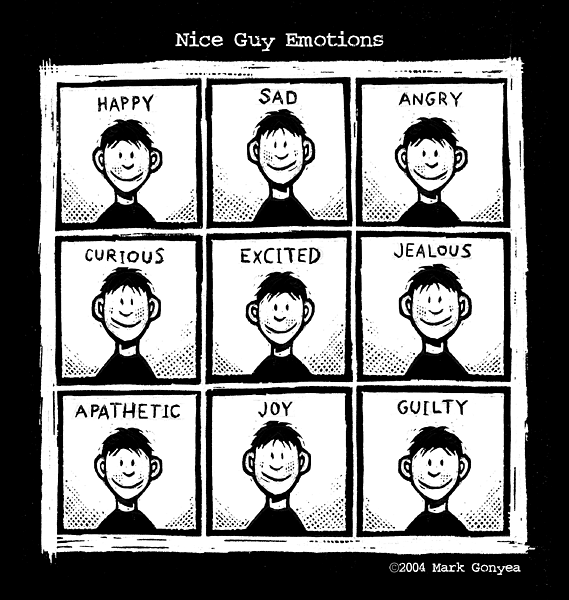
nice-guy-emotionsYesterday Threads’ anonymous Girl About Town wrote about her date with pleasant Christian guy. And it provoked quite a reaction. Guys split down the middle between trying to demonstrate their ‘fun’ credentials, and those like myself who sneered at the somewhat faux virility and opted instead for self-deprecation. An elaborate double bluff showcasing introversion and nerd like pursuits as a masquerade to shield insecurities.

It’s a cliché that good guys finish last, but sometimes that is what it feels like. It feels as though to achieve success in one part of life I have to screw up a little more. I could swear here to make my point with added weight but I don’t want to. I prefer not to swear.

We turn finding someone to build a relationship with into a game, where there is success and failure, and we are tempted to try and stack our hand. We weigh percentages and hunches and work out what would give us an advantage. Wondering whether if we were someone else the road might be easier. Wondering if a new identity might help. Thinking the grass is always greener through our rose tinted glasses.

We want everything to be okay, we want to be without blemish so we erect structures and façades to shelter our fragile self. We are told there are ways to behave, things to do and not to do, and knowing that we don’t always live up to that we sometimes try to present an image that we do.

I think that if I wear the costume enough it might become a second skin. It is never quite home, but close enough that I lose sight of the ways it betrays me.

Sara Kewly Hyde commented: “I think sometimes rather than discovering the fabulous and unique individual God’s made them to be, some men (people) are trying to be what impresses others and that in turn can lead to… Well a whole host of insecurities, the fruit of which is sometimes blandness… I think as Christians we also struggle to assimilate our dark or shadow side so at times repress it rather than asking God to glorify himself through it. Repression can also = pleasant but nowt else. If we allowed our imperfections to be as visible as our good bits then it’s unlikely ‘pleasant’ would be the adjective de jour here. Pleasant is great if accompanied by other adjectives.”

Another friend simply said: “pleasant might also mean stifled”.

When guys hear they are too pleasant, the immediate reaction can be to add another layer of characteristics they think might help. So as well as being the good Christian guy they also need to be the Alpha male chopping down trees, skinning rabbits and rescuing the damsel in distress. I mock to make a point.

Christian guys are told to pursue, protect, provide and pastor, and that becomes another list of things they ought to do to make the mark. If they are being rejected as dull, dismissed as pleasant, then they are not doing enough to woo the women. Emily Maynard commented on cultural norms that so heavily circumscribe Christian dating, which create a culture imbued with such deep, existential morals and genderised stereotypes. And the fear of slipping into sin or causing someone else to sin.

We are afraid of doing it wrong. Asking the wrong girl out, acting improperly, not being sufficiently chivalrous, not picking up on signals, showing too much affection, or more likely not enough. And under the weight of it, all that emerges is a bland pleasantness that might not be offensive but betrays its insincerity. It can also freeze us into inactivity.

The layers of personhood expected to be worn to fulfil the role of the right Christian guy become so deep personhood is lost. In trying to be something we stop being ourselves.

Here’s the challenge, I get the thrill of the different, the exciting, the edgy, but telling Christian guys they are too pleasant puts them on the defensive. It knocks their security and only encourages more layers covering over who they are.

Truly pleasant

Being nice is not bad. Being pleasant is not just about being polite. And good guys do not need to finish last. But if the pleasantries are a charade or a forced manicure they leave an emptiness where you or I should be.

Dave Shearn put it like this: “I think lots of us are non-committal and non-confrontational in the name of being ‘loving’ and that is lame. Passive aggression and people not agreeing with God that he made them awesome also doesn’t help.”

I also wonder if there’s a false dichotomy that’s being set up between atheist-guy and pleasant-guy, is the very fact atheist-guy is such what gives him that edge? Pseudo-rebellious was the way someone put it. It’s not that Christians are necessarily more dull than anyone else, but they are known and to some degree safe, and sometimes an element of danger is alluring.

The unknown can be attractive but it is also dangerous. Because I hope one day to be fully known and to know someone fully. I want safety to be a good thing. In the long run maybe pleasantness is a valuable attribute.

That don’t impress me much

I want to marry someone who loves me, and not love who I might pretend to be. Someone who knows me with my frailties and my failings, who sees my longings and my hopes and dreams. But I also want to be a better man. And I think it is a noble thing to want to be with someone who prompts you to be your better self. Not some act to be more edgy or less pleasant. But to find the ways I can glorify God more fully. To see the ways I can live a more holy life. To bear witness to the image of God that gives me dignity and humanity. To echo in a quiet whisper the love that has been given me.

And be all of it. No one is just one thing. No one is just pleasant. No one is just dull. No one is just boring. And no one is just exciting, edgy or different. We are whole people with a breadth of characteristics and being pleasant is a good one to own. But if that’s all you see yourself as no wonder that don’t impress her.

And I think trying to impress a girl who takes your fancy is a good thing. As long as the impression you’re making is yours to give.

PS while writing this a friend tweeted a link to an interesting sermon on ‘new rules for love, sex and dating’ so I thought I’d share it.

Thoughts on Bangladesh – bought at too heavy a price

130425062811-01-bangladesh-building-collapse-0425-horizontal-galleryIt’s thought that over 1000 people died after a garment factory in Bangladesh collapsed. They say that guns don’t kill people: bullets do. Maybe in this case t-shirts don’t kill people but garment buyers do.

This is nearly a third the number of people who died in the terrorist attacks of 9/11. But the cause was not terrorism, it was not global jihad. Perhaps if it was it might be easier to explain, it might be easier to put the tragedy at a distance with a clearly defined other responsible for the senseless loss of life. Perhaps then we might have an enemy to label and target if we were wont to avenge their deaths.

But apportioning blame in this case is harder. I can wring my hands and reach out for someone somewhere who could have done something different, who could have acted to prevent this tragedy.

I blame the building owner for the unsafe structure.

I blame the manager for making people work there.

I blame the authorities for failing to enforce safety standards.

I blame middle-men for complicated supply chains that obscure responsibility.

I blame shops that sell clothes produced at such a cost.

I blame consumers and the cheap clothes they buy because of cheap labour they ignore.

I blame myself for not noticing the abhorrent and the abusive. I blame myself for using complexity as the crutch of the complicit.

And it doesn’t help.

I can also read articles that tell me wages in urban Bangladesh are double what they were six years ago, and offer more than a subsistent rural lifestyle would provide. I can nod in agreement at the thought that if everyone stopped buying clothes produced in such conditions at such a cost the 4 million garment workers in Bangladesh would be even worse off.

But 1000 people died when a building collapsed. 2500 more were injured, rescued from the rubble as cries reached through crushed concrete. Today the rescuers moved out and the bulldozers start to clear the rubble.

And today a woman was pulled from the wreckage after 17 days entombed in the fallen structure. The redemption of one life is a symbol of hope. Almost a motif of resilience against the greed of corporations; against the ignorance of consumers; against the treatment by employers of workers trapped in a choiceless world.

Is knowing that things could be even worse than their current dire state enough to excuse the status quo? Clothes marketed for our convenience and sold at great cost. Is it enough to realise that stopping buying clothes the price of a cappuccino might actually make things worse?

Of course it isn’t. The complexity of supply chains, and the undesirable consequences of good intentions, cannot be allowed to shunt us into acquiescence. It cannot stop us from taking notice that of the £6 we pay for a t-shirt only two pence goes to the garment worker. Complexity cannot be an excuse for indifference.

We’re not indifferent when a single hoarse cry echoes through layers of mangled building. Hundreds of soldiers and fire-fighters rushed to drag her clear of the rubble. Not indifferent when the chance of saving a life means amputating a hand. Life seems precious in the moments its precarious state is presented to us.

We’re not indifferent when it’s someone we know. We’re not indifferent if they’ve been missing two days or twelve years. Hope isn’t extinguished with the passage of time or tonnes of wrought concrete.

Immediacy conquers indifference.

When we know our actions have an immediate impact for better or worse we weigh them more carefully. We rush into act, or we suddenly halt. We drop everything.

Why then do we let detachment and distance dull our relationship to those who stitch our clothes?

The Sea Change by Joanna Rossiter: A Review

20130509-113349.jpgIt is a weird feeling buying a book off a shelf and knowing the person behind the book. There was the surge of excitement that a journey has reached this milestone (accompanied with the obligatory tweet). But there was also the apprehension of having to read words that someone has poured every ounce of effort and energy into.

I hesitated as I sat on the park bench and turned the cover and found my way through the opening epigram. Within a few pages I realised I was reading this differently. I was more deliberate, and I was more critical. I wondered why ‘underneath’ was used instead of ‘beneath’, convinced the latter carried better cadence.

I soared through the first half of the book that first evening in a frantic, and slightly pointless, attempt to read the book before its official launch last night. And I wondered, when such vast amounts of time have been spent crafting and working, and editing and refining, the words that make up a book does reading it in three days do it justice? That was all a bit academic because while the first hundred pages were enjoyable and delightful to read, an experience I wanted to cherish, the pace at which I read the rest of the book was not optional. It had grabbed hold of my collar and pulled me beneath the surging wave only to then thrust me headlong across the contours of the page and to the end. I was reading on the escalator, reading walking, reading while the kettle boiled. I would have read it in the shower if that was vaguely feasible.

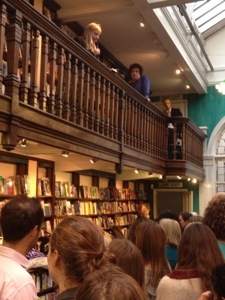
20130509-113514.jpgI finished it last night after joining Joanna Rossiter and many others for the official launch at Daunt Books in Marylebone. Several of the early reviews cited yesterday commented that it was an extraordinary first novel, written with a maturity that one would think only comes from years of experience. And I agree, my pathetic thoughts of replacing words soon vanished as I realised just how good this book was, and how astonished I was anyone I know could write like this. I’m thrilled for Joanna that the book’s been picked for the Richard and Judy book club and hope this helps it get the many readers it deserves.

The Sea Change is set across two generations, in 1971 and in the years leading to and during the Second World War. It tells the story of two women in two different places, it speaks of home, and of loving and losing. One part of the story is based in the village of Imber in Wiltshire requisitioned during the war, while the other in south India in the wake of a tsunami. It speaks of drifting and driftwood, it uses distance and proximity as the currency of relationships. It builds layers of characters on vibrant portraits of landscapes. The characters barely distinguishable from the places they inhabit. Place is not impersonal in the world Joanna Rossiter creates.

By the end I was enraptured by the characters and their stories. I wondered if some, one in fact, was too loosely painted, lacking in depth, but I now wonder if that was to tell its very own story. The incredible depth and detail with which one character is portrayed, and still not all of the story is told. And for another where although the details slip through the cracks, more is perhaps told. At first I found the slightly chaotic and haphazard introduction of characters difficult to manage, names are used scarcely; relationships are at time unclear. Yet as the book develops the relationships begin to arc across the plot lines and across villages and oceans. And the rootedness that is at the heart of so much of the story is at one point suddenly and swiftly suspended.

The book isn’t perfect, there was one particular aspect that annoyed me, and I found myself wanting to know more about all of the characters – the brevity and detachment which I’m sure was intentional was also frustrating. There was so much which was unspoken and remains unknown. Jennie Pollock commented in her review that she struggled with the weight of similes in the book and with that in mind as I began reading I was very aware of each one in the early pages, but actually, once I was engrossed in the stories, the layers of words only helped to drag me deeper into their clutches. And as with perhaps the very best books the ending left me nearly hurling it across the room, but I wouldn’t have had it any other way.

I highly recommend this book and suggest you buy it right away!