Faith in the Community: we need more than tolerance

FITC cover

“Building strong working relationships between local authorities and religious communities should not be based on mere ‘tolerance’. It should be about talking, listening, and growing together. Together, working in unity of spirit, we are stronger than when we try to do things in isolation.”

Tolerance is not enough. That’s what Archbishop of York, Dr John Sentamu, says in his forward to the Faith in the Community report out today. Produced by Christians in Parliament and the Evangelical Alliance it follows a survey of more than 150 local authorities detailing their relationships with faith groups.

The report finds that faith groups provide a vast quantity and range of activities and services for and with their community. They are valued partners and they are achieving results in part of the country where the formal structures of local government struggle to reach. Preston City Council commented that faith groups are “close to the ground to the communities they serve, have access to ‘hard to reach’ communities, and have a better understanding and knowledge of communities and their needs.” In (almost) the words of Heiniken, refreshes the parts others cannot reach. Continue reading

Do you trust lobbyists?

lobbyOver on Tearfund’s Just Policy blog Rosanne White confesses to being a lobbyist. I particularly concur with her fears of alienation at the dinner table if the topics of religion and politics are off the agenda, because I, like her, work in both.

About 18 months ago I wrote a similar defence. I attempted the herculean task of defending lobbying as a noble profession. That was the last time a crisis erupted over claims of access for cash, shady meetings to steer government policy. Yet before the reputation of lobbyists is tarnished any more than it has already, remember the lobbyists Patrick Mercers and Lords Laird, Mackenzie and Cunningham purportedly did business with were not lobbyists at all. They were journalists pretending to be lobbyists.

The politicians under the microscope have serious charges to answer and on the prima facie evidence seem to have been willing to take money in return for parliamentary favours. That is wrong and inexcusable. But to then blame lobbyists is a bit like a journalist going under cover as a fire fighter, starting a fire and than splashing headlines about fire fighters burning down what they are paid to protect.

It also means the government’s proposed action in response is reactionary and ill thought through. A register of lobbyists will not stop MPs from behaving how Patrick Mercer is accused of, if true he is likely to have fallen foul of rules on paid advocacy and possibly also face criminal charges under bribery laws. A statutory register of lobbyists would not have stopped it and is not needed to tell us it is wrong. That’s where I disagree with Rosanne’s blog, I have no huge problem with a register, and likewise I have nothing to hide, I just don’t think it would solve the problem.

Continue reading

Thoughts on Bangladesh – bought at too heavy a price

130425062811-01-bangladesh-building-collapse-0425-horizontal-galleryIt’s thought that over 1000 people died after a garment factory in Bangladesh collapsed. They say that guns don’t kill people: bullets do. Maybe in this case t-shirts don’t kill people but garment buyers do.

This is nearly a third the number of people who died in the terrorist attacks of 9/11. But the cause was not terrorism, it was not global jihad. Perhaps if it was it might be easier to explain, it might be easier to put the tragedy at a distance with a clearly defined other responsible for the senseless loss of life. Perhaps then we might have an enemy to label and target if we were wont to avenge their deaths.

But apportioning blame in this case is harder. I can wring my hands and reach out for someone somewhere who could have done something different, who could have acted to prevent this tragedy.

I blame the building owner for the unsafe structure.

I blame the manager for making people work there.

I blame the authorities for failing to enforce safety standards.

I blame middle-men for complicated supply chains that obscure responsibility.

I blame shops that sell clothes produced at such a cost.

I blame consumers and the cheap clothes they buy because of cheap labour they ignore.

I blame myself for not noticing the abhorrent and the abusive. I blame myself for using complexity as the crutch of the complicit.

And it doesn’t help.

I can also read articles that tell me wages in urban Bangladesh are double what they were six years ago, and offer more than a subsistent rural lifestyle would provide. I can nod in agreement at the thought that if everyone stopped buying clothes produced in such conditions at such a cost the 4 million garment workers in Bangladesh would be even worse off.

But 1000 people died when a building collapsed. 2500 more were injured, rescued from the rubble as cries reached through crushed concrete. Today the rescuers moved out and the bulldozers start to clear the rubble.

And today a woman was pulled from the wreckage after 17 days entombed in the fallen structure. The redemption of one life is a symbol of hope. Almost a motif of resilience against the greed of corporations; against the ignorance of consumers; against the treatment by employers of workers trapped in a choiceless world.

Is knowing that things could be even worse than their current dire state enough to excuse the status quo? Clothes marketed for our convenience and sold at great cost. Is it enough to realise that stopping buying clothes the price of a cappuccino might actually make things worse?

Of course it isn’t. The complexity of supply chains, and the undesirable consequences of good intentions, cannot be allowed to shunt us into acquiescence. It cannot stop us from taking notice that of the £6 we pay for a t-shirt only two pence goes to the garment worker. Complexity cannot be an excuse for indifference.

We’re not indifferent when a single hoarse cry echoes through layers of mangled building. Hundreds of soldiers and fire-fighters rushed to drag her clear of the rubble. Not indifferent when the chance of saving a life means amputating a hand. Life seems precious in the moments its precarious state is presented to us.

We’re not indifferent when it’s someone we know. We’re not indifferent if they’ve been missing two days or twelve years. Hope isn’t extinguished with the passage of time or tonnes of wrought concrete.

Immediacy conquers indifference.

When we know our actions have an immediate impact for better or worse we weigh them more carefully. We rush into act, or we suddenly halt. We drop everything.

Why then do we let detachment and distance dull our relationship to those who stitch our clothes?

UKIP if you want to: How to assess UKIP following the local elections?

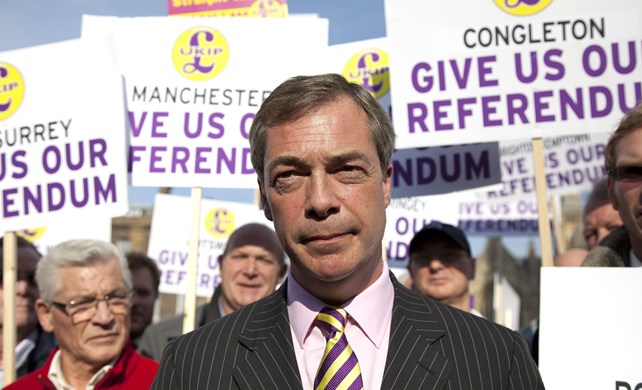
FarageFirstly, did they really do that well?

There’s been some comment casting doubt on this, pointing out that their presence on local councils across the UK is similar to the Green Party, and unlike the Greens they don’t have control of any councils, or an MP in parliament. I reject this response, it’s indisputable that until this week the Green Party’s electoral achievements were more significant than those of UKIP, and with council control and Caroline Lucas in parliament they have a better embedded depth of political support. But this week’s events were remarkable, from some back of a napkin calculations I reckon the Greens have 127 councillors across the UK, and UKIP have 163. What is notable about Thursday’s election is that UKIP gained 137 of those councillors in one day, from virtually a standing start it is a noteworthy achievement, and one that deserve the attention being paid to it.

Local elections are also notoriously difficult landmarks between general elections. Not only do the councillors elected have different responsibilities, the parties often have a different flavour on a local level, local issues are in play, and because they are sometimes seen as less important they can be used as the repository for a vote against the parties in government. The way that people vote in mid term local or European elections isn’t necessarily an indicator of what will happen the next time parliament is elected. Further, trying to work out who does well and who does badly is complicated because not all parts of the country elect at the same time, or the same cycle. It is therefore difficult to turn the votes cast in local elections in a national percentage for each party, you can read more about that here.

The seats contested this week were last fought in 2009, a year where Labour sunk to the 22 per cent, and lost 291 councillors, the exact number they won back this year. So Labour did fairly well, but against a background of a deeply unpopular coalition government with the normal recipient of protest votes co-opted in to culpability for the nation’s woes, this wasn’t a result to get the pulses racing for them. The problem, for Labour, was that voters turned off by the policies, actions and personalities in the Conservative and Liberal Democrat parties, had an alternative vehicle to use to register their dissent.

UKIP did very well in seats they had not previously contested and okay in those they held. There was not a continuation of a dramatic swing in places they had already won council seats. This suggests their support is broad but shallow. If they are to have more, and more substantial, electoral success in the future they will need to marshal their forces to target gaining control of councils or specific parliamentary seats. To some extent this goes against the nature of their support which has an element of Farage against the machine. Professionalism and strategy don’t always go well with raw passion and dissenchantment.

Is UKIP full of loonies and fruitcakes?

Maybe, a party that expands is candidate list as fast as UKIP has will have had a fairly low level of competition and scrutiny for selection. Following this week’s results, the attention paid to candidates by the press will increase, and the party is likely to up its game and vet candidates if it doesn’t want to shoot itself in the foot. A caveat here is that the very unvetted nature of the candidates appeals to the non-PR-polished image the party seeks to portray, too much professionalism may also damage the party’s prospects.

Is UKIP just a protest party?

A lot of the support that UKIP received comes because of dissatisfaction with parties that voters would traditionally support, that they are not doing what the voters would like them to do. So to some extent the UKIP surge is a beneficiary of protest voting. But it is more than that, the votes for UKIP are not only votes against the policies of the traditional three parties, but against the politics they are seen to represent. Their support is less protest and more anti-politics.

Is UKIP a single issue party?

Their origin and their initial support was single issue, it is still their raison d’etre. But they are supported for multiple reasons not just because of their views on Europe. They are seen as a more straight-talking right wing party, they pledge to do something about the things other politicians make excuses for. They are prepared to talk about immigration and tackle it. But their policies also don’t add up because they haven’t come under the scrutiny other parties do, and this is likely to change in the near future. Their spending is uncosted and set against aspirational, plucked from thin air, cuts in taxation.

But Europe does matter, and it is a form of xenophobia.

Europe matters less in terms of a policy position, which they are clear and unequivocal about, and has garnered them a certain amount of support in recent years, but more of a symbol of what politics has become and what it shouldn’t be. There is a core of support for UKIP which is passionately Eurosceptic and sufficiently so for that to be the main reason choosing this party over the others, but I don’t think their expansion this year is due to an increase in support for that perspective. Those voters aren’t going to be won back to the other parties by a more Eurosceptic position, because they’ll always be outflanked.

But Europe is a bogeyman. It is the exemplary case of a political institution disconnected from the real world, it is overseas, it is far away, it is overpaid, it makes unnecessary laws, it makes laws that cut across our way of life. It is something else, it is distinctly other, it is easy to reject and easy to use as a basket-catch-all for political disgruntlement.

And the opposition to this aloof political institution provides a platform to set the party as different to the conventional political class. We are different, they say, we’re not like them. UKIP thrive, as do all populist parties, by emphasising a faux familial relationship with voters and casting that in contrast to the disconnect other parties represent.

The problem with populism

It’s easy to be liked when you don’t have to do anything. As soon as difficult decisions have to be taken greater conflict will emerge and the rosy, simplistic picture presented collapses. Populist parties present politics as easy and straightforward, and sometimes a bit of clear passion and direction is vital to good leadership, but decisions are difficult.

When President Bartlett was running for re-election his opponent came out with a brilliant sound bite answer during a debate: “We need to cut taxes for one reason – the American people know how to spend their money better than the federal government does.” This is what populist politics does, it cuts complex issues down to fortune cookie wisdom. It suggests complex situations and simple solutions. But Bartlett catches it and replies:

“That’s the ten word answer my staff’s been looking for two weeks. There it is. Ten-word answers can kill you in political campaigns. They’re the tip of the sword. Here’s my question: What are the next ten words of your answer? Your taxes are too high? So are mine. Give me the next ten words. How are we going to do it? Give me ten after that, and I’ll drop out of the race right now.”

The test for UKIP will be whether they can follow up this week’s success in future years, can they translate second places into victories, can they work as the opposition to the ruling group in local authorities, can they turn opposition into council control? Can they focus their resources in a way that translate broad but shallow support into sufficient backing to win a foothold in parliament. And will they be as popular when they have to make decisions that are difficult? I don’t think so.

Did marriage matter?

I don’t think the government’s plans to introduce same sex marriage were hugely influential in the tide of support that swept toward Nigel Farage’s party. I’m sure for some it was a crucial issue, and I’m sure the presence of a minor party opposing the government on this provided a useful way of signalling disagreement at a local election. I’m sure for many Christians frustrated at the actions and positions of the three main parties it was appealing to see a party taking a position they could support. But I think in a similar manner to Europe as a symbolic policy area representing disillusionment with politics, same sex marriage could be symbolic of disenchantment with policy positions. The political efficacy of voting for UKIP on the basis of their opposition to same-sex marriage is also open to debate, personally I don’t think it is particularly affective.

I would also question Christians supporting, or not supporting, any party on the basis of one issue. Political parties are there as vehicles to govern and when considering which to support we should take a broader perspective than just a signal issue, even though for many this is a vitally important one. If it is the issue that tips the balance then fair enough, but I don’t think it should provoke a switch in support in ignorance of other policies.

What does this mean for Cameron, the Conservatives and the Coalition?

Cameron has a problem because the voters do not see him as sincere, they consider him opportunistic and pragmatic, and will do what it takes to win votes. This is problematic for him because if he now pitches explicitly for those voters disenchanted with him and his party for that very reason he will look like he is being opportunistic and interested in winning votes more than standing for principles. It’s a bit of a catch-22.

With the emergence and success of a party such as UKIP it is possibly a little too easy to rely on a generic anti-politics response as the reason for their success, and this to some extent places the blame on the voters for not being sensible in their voting. This ignores the very real deficiencies in our political system and the political class. There are political parties led by people not trusted by the public and not wanted by large sections of their parties.

Saying a party succeeds because of anti-politics sentiment ignores that it is politics which is allowing this sentiment to be expressed. It can be a way of letting unpopular politicians off the hook by blaming the voting public.

Politics, perhaps to the chagrin of UKIP, is not other, it is not detached from the people. It is not a disconnected alternative reality far away from the lives of people casting votes in schools, community halls and leisure centres. Politics is of the people, and that is what we have seen this week.

It may be a short term development, it may be all flash and no lasting significance. But my hunch is that it is a decisive marker in collective disillusionment with politics as business as usual, and politics as process over policy. We want our politicians to be without fault, but moreover, we don’t want them to pretend they are without fault. It’s why Boris wins after swearing at Ken in the lift.

UKIP have a gift with the European Parliament elections next year, they are not voted on based on European policies or the performance of the European representatives. They will likely do well. The challenge for other parties is taking them seriously as a party that has received a significant number of votes, but also not jumping to the tune of a party that sets itself against the notion of politics and the manner in which it is performed. If they do try and ape UKIP too much politics could become a cross between blind man’s buff and Russian roulette.

Living on porridge and making pea soup: I’m living below the line

20130429-151914.jpg50 grammes of porridge isn’t very much. And it’s fairly tasteless on its own, but I’d ran out of money so couldn’t afford even the cheapest jam, honey or golden syrup.

For £1 I’ve got a pot of broth on the hob that will be my lunch for the entire week. A bag of split green peas, a carrot, an onion and part of a swede. And to do this this with the greatest level of integrity I have to account for the shake of salt, pepper and parsley from my shelf.

And yes, the pot is still on the hob and won’t be ready until gone 3pm. And this is my lunch. Good job I’ve got a day off work as I start living below the line for a week. Time in the morning to go shopping, time to prepare cheap but labour and time intensive food. A luxury I won’t have time for the rest of the week, so today’s goods will be divided up, put into boxes along with 3 slices of value bread.

I had to put food back on the shelf at the supermarket. I couldn’t afford as many eggs as I would have liked. If I want to drink tea, which I do, I’ll have to forego an apple one day.

If you haven’t came across Live Below the Line before, let me explain. Across the world 1.4billion people live in extreme poverty while we are too busy buying happy meals. This is twenty times the number of people in the UK living on the equivalent of less than £1 a day. This isn’t one of our pounds taken over to different countries, it is calculated through purchasing power parity – adjusting prices for different countries. More details are available about the calculations on the Live Below the Line site.

So for five days I am joining with many others and living on £1 per day. That’s why my caffeine intact will be down, why I’ll have a small breakfast, the same lunch each day, and an unexciting rice and beans dinner, on a couple of days I get to have eggs.

This is not just a stunt. It’s not just an exercise in embodied empathy, but hopefully it will do that. It’s about learning what many, far too many, go through each and every day. They cannot look forward to Saturday like me, when I can have a fry up.

Live Below the Line is also a fantastic way of raising money for charities who are doing vital work in many of the countries those 1.4 billion people live in. I’m joining up with Tearfund as I live below the line this week, and I would love if you could sponsor me – all the money goes direct to them.

SPONSOR ME NOW!!! (Forgive the poor etiquette, this is important.)

The Daily Mail: What an insult to Christians

Jan Feb 2012 008The Daily Mail splashed their front page this morning with “An Insult to Christians”. No, that’s not how I’m describing it, that is their actual headline.

They might think it is a descriptor of the dreadful events they outline in their story, but it is a far closer label for their own treatment of Christians. And in particular in thinking that the situation they discuss is an insult to anyone.

The “insult” is that followers of other religious belief systems including paganism and non religious deeply held belief systems such as vegetarianism will receive the same protections as Christians. Firstly, this is not news. Secondly, it is not controversial (although a little tricky to implement). Thirdly, this is not an insult.

The law has for a while placed all religious and non religious beliefs on a par with regards to their protection under the law. Although only in the last decade has it been codified into statute through regulations following the 2003 Equality Act, and then drawn together in the 2010 Act, court precedence has provided strong protection for non-Christian beliefs in a similar manner (although due to differences in beliefs never quite the same).

The dreadful situation before us today has occurred because the Equality and Human Rights Commission issued guidance last month on how employers should handle religious beliefs and their manifestation. This in the wake of Nadia Eweida’s successful claim in the European Court of Human Rights that her employer had failed to protect her freedom of religious expression when they said wearing a visible cross was against their uniform policy. Legal precedence on religious belief protection is often carried across from one belief to another so there was absolutely nothing of controversy or even interest in the EHRC saying the judgement would affect employers responsibilities towards those with other beliefs.

The controversy has been whipped up because a gaggle of Tory MPs on the right of their party were baited into giving a critical judgement of the EHRC. This is hardly a difficult topic to exploit for that effect, it is high on the list of bodies those of their ilk would prefer were scrapped. What is most controversial about the guidelines is that they had to be written at all, because one would have thought it was common sense. But apparently this morning has demonstrated just why it is necessary.

The requirement to protect non-religious beliefs is also not a new one. A key legal case in 1978 Arrowsmith v United Kingdom found that the applicant’s beliefs in pacifism were deeply held and sufficient to warrant protection under Article 9 of the European Convention of Human Rights. The court found against the claimant for wider reasons but importantly held her beliefs were worthy of protection. The ECtHR judgement in the case of Eweida et al also found that the actions of all four claimants were borne out of religious beliefs and therefore worthy of protection. The Court also went further and said that it was not up to them or any other applicable body to decide what was or was not of sufficient centrality in a belief system to merit protection, or what actions arising from those beliefs should be counted as a manifestation of belief. What the court held to matter was that the belief and action was of importance to the applicant.

Therefore, while this eases the difficulty of deciding when a belief or action becomes sufficiently meritorious for protection, it opens up a whole other can of worms in potentially allowing any belief or opinion protection on these ground. While this is a tricky situation for courts to adjudicate it is not a particularly controversial one. While the beliefs and actions may come under Article 9 jurisdiction it does not mean an employer is forced to allow them. In the case of Eweida the court found that the uniform policy was insufficient grounds to restrict the wearing of a cross, but in Chaplin found the health and safety concerns in a hospital, coupled with the proposal of alternative ways of wearing the cross, were sufficient grounds and found against the claimant. The court also found in Ladele and McFarlane that the equality and anti-discrimination policies of their employers also provided the latitude for their requests to be denied. (This is a more controversial decision and what is at the heart of an emerging hierarchy of rights among equality strands.)

Therefore I doubt that a vegetarian employed in a kitchen role would be granted a request not to handle meat. If it is a central part of the job which would put an unreasonable burden on the company and other staff I suspect the request could be legitimately denied. If however, the staff member is employed in another role but is asked on occasion to assist in the kitchen the request may well be expected to be granted. If we expect a common sense type of accommodation of reasonable requests we also have to understand situations where without any hint of an attack on Christian belief they might not be accommodated.

Finally, this is not an insult. An insult would be to suggest that Christian beliefs alone are worthy of protection. Or moreover that Christian beliefs and practices need more protection than other beliefs. I want the freedom to practice and promote my beliefs and I think the surest way of ensuring that is to fight for others to have the same rights that I do. I may think they are wacky, I may find them absurd. I may even find them offensive. But I want to fight for their freedom of belief: I want them to be as free to promote their beliefs as I want to be to promote mine.

Freedom of belief means freedom of belief for everyone. And at the heart of the Christian message is a voice of freedom that calls into the wilderness. That releases slaves from their captors. It is freedom to choose to worship a God who chose to send his Son so that we could have life and life in all its fullness.

It is the freedom not to worship that makes the choice to worship such a precious gift we have to offer.

To suggest that Christians would rather others were not free to follow their beliefs is an insult.

Are benefits of benefit?

Is the future of the welfare state “poor, nasty, brutish and short”? To take Thomas Hobbes’ descriptor of humankind and apply it to the welfare state may seem unnecessarily apocalyptic, but it may also be rather apt. I think reform of the welfare system is vital. Whether the current reforms that are starting to come in are the best way ahead is a different matter. But before we get onto that, let’s take a few steps back.

Nearly ten years ago I first realised the scale of the the problems facing any developed countries’ welfare system and then two weeks ago I met the graph of doom. I was in a small seminar at university looking at welfare policy when two numbers made a difference these numbers were 7 and 20. They are the years the average person in the UK was expected to live in retirement in 1945 and 2004 (exact years may have faded in my memory). According to the 2011 census one in six people in the UK are now over 65.

The graph of doom was produced by Barnet Council last year and is now being cited across the country to illustrate the crisis pending for local government funding. By 2022 the cost of adult and child social care will be greater than total local government funding. This means that between now and then they will have less money to do anything else, parks, leisure centres, bin collections and the rest, and from then they will not be able to afford that.

And I know this is not the focus of the benefit reforms that have come into practice this week. But if we think the current reforms are causing upheaval and controversy just wait a few years. It is also why I expect to carry on working beyond my current projected retirement age of 68 and cannot support universal benefits for pensioners such as bus passes, winter fuel credit and free TV licenses.

A further problem in navigating the current debate is that disputes are not about different ways of achieving the same goal, they are marked by significantly different philosophical conceptions of the state – philosophical differences that were overshadowed by the post-war welfare consensus and even as that disintegrated a reluctance to probe beyond a policy level. On one side you have a free market perspective that (usually) supports the welfare state as a safety net, and on the other side a broadly socialist perspective backing wider redistribution.

For some in this latter category lifting the lowest paid workers out of the tax system is not a wholly good thing. When I first came across this opinion it shocked me – surely not paying tax is a good thing, it means you get to keep more of your income and therefore are less reliant on the state? But the point is that by paying tax, and if necessary receiving additional income via state benefits people are brought into a relationship with other people and are not just autonomous individual economic actors. My friend had a point (not one I agree with).

Free marketeers believe that at root taxation is theft. Maybe theft that the victim acquiesces to, but still taking something that belongs to them against their will. What someone has earned or owns should be theirs to keep unless there is a very good reason otherwise. And the more charitable (admittedly most of them) will at least allow that creating a welfare safety net of some sort is a good reason.

These are both fairly extreme positions, and for most their view of the state will lie somewhere in between, and often have aspects of both at different times and be swayed depending on their situation and their view of others. The role of the media in presenting policies and the lives of those impacted therefore also plays a crucial role. It is why, regardless of you position, the report ‘truth and lies about poverty produced by the Methodist, Baptist, URC and Church of Scotland makes essential reading. We have to talk about what really goes on, not what supports our a priori philosophical position.

We also need to watch the language we use. When we talk about welfare dependants we are talking about people. When the BBC runs a cutely times web gimmick to decide which class you are in it puts us in boxes and builds walls rather than tear them down. When we reinforce stereotypes by forcing people into red and blue corners that only encourage them to come out fighting even harder when the bell tolls.

And then a debate about significant welfare changes shifts to whether the cabinet minister in charge of the changes can live on £53 a week. I think those who make decisions which affect the poorest and most vulnerable in society should have an intimate awareness of what their decisions look like in the homes of those they affect. I also think Iain Duncan Smith has done more than most in the past decade to acquaint himself with these very problems.

He dismissed it as a stunt. It was a stunt, but maybe it wasn’t very good politics for him to label it as such. It brought to mind a scene from the final season of the West Wing, Santos has skipped off the campaign trail to fulfil his marine reserve duty, one of the staffers Ned turns to Josh and says: “Half the press is calling it a stunt.” And Josh replies, “Yeah, but all the press is running the footage.” The petition is a stunt, a good stunt, and it makes a good point – but a stunt none the less. Noone is quite sure what the £53 includes or doesn’t include, it would certainly be difficult to live on that amount even if it is after your rent and council tax is paid. But that doesn’t mean it is impossible, or means that Iain Duncan Smith should relent to the wave of pressure building for him to do it for a year.

I think Iain Duncan Smith would acknowledge it would be difficult to live on that amount, but maybe he would say it should be that way. Maybe he wants the benefits system structured to discourage reliance and encourage people to find other ways to pay their bills. Of course that’s not an easy route in a economy where jobs are scarce and living costs rising fast, but I think it should still be our intent.

There’s one other big hurdle in understanding the contours of the current debate about benefits. The tension between long term goals and short term necessities. The long term goals are reforming our welfare systems to make them affordable for a population that is getting older and costing more to look after, and doing so at a time of continued high unemployment and stagnant economic growth. The short term necessities recognises the financial difficulties many people are in and prioritises meeting those needs.

While many may object to specifics in policy changes, the philosophical differences come to the fore when considering whether a system should remove people out of the benefit system altogether or provide support towards a more equitable distribution of resources. Personally I think in an ideal system no one paying tax should receive benefits and vice versa, and I think the Universal Credit – in its intent – is a way of moving toward such a system without too steep a cliff edge. But then I am at heart an advocate of the free market.

I also recognise that making changes to the welfare system comes at a real cost and people will suffer because of changes made, and I do not think that is a price worth paying. It is why I back the principle of the bedroom tax/spare room subsidy, I think if the state is providing for your housing needs it should only provide for what is necessary. And yet of course it is not that easy, there are not enough smaller properties available, and there are various other wrinkles in the policy that mean it looks pernicious.

Each policy has similar good intents and harmful consequences. The challenge in contemplating the policies is deciding whether the end to which they serve is justified, and then whether the means by which they are achieved is acceptable.

And what for the role of the church in all this? I believe the church should stand on the side of the poorest. I believe it should care for the vulnerable and advocate for their cause. I believe it should be a place of refuge and a speaker of truth. I also believe it should look for good where it can and not slander without cause. It should be quick to care and slow to judge – and that applies to both politicians and those in poverty.

The church should be a witness of a better way. A way that does not get caught in the tramlines of party political campaigns. A way that is wary of easy answers, a way that sees charity as irresistible and politics as necessary.

I’ve heard Christians argue in recent days that their faith backs redistribution and private property rights. And I can consider the cases on both sides. I can look to the Old Testament and the New and see points on both sides. I can see generosity and communal living and a God who gave a people their land.

I also see the temptation to walk away from the debate. Because it is too much. Too aggressive, too difficult to put reasoned arguments that might upset, arguments that might inflame, arguments that might have little to do with what I want to say. But that is the case in most things that matter. And we need to find a way to accept we see things differently, and sometimes want different things but that doesn’t mean we should vilify those we oppose.

I’ve spent the best part of the last week in the company of my niece, she’s not quite two but plenty able to show her own mind. When she wants to stick the blue rocket sticker on the grass and not in the sky. When she wants to wear the pink coat that doesn’t fit her any more. Sometimes you accept that things don’t quite work out how you like, I wasn’t going to pick an argument over a rocket about to destroy Peppa Pig’s house. But sometimes it is worth fighting for what you think is right. We need wisdom to know which and grace to do so in a way that enlightens and does not condemn.

I don’t think the future of the welfare state is necessarily “poor, nasty, brutish and short”, but I think we need to try harder than ever to make sure the way we talk about it isn’t.

What might Lincoln and Euclid have to say about same-sex marriage?

Last night I heard Bible verses quoted with abandon.

I heard God’s will invoked in defence of the cause.

I heard that some things are against how God created nature.

I also heard a man quote Euclid, “things which are equal to the same thing are equal to each other”. I saw a man who for the greater good denied the strength of his commitment to racial equality: to free the slaves he was prepared to limit his conviction that all men are equal.

Last night I went to watch Lincoln after watching the parliamentary debate on the Marriage (Same-Sex Couples) Bill. And I’m well aware that Jennie Pollock has already made precisely this comparison, perhaps it was why my ears pricked up at the relevant moment.

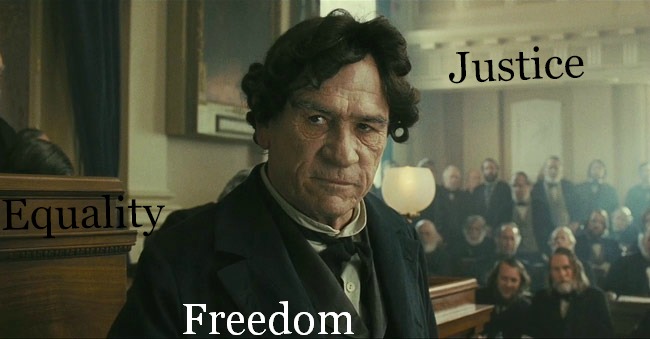
tommy-lee-jones-linconln-thaddeus-stevens EJFAdvocates of same-sex marriage argue that this is an issue of equality on a par with the struggle for racial equality which won a huge leap through Abraham Lincoln and then lurched on in fits and starts for the following century. I do not, however, think this is an appropriate comparison, and maybe Euclid can help us out. Man, both black and white, equal a human, they are therefore equal to each other.

To achieve the same result with same-sex marriage and heterosexual marriage requires some linguistic gymnastics. It involves emptying marriage of much of its meaning and then refilling the shell which is left with what ever we choose, only then can we suggest that the two are equal. If marriage was only about love and commitment between two people, then Euclid’s notion might provide some comfort, but to achieve that you have to remove much of what makes up marriage and turn it into little more than a contractual agreement. This is why I agree with those who say you can only achieve marriage equality by changing what it fundamentally is. For marriage to be extended beyond it’s heterosexual bounds it requires first turning it into something which it currently is not.

I would have a great deal more respect for the government if they were honest about this, what bothers me is the insistence that this is no great change, just the extension of something to a previously excluded group. But no one is excluded from marriage, people only become excluded from marriage when it is first changed into something different, something that is defined solely by love and commitment and not also by male and female, and conjugation and the potential for children. Only once you have changed this definition can the institution of marriage be considered to be restricted. But the government jump to the end and use their own definition of marriage to pretend their plans are no big deal, moreover that they are a vital step towards equality..

But as Philip Blond and Roger Scruton put it: “The pressure for gay marriage is therefore in a certain measure self-defeating: in seeking equality with something unlike yourself, the thing that you join to is no longer what you joined.”

* * *

Maybe it was the experience of following the debate that made watching Lincoln immediately after a slightly strange experience. But I couldn’t help but watch the many scenes of the House of Representatives debating the thirteenth amendment and wonder whether future generations might look back at yesterday’s debate in the same light. I wondered whether those who oppose same-sex marriage would be viewed in coming years as behind the times, stuck in the mud, on the wrong side of history – as some observers have suggested this week.

I also wondered what I would have said and done had I been in either of those chambers. Whether I would have stood and spoke of the equality of man, or sought to protect my prejudice or financial interest. I wonder whether I would have compromised my beliefs in order to see a greater wrong righted. I wondered what constituted a greater wrong.

I wondered if I would have said what I believed despite the critics howling at the door, I wondered if I would have had the courage to make my own mind up and not hear threats of no promotion, or being ousted by the voters at the next election. I wondered if I would have taken the calls from the media, stood outside the steps of parliament and found the words of grace that did not deny what I believed to be true.

And I saw the hostility of the 1860s and the legacy it left in its wake stretching nearly a century until the 1964 Civil Rights Act achieved much and left much more to do. I saw the bitter wrangling over reconstruction as the Confederate leaders sued for peace.

If I was in that chamber in Washington DC 150 years ago I would hope to have been like Thaddeus Stevens. Many others thought peace was more important that equality but he stood for freedom and justice. But if I was in the House of Commons yesterday, I don’t think I would have been so strident. I wanted understanding, and I wanted peace. I wanted space for different views. And I wanted some understanding that just because something is claimed in the name of equality, that doesn’t automatically make it a good thing.

I didn’t pray enough for peace during the debate yesterday, but I will in the coming weeks. I know not what the weeks and months to come hold but I hope for a future where we can have civility and peace even if we think fundamentally different things. Perhaps I hope that those with the strongest of views can find a way that is better for all of us. Perhaps.

Is there a religious right emerging in Britain?

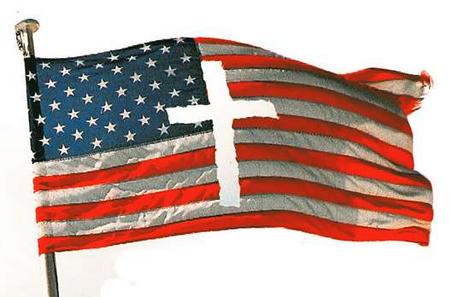
religious-right-flagBefore the US election last autumn several high profile Christian leaders offered their support for the Republican party and I wrote about it. Billy Graham said everything he possibly could short of endorsing Mitt Romney and Wayne Grudem produced a crib sheet comparing party A to party B – there were no prizes for guessing which was which and who a good Christian would vote for.

Taken against the previous 40 years of American politics such interventions are not unusual or unexpected: a cohesive bloc of voters encompassing both evangelicals and Catholics has disproportionately sided with the Republican Party. The political theology behind this is questioned, and rejected by a large minority of evangelicals in the US but the trend still exists, in contrast such a move is currently unthinkable in a British context.

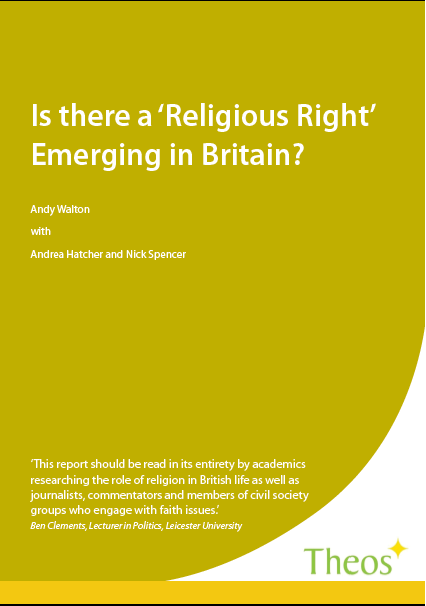
Religious right front coverOr is it? That’s the question at the heart of a new Theos report out today. Because something in Britain has been labelled as the religious right by journalists, commentators and even an Anglican bishop. The activities of Christian groups have been investigated and ‘exposed’ to show the apparent dangerous power of right wing religious lobby groups. Most memorably this took the form of a dispatches documentary in 2008 but perhaps most graphically illustrated through an organogram which accompanying Ben Quinn’s article in 2011.

Andy Walton’s research draws a helpful distinction between Christians with socially conservative values and a religious right. The report develops a criteria for measuring this but at simplified level equates to a clear cohesion of different groups centred around specific policy aims and political affiliation and having the size and influence to leverage political action. This is evident in the US, although perhaps not as stark now as in the mid 1990s with Newt Gingrich’s Contract With America which saw considerable mid term gains in 1994. A movement of this nature is not in existence in the UK, although some of the social conservative policy goals are similar to across the Atlantic.

A more pertinent question than whether a religious right exists is whether one is emerging, or could come to exist. Taking appropriate caution the report does not completely rule out the development of such a trend but considers it unlikely. Three areas of difference back up this argument: size, policy focus and political affiliation. Firstly, the UK religious population is far smaller than the US, the number of evangelical and Catholic voters make up a far smaller percentage of the population and therefore there is less political power to leverage.

Secondly, evangelical organisations that engage in lobbying do so on a far broader range of topics than those characterised as ‘right-wing’, these include adoption, alcohol and aid. Issues around sexual ethics and abortion do feature, but not to the exclusion of other policy goals, and have not become the touchstone for evangelical engagement. Research from the Evangelical Alliance showed the diversity of issues Christians contacted their MPs about (page 12 of this research booklet).

Finally, and perhaps related to the previous point, evangelical Christians in the UK support political parties along broadly the same lines as the wider population. While they are more socially conservative than average they are also more likely to support traditionally left-wing economic policies (see page 11 of this booklet). There is also minimal evidence of key Christian leaders encouraging their congregations or supporters to vote for or against certain parties or candidates. One point that is relevant here which is not noted in the report is the role of charitable status: a church could not retain its charitable status and support one party or candidate over another. While this should not be the principle reason for remaining a(party) political, it could be a factor which discourages campaigning organisations from taking this position.

The report shows good reasons why the UK has not seen the development of a religious right along the lines of the US and offers strong evidence for why the development of such is unlikely. But the question that recurred earlier this week at a discussion around the report was whether the definition had been drawn too narrowly and even the US religious right would fail to meet the criteria. The defence offered was that when the comparison is used it is used to suggest a certain thing, and certainly not a good thing, is happening within UK politics, and the report strives to point out this is not the case. But something is happening, several commentators suggested that the way Christian groups engage has changed and become more sophisticated and the current focus on government plans to introduce same-sex marriage perhaps invite the US comparison.

If something is emerging that represents a new turn in Christian political engagement in the UK then it is definitely different to what occurred in the US over the past 40 years. The challenge for commentators, researchers and Christian organisations is to identify what it is and discuss it without recourse to simplistic comparisons. It is also incumbent upon Christian organisations involved in political activity to understand the direction they might be travelling in and the potential consequences both of such a shift and the perceptions of this move.

As the report makes clear, organised political activity, or lobbying to give it its sometimes more grubby title which I’ve defended before, is a legitimate part of our democratic system. It shouldn’t be pejoratively labelled just because you might disagree with the goals. At the same time, perhaps there is a space for Christians to imagine a better way of engaging in politics: one that is more akin to playing on the pitch than shouting from the sidelines.

Legal rights and religious wrongs

Yesterday’s European Court of Human Rights judgement on Eweida, Chaplin, Ladele and McFarlane didn’t get the attention it might otherwise have received. For the mainstream media this was the news story getting all the coverage with Steve Chalke relegated to a small sidebar. But within the Christian world the cases got a distinct shove to the sidelines.

In response to the cases I want to make two legal points as best as I feel able to from a layman’s perspective. And then two theological reflections about where the cases and the judgement leave us.

Summary of judgement

Firstly, what did the court decide? It determined that one of the four claimants, Nadia Eweida, had been subject to an unlawful restriction of her freedom to express her religion. In the other three cases it found no unlawful restriction, and refused a claim for direct discrimination on grounds of religious belief for Lillian Ladele.

Legal view

Nadia Eweida should have been allowed to wear her cross to work but Shirley Chaplin, a nurse, was reasonably prevented from doing so. The crucial legal point affirmed by the judges in Strasbourg was that this was not dependent on whether wearing a cross was a necessary, or even generally recognised, aspect of Christian belief. Rather, and importantly, what matters is whether the action arising from belief is important to the person in question’s religious belief.

The desire to wear a cross for both Eweida and Chaplin passed the manifestation test that I set out last week, and the actions of their employers was deemed to be interference with that expression of belief. The key question was whether that interference was justified. This is where I think the court took a very simple to understand common sense stance. In the case of Chaplin health and safety concerns were considered justified while for Eweida the desire for British Airways to maintain their brand image was not. Added to this, British Airways were inconsistent in their accommodation of religious belief and had allowed the uniform code to be modified to satisfy other religious beliefs.

The second interesting and important point that comes from the judgement comes in the case of Lillian Ladele. Both she and Gary McFarlane requested an opt out from certain duties in their work because of their beliefs about homosexuality. For several reasons I consider Ladele to be the far more interesting and valid case, not least because she was employed by Islington Council prior to the introduction of civil partnerships and her job was changed to include their registration as well as marriages. In both cases no users would have been restricted from accessing a service, but their employers refused the request for an opt out because it would go against their equal opportunities policies.

In the case of McFarlane, he choose to change the remit of his role by training in psycho-sexual counselling, in doing so he raised the prospect that he might be unwilling to provide this service to gay and lesbian couples. In doing so he showed intent to restrict the service he provided on the basis of sexual orientation. A further point in his case was that his scruples applied only to gay and lesbian couples and not to heterosexual couples outside of marriage, which strikes me as an inconsistent application of biblical sexual ethics, although following the reasoning above the court accepted his stance constituted a manifestation of belief. For these reasons, I am satisfied that the court reached the correct decision in finding that Relate acting fairly.

The European Court of Human Rights allows the relevant authorities, in this case the employers and the UK courts and wide margin of discretion when determining how to protect convention rights. Therefore in both these cases the court found that the actions of the employers in their equal opportunities policies, and the courts in backing them, were reasonably because they were in pursuance of protecting the rights of others on the basis of their sexual orientation.

The question that arises following the decision to place the actions of Islington Council in the case of Ladele within this ‘margin of appreciation’ is what would be needed to fall outside of this margin? The court has acknowledged that there is a need to balance the protection of different convention rights, but in its decision leant heavily towards protecting sexual orientation rights without any guide to how religious expression would be equally protected. I am not sure, if this judgement is confirmed by the Grand Chamber, whether there is any action that an employer took to protect sexual orientation that would be deemed an unjustified interference in the manifestation of belief.

Theological reflection

Both the pairs of cases, raise theological as well as legal issues. And these come into play layered over rather than in conflict to whether or not they should have won. For what it’s worth I think both Eweida and Ladele should have won, but I think sometimes we can get caught up in the legal rights and wrongs of specific cases that we detach it from the our faith.

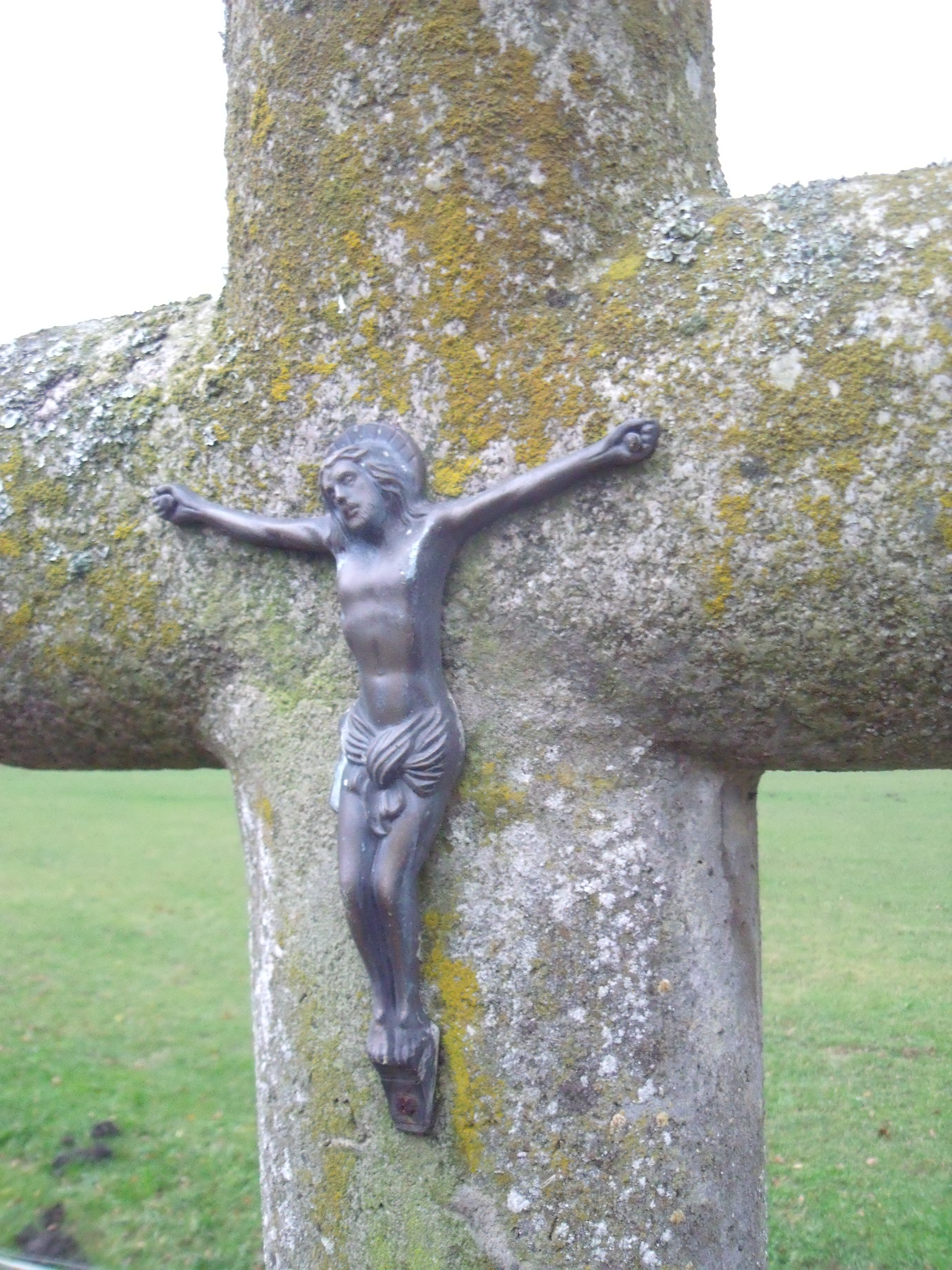
On the cases of the crosses, I don’t wear a cross, I don’t think it’s important to my belief. But I accept that for some it might be, a friend coincidentally wore a pair of rather large cross earrings yesterday. But that wasn’t a statement of faith. And I think it’s a mistake when we make a big deal of things that aren’t a big deal. And whether or not we can wear a cross is not a big deal.

That’s the first theological point. The second is bigger, and harder to define. It’s the question of whether cases such as these are helpful or a hindrance to public Christian witness. I think when cases are brought that are unlikely to ever win but instead used to promote the perspective that Christians are being discriminated against they are a poor weapon which leads to a culture war which leaves far more loses than winners.

The Clearing the Ground report issued by Christians in Parliament last year commented: “The cyclical strategy of generating-fear-to-fuel-funding-to-fight-cases (cases that are often doomed from the outset) is a recognised part of the culture war situation in North America. Although such an approach can have the effect of giving Christians a sense of ‘taking a stand’ against a tide of secularism, with protest as a primary mode for political engagement, it is clear that it simply reinforces a victim mentality, polarises society, and does not work.”

But sometimes there are legitimate grievances, and how do we respond in those cases? What of Lillian Ladele who was pushed into a job she never applied for, doing something that conflicted with her deeply held belief, in a situation that could have been resolved without anyone deprived from getting a civil partnership, and the only cost Islington Council’s equal opportunities policy?

I think in these cases we have to act with humility, we have to exhaust all possible options. And I think sometimes we need to turn the other cheek.

It’s a thought I can’t get away from at the moment, that when faced with a situation when we are sure we are right how do we prioritise relationships without giving up on what we believe. And how in it all do we live out the reality that we are created in the image of God, how can we be attractive to the world that needs to know God in whose image we were created?