Quarter life crisis – relationships, romance and reality

One of the reasons I felt I needed a break from blogging over the summer was the intensity with which I had posted during June and July, both in terms of volume, and the topic. I’d often rise early write in my favourite spot for an hour or two and then head into work. I was often emotionally as well as physically exhausted. I’ve always tried to write with as much frankness as I can muster and it took its toll.

Which is why when I turned my mind to what I might write about upon my return relationships were further down than the bottom of my list. I was positively determined to steer clear.

Yet as I worked my way through the aspects of life that the phenomenon of the quarter life crisis affects I realised that avoiding talking about relationships would be doing exactly what I fear we do all too often. That is, push to one side the inconvenient and challenging topics and cling to what is safe, known and under our own control.

Emily Maynard wrote a cracking post a couple of days ago about the recurrence of inquiries about ‘why are you not married?’. I think it’s slightly different from a guy’s perspective, I don’t think it comes so frequently, but rather than the sympathy that is perhaps attached (but not always appreciated) when directed at women, for men there is built into the question an element of criticism. That’s because in the church one of the seemingly irrefutable facts is that women outnumber men. Also, as men and women age through their late twenties and beyond, it is women who see the biological countdown with greater clarity.

When the question comes there is always a hint of the underlying questions, either, ‘why haven’t you got your act together?’ or ‘why are you being so picky, there are lots of stunning girls at church?’. And yes I’m guilty of the first charge and I agree with at least the second clause of the latter critique.

What most often provokes the question is when I bake a cake, or brownies, or a pavlova, or decide on a whim to spend an entire Saturday creating a unique, never to be replicated dessert concoction. Then the question is a little different, it’s usually backed up with: ‘any woman would be grateful for a husband who can cook’. Ignoring for now the incredible gender stereotypes in such a statement, such a question places incredible pressure, am I supposed to use edible goods as my principle flirting mechanism?

The other prompt for the gentle prising open of my romantic commitments, or lack thereof, is when I’m in the company of either of my incredibly beautiful nieces. They’re 18 and 15 months old (each other’s cousin) and generally amazing. The occasional case of mistaken identity as their father is quite fun, but sometimes I manage to successfully pacify them, and then the observation comes once again…

Coming back to the quarter life crisis theme this comes into play because I have too many choices. My friends and colleagues, with their not always subtle critique, have a point. I am overwhelmed with choice. There are many incredible women who if in a different situation, with less choice, I may well view in a more romantic light.

But my hopes are built for that experience, that attraction, which transcends the normal. The defining feature of what makes life special seems to be that which lifts us from where we are and onto another plane. Relationships, and the romance within them, are heralded as the hosts of such achievement.

From a personal perspective, for most of my life I simply shrug it off and move on. But this makes me inoculated from the promise of relationships. It makes me view it as something that is even further away from my present state. It allows me to think in abstract concepts and not engage with what the challenge might actually be. I don’t have to become comfortable in my life outside of marriage if I don’t consider that an important part of me.

I respond to choice by running away. Scared of opting for an imperfect solution I prefer to delay resolution altogether. I let it linger in the air, I wait for too long to decide whether or not I – in that most infantile of phrases – fancy a particular person. I hang on to attraction even when I know that it is going nowhere, I hold it like a comfort blanket that doesn’t satisfy but constantly offers the promise that maybe one day it will.

During the frenzy of posts earlier in the summer Jennie Pollock wrote a guest post for me, Singleness is not a prelude, and it has attracted quite a lot of attention. It’s a really good call for contentment in where God has placed you. In it Jennie challenges our view of singleness: “our cultural attitude to singleness – particularly within the church – is similar to my attitude to my life in OM: it’s fun, but it’s not the real thing. It’s the phase you have to get through while waiting for your real life to start.”

The quarter life crisis is about wanting adventure and change, and a life that does not disappoint. But when the adventure carries the risk of disappointment we are pulled in different directions, some pursue the adventure and some avoid disappointment. Unfortunately the adventure is always a gamble.

What questions about relationships do you find hardest to handle? Do they cause you to question you place, identity and security?
Quarter life crisis – a community called love

One of the things that I’ve highlighted as a defining feature for the lives of plenty of people in their twenties is a lack of commitments. This can take the form of getting married and having families later, changing jobs frequently, and being unable, or unwilling, to buy a house. The composite effect of these trends is a generation that is transient and is always open to change. But moreover, change is championed as a good in and of itself, decisions that could tie you down are delayed in order to be able to change at a moment’s notice.

I don’t think this is all bad, I think there are in fact very good things to be said for an attitude that is willing to experiment, and a flexibility to change when that is necessary. But it can also have a corrosive effect. It can shun stability as boring or constricting, it can limit the depth of relationships, and it stands in the way of developing community.

We’re so open to change that we no longer know what holds us together.

In the absence of married and family life, not only is permanence a luxury, but community is harder to form. I may have plenty of friends, I may have a diary full of social activities, and facebook notifications inviting me to more, but am I part of a community that invests in each other and cares and grows.

There is something about being part of a family unit that makes the development of community easier. And as you grow older and more people shift into that camp the remaining options become sparser. This is on top of the life in a city such as London where people frequently work long hours, commute considerable distances, live far apart and have hectic social lives. Where in this space does the energy and capacity for community?

A contradiction is at work here, I want to be a part of something, I want to know people and I want to be known. But I don’t always make the sacrifices necessary to make that happen. I tick the box to say that I want it but my priorities tell a different tale. We turn creating community into a purpose that we can reduce to defined functions and complete. We will spend time with people, we will eat together, we will be accountable to one another. We will do so much while still failing to build a community of love.

There are two things that mimic community but in my experience tend to fall short. The first is friendship groups and social activity and the second are church small groups. I think they come at the need from two different directions, friendships are built on time and communal activity, small groups based on defined purpose and structured meeting.

And we avoid intentionality, whether it’s in friendships or in church small groups. We like things to go with the flow, intentionality in friendship seems forced, and our church groups are too often simply a secondary reprise of the Sunday before. We can do a lot of stuff, whether it’s social or spiritual activity, but that doesn’t by itself translate to community.

I’m beginning to think that the starting point for developing an authentic community is a willingness to prioritise, so that while other things will make their calls on our life, the community to which we commit does not suffer. The social dimension of the gospel means that we cannot live out our faith alone, or in narrow silos unconcerned with each other. It needs an integrated space where we may live different lives, and work out our own stories but we can come together, and in doing that the stories of our life will always be changed.

Quarter life crisis – a place called home

I still think that Southampton is my home. I’ve lived in London for four years this time around and in a couple of weeks, all being well, will own a flat. I will have a home of my own but it still doesn’t feel like home.

Maybe when I’ve painted the walls, purchased the oven, chosen which tea towels to buy and the rail to hang them on I may achieve a more marked sense of rootedness. Maybe when I know my neighbour’s names, taken my place in the residents management company, felt the first mortgage payments leave my account. Maybe then it will feel like home.

The biggest hurdle to buying a flat has not been the money, or the bureaucracy – although I know more about double glazing regulations than I ever thought possible – it has been surrendering transience. I could still just about bail, and I’ve thought about it once or twice. I could pull out of the process, count my losses and move on. I would then have the flexibility and the freedom to do what I wanted when I wanted.

Because I have taken certain choices my life is now constrained. The other day in the opening post to this series I referred to people getting married at a relatively young age and that this choice, and even more so having kids, restricts your ability to do whatever it is that takes your fancy. One of the causes of the quarter life crisis is the delaying of taking decisions that tie you down and limit your flexibility.

Freedom is exalted, the ability to do what you want and when you want it is lifted high, and even choices taken for your own interest that limit this freedom are somewhat frowned upon. Next month if I wanted to become a cattle drover in the Australian outback it would be harder. There are now things that I cannot do. Andy Crouch talks about the horizons of the possible, that by doing things we not only make some things possible we make other things impossible. It is my hope that by investing, in a personal rather than financial sense, I will open up possibilities even though I close others off.

I shuddered for too long at the prospect of putting down roots because I wanted to be free to move on at a moments notice. In some not so hidden recess of my mind I hoped I wouldn’t be living in London forever. I may still not, but I am for now, and the reluctance to accept that with any certitude meant I lived on the verge of the potential for change.

But home is not just about bricks and mortar. It is about commitment and it is about community. I didn’t have to buy a flat to settle down, but it’s something that forces me into that mindset. Maybe transience is here to stay, but that shouldn’t prevent commitment, rather it should make commitment even more urgent.

How would you live if you knew you were where you would be for the rest of your life? What do you need to change about your habits, routines and commitments? Are you afraid of permanence?

Quarter life crisis – work and the need for adventure

I’ve written before about how even in a job that I love, working with people who are great, I at times get dissatisfied. And I think that’s a pretty common symptom of the quarter life crisis.

Later this week I’ll reflect a little more about the factors that come together to create this effect, but for now let me simply say that there is both good and bad in the dissatisfaction with how things are and the desire for something more fulfilling.

Like virtually all people who enter adulthood, whether after university or having skipped it, I need to work in order to pay my rent, keep my stocks of ready meals intact and occasionally have some fun. For many work is simply a way of paying the bills, but for many also this is not all they want work to be. There is a desire that while the pecuniary aspects are essential, fulfilment of some sort would be a nice accompaniment.

On the spectrum of work satisfaction I consider myself fortunate to be towards the positive end. Although I could hardly write this if I were to vent my frustrations and hatred of my place of work. I like variety, and in work I get variety. I like challenging tasks, I get those, I get to write, solve problems and work with some great people in a cause I believe passionately in.

And yet. And yet it doesn’t give me everything I want. Sometimes the workload is heavy and the problems too complex and I decide that becoming a tree surgeon might be a serious option. At other times I want something more tangible, perhaps providing clean sanitation to children in The Sahel would sate my appetite for doing good. But what I’ve come to realise is that I would always want something else.

There is a need for adventure in all of us. There is a desire to be living a story that has purpose and be playing a role quenched with meaning. Last week I got to go to a screening of Blue Like Jazz and hear from the director afterwards. Part of what he said was the story of Don Miller’s follow up best seller: A Million Miles in a Thousand Years which chronicles the process of writing the screenplay for the film and in the process learning what it felt like to edit your life down to a meaningful and worthwhile story. What if, he pondered, we did a better jump of knowing the story that we are living and the part we get to play?

It may be that you are fortunate to be living out a story that melds your work and your passions together. But I don’t think the Paul’s overriding passion in life was to make tents. It may be a cliché to fall back on, but I think it helps, sometimes our jobs will pay the bills and our adventure will come alongside. However, I wouldn’t write off just working to pay the bills, or marking time until the next big thing comes along. I spent a year making sandwiches and coffee and was challenged for the way I tended to say that this was ‘just what I was doing for now’. It was important and I learnt a lot through what I was just doing which I thought was to just pass the time.

How should we embrace the need for adventure without giving into every wave of dissatisfaction that comes? How do we integrate all parts of our life into a story that is consistent with the purposes we seek?

Quarter life crisis – finding church

Straight out of university I moved to London, I had a year placement all set up and I was ready to start my life. I registered a new email address with pretensions to drop the Danny and become Daniel. I was ready to be a grown up.

I’d moved away from home to go to university, I’d settled swiftly and part of that was finding a church. I’d grown up in Southampton, lived in the same house my first eighteen years and been a part of the church from the day I was born. Church was a place I knew people and where I was known. It was not a small church, but by virtue of a countless Sunday, fundays and games of hide and seek I had a place I belonged.

Moving to university created a rift, suddenly the known nature of church was replaced with a void of choice and novelty. But when you have organised tours of churches in your new home town, life is made a whole lot easier. There were some churches which with the greatest respect to them and friends who were and are part of them were simply never going to be the place I called home. And when I settled upon where a place to be a part off, integration was facilitated by special events, teams and a group of people in the same situation as I was.

All of this is a way of very briefly sketching the ease with which I transitioned from a church that I loved and felt a part of to another where I felt the same. When it came to searching for a church in London there was no such custom built process or teams prepped over the summer for my arrival. I was on my own. One Sunday before I moved I travelled up to London, with my sister for company, and went to a couple of churches, it was a surreal experience. You are on your own in the mist of people who know each other. When I moved I tried out a few more and chose a church to make my own. And for a year I went fairly diligently, went to a small group slightly less diligently, and when my year was up and I moved back to Southampton I faded out of the church without effort or notice. The last Sunday I went was like the very first.

Movement is a defining fact of life for many people in their twenties. Something happens, and then the next, life moves on, priorities change, home is a moveable concept, and church becomes a convenience store. It becomes something static while we are mobile so we drop in and out and our relationship with it becomes more like a consumer and a provider than a church made up of people.

And the problem only gets worse when the church responds to this attitude. It’s sees people wanting church for what they can get out of it and they seek to provide that. Now I don’t go in for all this self-flagellation nonsense, I’m not saying we should make church boring and hard work and painful just so we are not appease our more sensual appetites, but we shouldn’t change just because we think it will make people like us more.

Four years go I returned to London and aside from visiting other churches for baptisms, christenings and the like I’ve stayed with the church I went to the week I arrived. And now is the place for very carefully crafted confession: I don’t agree with everything, and I don’t like everything. Just step back and imagine what a church would look like if you did agree and like everything. You would be preacher, worship leader and serving the tea, and doing it all to yourself.

There’s a crisis with people in their twenties leaving church, but I don’t think the answer is to serve them the church that they want on a plate. I think that church needs to challenge the presumptions and attitudes that we hold and ask why it is we hold them. Maybe when the church is clear about what it is and what it is for it will find the authenticity so sought after.

Anatomy of the quarter life crisis

When the sports car turns up on the drive, or the order goes in for the new Harley Davidson, or the letter of resignation is tendered in order to start up an Alpaca farm, or the man who has loved his wife for the past 25 years finds his affections wandering. It’s the mid-life crisis.

Well known, frequently observed, caricatured across popular culture it’s a phenomenon that hits at a certain point in life. Usually sometime in their late forties a person wake up one morning and wonders what they are doing with their life. They have gone through the phases of life set out in the manual, they’ve climbed the rungs of the career ladder, they’ve got married, had kids, those kids have grown and are becoming more independent. And they realise the things that have anchored their life for so long do not provide satisfaction.

It’s the reach for something to provide the thrill which they have suddenly realised is missing that is most notable. Whether it is the fast car, the off beat adventure, the marital infidelity, it is the desire for something greater which gets the attention. But that desire does not emerge out of thin air.

The search for something more, something to bring satisfaction, give meaning, provide fulfilment is not restricted to middle aged men. And maybe I’m imagining it, but the dissatisfaction seems to be coming earlier in life. The disappointment that things are not the way they hoped they would be; that the promises they lived for turned out to be illusory. This is the quarter life crisis.

Frustration that life hasn’t worked out how we want is not enough by itself to spark this crisis, what is needed is the opportunity and the capacity to do something about it. So the mid-life crisis came at a stage after the busyness of life has subsided and due to increased time and resources living with the apparent inadequacies of life was not unavoidable. What enables the mid-life crisis to occur is dissatisfaction and the capacity to choose something different.

And for many people the same two things now exist at a much earlier age. Maybe life is, as was suggested to me, just lurching from one age related crisis to the next, but I think there is something specific that hits people in their mid to late twenties.

Maybe I need to add a caveat or two. No one is the same as anyone else and the life experiences we have will vary. So what I’m saying is a generalisation, it may will apply to some people and not others. You may think I’m speaking precisely to you or think I’m spouting nonsense. The second caution is that there are many different causes that lie behind any particular action or train of thought. So my analysis of dissatisfaction and opportunity is simplistic and of course misses the many personal goings on that will be at play.

But there is a conveyor belt that pushes us through life for the first twenty or so years. There’s childhood when you’re dependent, there is adolescent when we strive for independence but with the safety net of family and community reigning us in. There is the freedom granted when we leave home, head to university but there is a purpose that under-girds that free form explosion of individuality. We leave university for the world of work with ideas of changing the world, of hopes and dreams and a complex assortment of desires to make something of ourselves. And it’s easy to get to 25 without having thought very hard about why we are doing what we do.

This is not new, the progression of life has always had templates and norms to follow. What is novel is the absence of the constraints in this next phase of life. Some people still get married at this stage in life, have kids, and are in a chosen way constrained. Yet for many people the choices are kept open and the options remain on the table.

The promises of changing the world do not always turn out the way that we hoped. The people we imagined living our life with do not fit the form we choose. The jobs that we do pay us a wage but do not provide the satisfaction we think we want. It is the sudden overflow of options that creates a crisis. As Don Miller says in the film Blue Like Jazz “You wake up everyday lost in a sea of individuality”. We want to make something of ourselves and we feel like we should be able to. With the time, the flexibility and the disposable cash we want to attain something that is missing, something that will make our life more worth living. But it doesn’t, so we hit a crisis.

All this week I’ll be writing about how this plays out in various areas of life. I’d love your input, have you hit such a crisis point? What causes it and what does it look like? How can it be resolved?

Finding Wonder

Tonight the Olympics begin. And they begin with the spectacle of the opening ceremony grandly titled ‘Isles of Wonder’. From what I’ve heard it’ll be quite a show, around 160 000 people have seen the two rehearsals this week meaning enough has seeped out to wet the appetite, explanations of scenes that can probably only be seen to be appreciated, all no doubt part of a clever marketing strategy. Glimpses of grandeur hidden behind calls to #savethesurprise. A couple of moments, so I’ve been told, that will make the hairs on your arms stand on end.

It’s not only the cold that gives you goose-pimples. My old drama teacher used to refer to that as his measure of whether a performance was hitting the high notes he was looking for. It happens with scenes taut with emotional suspense, it happens when things occur which defy expectations. Or when someone goes above and beyond. The three men who stood in front of their girlfriends as the shooter spewed bullets and death into the Aurora theatre last week. Such goodness defying such madness.

Wonder.

We find it in landscapes that speak of God the great artist. And in constructions and paintings that display his hand behind ours. It’s there in the laws that we use to explain how the universe sits in its fine balance. In the equations that come together out of mind boggling complexity. I once declared that a proof was pretty. My friends mocked my choice of words and my teacher was complicit in their reproof. Beautiful, elegant perhaps, but she had never heard a mathematical proof described as pretty.

My life is too crowded with notifications and appointments, demands and deadlines, responsibilities and expectations. I schedule activity to the most infinitesimal degree, even when I have nothing to do. I plan and scheme and orchestrate. And often I miss these moments of wonder.

But sometimes things go wrong. That’s what lies behind the ‘broken cameras’ part of this blog’s title. I was in Vienna on the second day of a break on my own escaping it all and my camera broke. No more pictures of European cathedrals. No record of my travels across the cities of central Europe.

I didn’t want to break my camera. I generally don’t like it when things go wrong, but it serves the essential purpose of reminding us that we do not live in a perfect world. In short: things go wrong.

A different trip abroad took even less time to go wrong. I had only just picked up the car from the rental agency in Portugal when while fiddling with my wing mirrors I managed to take one off another car. This little adventure underlined the truth of the well worn phrase,’less haste, more speed’. I was just trying to get on my way, but ended up shaken up, with a lighter wallet and it slowed me down.

Ironically that was exactly what I was trying to do.

Escape the rush of life, the busy diaries. The need to feel like I was busy when really I was not. Contrast the guilty pleasure of a quiet day with the faux contentedness of continual nights in. The pressure to seem like your life is full can be quite a draining exercise, leaving room for little else.

And then the real contrast. The village with seven inhabitants. The nearest shop a service station on the motorway that passes by without a sideways glance. The goat bells ringing their very own dawn chorus. The gnarled olive trees that litter the landscape. From the shops on the street corner that simply do not ever close transported to a world where a loaf of bread is unobtainable in the early evening setting sun.

Even on a last minute trip to the Portuguese wilderness there is the temptation to set agendas, daily reading targets, plans for action. So perhaps it was better that I got a bit of trouble early on to remind me that the perfect break is not going to happen quite yet. Each time I have to learn to stop.

And relax.

And watch.

The world go by.

Even if it is the distant hum of traffic or the crickets in the trees.

And watch the sun as it stoops low in the sky before titling below the horizon. The long shadows it cast vanish and all that is left is a gentle hue of colour where the sun once hung. And as the colours turn to dark and the sky lights up with countless stars, those names and unnamed.

Because that”s the other part of this blog’s title. I’m not particularly well versed in art and its appreciation. When I was in Vienna I thought I was going round a grand old house and it turned out to be an art gallery. Being the philistine I thought I might be I set to walk away but I saw it housed a collection by Gustav Klimt so instead pressed on. I stood before ‘The Kiss’ and gazed in wonder. This painting should not work, it is a catastrophic mix of colours and forms, with oils and gold leaf and other materials overlapping in a chaotic collage.

But it is beautiful. Somehow the wonder transcends the mechanical list of compounds. I want to be overcome with wonder more. I want to look at the world and fall to my knees. I want to see in those around me the reflection of the love of God. I want to see in myself the unending grace of God as he finds ways to surprise me.

I’m beginning to think that disruption is at the root of wonder. Only when we break from the normal, stop our routine, step out of the comfortable, do we see the wonder of God that surrounds us.

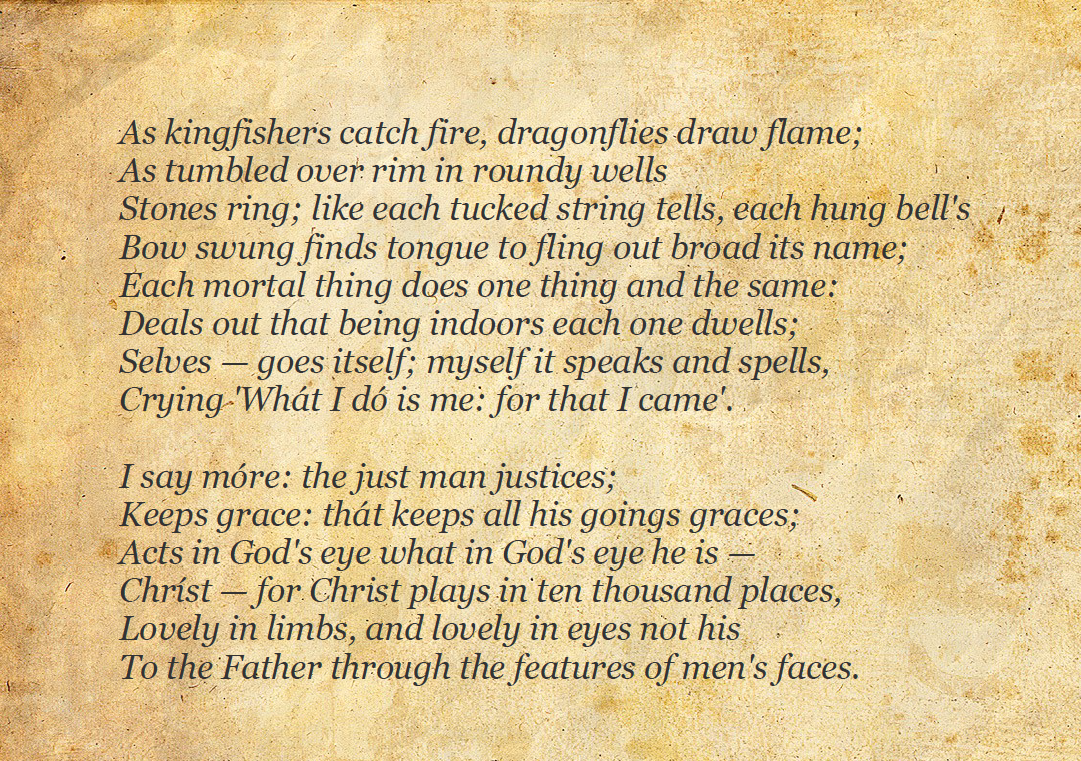
To close, a poem from Gerard Manley Hopkins, and from whence comes the title of a book by Eugene Petersen that I’ll be rereading this summer.

In pursuit of beauty

This is the 100th post on Broken Cameras & Gustav Klimt and I’m delighted that it’s the first ever guest post. And it’s a stunner from Sara Kewly Hyde. If you want to write a guest post please get in touch. 

What is beauty?

A philosophy? A physical attribute? Something that grows from the inside out? Does the way I choose to define beauty tell you about me, or more about the society I live in?

The ancient Greeks used it in the phrase kalos kai agathos (approximate transliteration), which literally meant beautiful and good/virtuous. But it was also used as a coverall term for the perfect and balanced gentleman. We used to write it in cards to each other in sixth form as a compliment “Carry on being your kalos kai agathos self, I love you” (I then failed the Ancient Greek exam).

The Bible uses the term both to describe physical beauty like Queen Esther’s, and also to point to something much deeper in a verse like Psalm 27:4 “One thing I ask of the Lord… to gaze on the beauty of the Lord and seek him in his temple.” Although the use of the word “gaze”, may still point to something observable.

For my new year’s resolution, I thought that for every penny I spent on my outward appearance, I’d give the same to charity. And in so doing I’d understand more tangibly how much I throw my resources after the pursuit of the external.

I haven’t done it, I was too lazy, too scared. How do I perceive beauty? Is it about my desire to look like Jessie J? Or is it about small moments of kindness, a smile from my baby niece – interactions that make my heart cry out that was just beautiful?

So I believe beauty can be a heart attitude, but I’m going to focus more on the physical, on the external, on the industry. I am a slave to the beauty industry, to 21st century consumerist capitalism. We cannot divorce the ideal of beauty that constantly surrounds us, telling us how to be a woman, how to be human and the huge market forces behind it. I see an image in an advert of a woman. I compare myself to that. I find myself hideously lacking. I spend lots of time thinking about how I could look more like that. I start to turn the thought in to action and buying products and clothes to make me more like that.

More acceptable aesthetically. More likely to succeed. This works for me, I feel momentarily better, I feel more attractive because I am a millimetre closer to her “perfection”. Rinse, repeat. Each image I see feeds my insecurity that I am not physically up to scratch, each product I buy tells me I can fix it with an item acquired by financial transaction and then the bar is raised higher the next time. I know what the ideal is, an ideal that I’d need to be an anorexic with a boob job and permanent real-time air-brushing to achieve. Good-o. The beauty industry laughs all the way to the bank, while we’re left trying to force our bodies to conform to the market’s latest aesthetic ideals and grappling with even bigger insecurities.

Who cares? Why does this matter? We need to ask who is setting the beauty agenda. Who gets to say what is beautiful? We need to wonder why only one kind of aesthetic rules. We need to think about how this impacts upon our treatment of those who lack representation in the “ideal”, the disabled, the disfigured, those unable to afford the right clothes or products to reach the beauty bar. It becomes a discriminatory issue. Getting caught up in a paradigm that privileges the visual, turns women into sexualised objects whose value is solely contingent on their appearance and denigrates many other types of beauty, is a dangerous one-way street to misery. We will never be good enough. Women will punish their bodies in to further conformity. Men will measure women more against the model standards. Our humanity, our capacity to interact, to love and be loved is reduced by the fantasy world projected all around us. We try, we succeed, we fail, we learn. But in a world of perfection, where is the room for failure? For humility? For recognising our brokenness and need of each other?

I say I only want to be a slave to Christ, to righteousness, but if that is true, why do I shave my armpits, worry that my grey hair will render me undateable and my large pores be the death of me? I know too well the verses about God looking on the heart and not on the external and I’m glad about that, but what about my potential partner? How can I focus on developing what’s on the inside when if I went to work in the same clothes every day for a week and no make-up, HR might pull me in to have a word?

We need to be honest about the impact that our visual culture has on our faith. I love the Message translation of Romans 12: 2, it is a constant reminder to be aware of my context at this point in space and time “Do not become so well adjusted to your culture that you fit into it without even thinking”.

What happens when the church pursues the beauty myth? We get our priorities wrong in what we are for and who we welcome most.

We spend too much money on assuaging our insecurities when we could be more generous to those who really need it. People get lonelier and we are alienated from our humanity. We need to reclaim beauty, to wrest it from the oppressors and celebrate the beauty in the small, the everyday, in every one who is made in the image of God. I’m still learning how and I’m getting it wrong, but I have to try because Jesus came to set us free.

Sara Kewly Hyde is a theatre maker and thinker who works with women in the Criminal Justice System. Follow Sara on twitter or find out more at www.kewly.org

Beliefs that dare not speak their name

I’ve hesitated long and hard about whether to say anything about the debate over gay marriage and the government’s proposals. I’ve held back for a couple of reasons. My work has a view on this. And it seems impossible to say anything that casts doubt on the validity of allowing gay couples to marry without being denounced as a homophobe and a bigot.

Because I don’t think that the plans are a good idea. And that probably makes me unpopular, both with those outside and some inside the church.

Today on twitter I’ve observed a lot of people despairing at the Church of England’s response to the consultation in which they urge the government to rethink changing marriage in the way that is proposed.

Because that is what the government are planning on doing. Whether you support the proposals or not, if these plans are implemented marriage will be different in a couple of years time to what it is now.

I want to make a few scattered comments about this whole escapade. I want to do so in the carefullest possible way as this is a subject that is not detached from people’s individual lives, emotions and identity. Maybe it would help by pulling out some of the slightly spurious points often made against those who would prefer that marriage remained as between a man and a woman.

I believe that there are ways to live that are better than other ways to live. And I know that this means that for some people it will seem as though I’m criticising the way that they choose to live. But I think that sexual relationship should only take place between men and women, and between one of each in the context of marriage. And marriage matters because it is placing the union between two people before God and under his authority. It is about submitting not only to each other but principally to God.

And as far as I can see that means we must do our best to live lives that honour God. Even if that means doing things we find hard, and not doing things which otherwise we may choose to do. For devout Christians who experience same sex attraction may well choose to put their belief in and devotion to God before that, and choose to live another way. This is not something I pretend to understand. It is not something that I pretend is easy. It is not something that I would pretend is not counter to the way that the world would choose to order things.

But as Peter Ould tweeted earlier today, “The moment you argue that Church should ‘catch up with society’ you demonstrate your theology is of man and not God”. Because while the church has so often got so many things so very wrong, and in it’s dealing with gay and lesbian people at times its actions have been horrific, that does not mean it should adjust its view because something is deemed out of fashion, or even intolerant.

The church is accused of inconsistency, and it has so often been guilty of that, but that’s not a reason to drop all of the values it holds to and rush towards a lowest common denominator that does its best to keep everyone onside. The church is told to not think that something is wrong, all the while told to stand stronger against other things that are wrong. Told to worry more about poverty and the injustices of the world because holding a view on sexuality will make people think the church is out of touch. It’s curious that at a time when morality is coming back into vogue, when questions are being asked about the value of money in our lives, or the isolation created by ongoing technological  advancement, the church is told to pipe down.

Many have commented today that the church accepts divorce but opposes gay marriage. Often that’s the case. Divorce isn’t what God wants, but sometimes it’s the best way out of difficult circumstances. Confusing? Yes, but often handling the tensions in the way that we live will look like that. God is redemptive, and although marriages should stay together many will not. So there is hope in the hardest of situations, which is why divorce should be allowed. To introduce gay marriage is to create something new, and in doing so change something old.

And then there is the West Wing argument. About shellfish and mixed fabrics. It’s a neat little charge but it misses any attempt to understand the purposes of different Old Testament laws. This isn’t the place but I think a decent case can be made for those laws to keep people clean before a holy God and therefore not needed since Jesus’ death and resurrection have made us all clean; those laws given to aid the governance of Israel (many of which we can learn from without direct application), and those laws which give us moral guidance on how best to live.

The particular proposals that the government make suggest that a distinction can be made between civil and religious marriage. That’s nonsense, there are civil and religious weddings but they are just two different doors to the same room.

The proposals also allude to the fact that some people are banned from marriage, that’s just not true, anyone can get married, but only to someone of the opposite sex. Trying to allow gay couples to marry is trying to make marriage into something that it simply is not. On one level marriage will always be marriage, and nothing that the government says will change that. It’s like trying to suggest that the government should pass a law allowing two floor bungalows to be built.

A big part of me wants to stay quite about this debate. I want to shut up. Turn off my computer, deactivate twitter for a while and stay away while the government push their case, opponents dismiss it and are subsequently tarred and feather in their virtual stocks.

But that’s actually what makes me speak up and say my piece because I shouldn’t be shamed into silence. It is what worries me most if these proposals go through: that I won’t be able to hold, and promote, a view that marriage is and should be between a man and a woman. I’m not expecting every one to agree with me, much as I don’t expect everyone to agree with many of the things that I believe. When they do perhaps I’m a little too closely following the crowd.

Do I think that the world will collapse if gay marriage is constructed ex nihilo within the legal system? I don’t. Do I think that sometimes Christians have used language in their opposition that has made the charge of bigot stick a little easier? Yes.

But I don’t think that the church, and other opponents, should stay quiet when the government are introducing something which isn’t in keeping with what they believe is best for the world around them. And a world in which Christians are committed to making God’s kingdom come. That means fighting poverty and promoting relationships that reflect God’s desire. It means speaking truth in a way that people see God’s love and truth in the content of what you say and in the heart that lies behind it.

And this is not easy. And I’ve not really dealt with many of the issues in play but this is already plenty long enough.

More information about this topic and a briefing on the Evangelical Alliance’s position can be found here. And you can respond to the consultation here.

What do you think, do you think Christians should back gay marriage? Should they stay quiet about their views? Or loudly make their opposition know?

Freedom and consequence

What if you got everything you wanted? What if you were able to do all the things that you wanted to do? What if barriers were erased, consequences dismissed, costs discounted?

What would you do? What does it mean to be free?

I don’t think I want a world without consequences. I want what I do to have an effect, I want it to affect me, and to affect other people.

Trying to live in a world without barriers is a quest for the impossible. It is also a depressing endeavour. It suggests that we live in this atomised world that can only ever be a figment of our delusions. It would be a lonely life: I think it would be a life without much purpose. Because we live interlinked lives.

Andy Crouch writes in his book Culture Making about how the things that we do, the things that we create, change the horizon of the possible. By doing something we make certain things possible, but we also make other things near enough impossible. He uses the example of highways across the USA, they make travelling vast distances far easier, but they made travel by horse and carriage much harder.

Likewise, when I do something it has consequences, it changes things.

So when we try and live without consequences, when we try and make the most of this thing call freedom by throwing off restraints and doing whatever the heck pleases us in that moment we are caught in an infinite loop of impossibility. The things that we think will deliver the ultimate satisfaction in the end leaves us cold. They leave us in a lonely place because they have failed to deliver what they never had the power to provide.

Because with freedom comes consequences, and with consequences come responsibility. So we step back and we wait a moment before we embrace freedom for its own sake, or our own sake.

I write a lot for work, but when I write for work I write within certain parameters which restrict what I say and how I say it. In theory, when I write on this blog I can write about whatever I choose to, in whatever way I want. Except when I write something it has consequences. I could espouse views that would put my job on the line, even if I hid behind the ‘it’s a personal blog’ refrain. I could write in a way that would discredit my role or my employer, I could offend people I regularly work with. I have freedom to write what I like, but there are many things that would restrict my freedom were I to exercise said freedom in a careless way.

That doesn’t mean that I won’t write on controversial topics, or occasionally in a way that seeks to provoke a response. But what I choose to write about has consequences. When I write about dating and relationships, it changes the potentiality of any prospective relationships. I chose to say I disagree with Christian political parties, and maybe did so in an intemperate way, that has consequences.

Many of the best examples and stories come from those I am closest to, from my family and my friends. But if I were to write about these situations I would affect, and potentially damage my relationship with them. I had a couple of great examples I could have used in my previous post about women in church leadership, but they weren’t my stories, and it wasn’t my place to make them public.

A couple of weeks back I wrote about modesty with a few scattered thoughts about the challenges that guys, and girls, face in a world where sexuality is thrown around with abandon. And this question of freedom and responsibility is at the core of what we were talking about then. For girls who economise on the clothes they wear, there are consequences of that choice.

Here I’m making a slightly different point than I did in that previous post, and I’m very cautious about my choice of words. But guys will look at girls who are attractive and wearing clothes that make the most of that, and while this probably shouldn’t be the case, and it’s not necessarily the responsibility of the girl for what the guys look at, it is a consequence of that choice. So without excusing in any shape or form the leering looks or crude remarks guys might make, they are not detached from the choice that the girl has made in exercising her freedom to wear what she wants.

As I write this I’m conscious that I am exercising my freedom to write about a topic that I choose. And there may be consequences of that choice. Girls may think that I’m being a prude, encouraging them to cover up and spare a thought for the poor guys struggling with their beauty. While I’m content saying that there are consequences of the choice to wear certain clothes, I am far less confident to ascribe responsibility to the girl for the actions, because the way that guys respond is their responsibility, but that doesn’t mean it is unaffected by the choices that the girl has taken.

And the guys who look at the girls sunbathing on the grass? Well those looks have consequences too. It’s easy to think that a cheeky glance at the exposed skin on offer affects no one. But each time that you look, each time lust is stirred, each time you allow beauty to be read through a lens of sex you distort the way that you view women. And a counter intuitive consequence within the church is to adopt this mentality and to minimise an appreciation of beauty because we associate it with sex and with lust. So even in our mental thought processes about who we might be attracted to we view physical attraction as somehow wrong, and therefore look for more holy motives as ostensible reasons to justify our attraction.

Last night I read a fascinating first person piece in the Daily Mail (not a usual occurrence) from the former editor of Loaded magazine. After eight years dedicating his life to putting more bare breasts on pages than the competition he stepped away from that world, partly spurred by the birth of his son. He realised the consequences and ludicrous nature of what he had spent so much time and earned so much money doing.

When guys look at porn it doesn’t leave you unchanged. It affects the way that you look at women, it affects your expectation of relationships, it contorts and distorts the view of sex. And it makes you think you can have what you want without any of the baggage that comes with it. It promotes the idea of unattached satisfaction by pretending that is what it is providing. That it’s just you and your computer.

What a lie.

We live in an age with unprecedented freedom and an unenviable lack of accountability. I can do things if I want to and no one needs to know about them. But that doesn’t mean I should. And if I choose to use my freedom in ways that serve myself I shouldn’t be surprised to find that my freedom in fact becomes circumscribed. If my horizon of the possible suddenly becomes smaller.

What do you think? Share your thoughts, how do consequences affect how you act?