Fake it until you make it

Two types of posts get read a lot on this blog. Those about relationships and those addressing current political or church issues. So when I write about dating or singleness or Mark Driscoll or women bishops my stats page is suitably satisfied. When on the other hand I take a more rambling approach to writing, the readers do not come flocking. I suspect this is one of the latter.

It is also probably worth explaining at this point what happened to the endeavour I had provisionally titled ‘The centaur and the heir’. It was my attempt to write a novel in 30 days, 50 000 words from scratch onto the keys and into some semblance of a novel. I could try and sugar coat it and put it in diplomatic fashion but basically I failed. After ten days I was a few thousand words behind schedule and with a mostly free Sunday ahead of me I could have spent all my free time writing and given myself a boost. I had also rather shamefully posted the first two chapters of the work so instead of clarifying my abandonment I slipped quietly into the night. I decided I had other things I wished to do with my time. I took the choice to fail. It’s not often we make a choice so consciously as that, but I realised that while I was deciding to fail, I was still not entirely sure what is was I was failing at.

My novel would never have been published, not even in my most remote and wildest dreams. It was a work of fan fiction, an effort to hark back to the Chronicles of Narnia and explore what became of Susan Pevensie after her family’s death. I had lost the plot quite literally, I had no idea where it would go next, a vague concept I wanted to pull through the whole story but the characters were weak and they asserted no direction on the page. I had a handful of readers who had taken in the first two sections, but their engagement was not enough to keep me going. Nor was the brute stubbornness that had propelled me through the same endeavour last year enough. I had proved I could do it, proved I could write an inordinate number of words that made very little sense, read by even fewer and done so at a particularly busy period of work.

I simply had no reason to go on writing.

And sometimes that can be a lesson we face in so many parts of life. We want something to whisk us up and propel us forward. We want the glorious crusade, the righteous campaign, the infusion of meaning into a life otherwise droll and predictable. We don’t want to just carry on because we think we ought to carry on.

Sometimes in church life it can feel like a massive effort to keep with the programme, to show that you are on the same page as everyone else. Sometimes it can be a spiritual equivalent of keeping up with the Jones. We want to be as mature as everyone else, we want to have the same experience as everyone else. When we see others having prayers answered we wonder why ours are going unmet.

I see the doubt in my own mind and think others are plagued by the same lingering thoughts. But there is one particular doubt I want to zero in on. I doubt that there is purpose and meaning behind what I am doing. In the world in which I spend most of my time much is made of calling and vocation: of what you are doing with your life to serve God. And I feel I have none. I can scrabble around and cobble together something approaching a spiritual sounding narrative, but it is really little more than a projection of where I have come from and where I am currently at. It is all I have.

I hear exhortations to have plans and goals, and strategies, ideas of where you want to be in ten years time – and this is in church not a job interview. I hear the calls for a vision of what your sphere could look like if the kingdom of God was to break in. Except I don’t know what my sphere is and I don’t have a vision of what it might look like.

I sometimes think, if only I had something to commit myself to, a passion to throw my weight behind, a mission to get lost in, a conviction that it is this (whatever this might be) to which I am to spend myself. But I don’t and therefore I leave myself with two options. Well three if I include giving up. But unlike writing a novel in a month this isn’t something I want to pack in. At least, I hope not. So my options are either to fake it until I make it, to conjure some vision out of thin air, construct it on the back of what I do and what others might expect me to be passionate about. Or alternatively to get back to basics.

When I put it like that it seems like a no brainer, of course the basics should win over being a fraud, but I’m not so sure it’s that simple. Maybe part of the going back to basics is doing what I am doing right now as well as I possibly can. Going back to basics means not over complicating life. It means not looking for something that isn’t there. It also means stripping out the extraneous elements that combine together to create a noise through which we cannot hear the movements and melodies that lie behind our lives.

It means for me I need to stop worrying about not having a ten year plan. It means not being ashamed by what I am doing or not doing. Rescinding the relentless rhetoric towards bigger and better, onwards and upwards, letting go of the need for validity and worth in what I am doing or where I am going. There is a lot that I can do, or stop doing.

And I want that to be the focus of my attention, but there’s also a slight critique I want to make of the language, tone and rhetoric used in churches. I get the desire to cast vision, to get people caught up in where you are going, to inspire them to hear their own call. But does it run the risk of encouraging people to fake it until they make it? They see something that looks good so present themselves in a spiritual light and hang a personal vision off that prefabricated script? Does it lead to a conformity with the corporate vision by accident rather than design? Does it stifle innovation while actually seeking to unleash it? I don’t know. But I’ve felt the pressure to conform, and to find something which I do not at the moment have.

It’s a concern I have with all areas of the Christian life, if we place the expected and modelled level of behaviour high without an equivalent modelling of grace, we run the risk of encouraging a fraudulent faith because the fear of not performing up to the expected standard becomes too strong. And when faith comes down to performance it may be time to bring the curtain down, send home the cast and rewrite the script.

I don’t want to glorify messing things up or not having a clue. I don’t want to privilege doubt over faith. But I want to be honest that all these struggles exist and not present too perfect a picture.


Kyrie, eleison – Lord, have mercy

It is times like these that I wish writing could soothe all the sores that the world bears. Maybe if I could whip up a big enough batch of chocolate brownies then perhaps everything would be all right.

But I can’t, and as much as I wish it could I don’t think it would be enough.

The past couple of days have been too much, every where I turn I see conflict. I see violence and I see mendacity. The latest escalation of violence between Israel and Palestine has spurned another, more immediate incantation of dispute. One that is closer to me, one that draws me in, and one that makes me angry.

And that’s just twitter.

I’ve watched as a few incredibly passionate advocates voice adamant opinions and trade blows by virtue of asserted evidence, disputed claims and the occasional theological aside. That last one as a casual attempt to shut down conversation and prove their point beyond doubt.

And I have nothing to say. A couple of times today I hovered over the unfollow button ready to rid my timeline of their debate. I got even closer to pleading with them to give it a rest, but realised I’d end up drawn into a stream of replies I had neither the time nor inclination to engage in. It’s not that I don’t care, just that I don’t understand, and in that space of incomprehension the vitriol emitted from both sides of the debate pushes me towards a default position of ignorance informed only for a desire for reconciliation.

It places me in the naïve position of calling for an acknowledgement of the wrongs of both sides, it pushes me to call for both sides to cease the fighting. It almost takes me into the realm of Ellie Bartlett’s teacher who in the West Wing responded to her analysis of the problems of the Middle East with the retort “Wrong, it’s because it’s incredibly hot. And there’s no water.”

I am sure that I should be more informed, I am certain I am in no place to enter into the arguments of the rights and wrongs of decades of conflict based on millennia of history. But that doesn’t mean my basic plea lacks validity. There should be less killing.

I can go on quoting the West Wing, when challenged by Governor Richie in the debate President Bartlett says: “every once in a while, every once in a while, there’s a day with an absolute right and an absolute wrong, but those days almost always include body counts.” The problem comes when even on those days littered with body bags we can’t tell the right from the wrong.

What struck me as I observed the feuding played out in spurts of 140 characters, with vehement defence that each side’s calls for peace had more morality than the other, was: we can’t even keep peace in our discussions. What hope is there that there could be peace between the sides (even how they are described is disputed) in that hot, dry, place with centuries of animosity?

But of course there is a hope. There is a hope that in our most wicked and mendacious of ways, whether firing a rocket or a tweet filled with anger; we can cry Kyrie, eleison: Lord, have mercy.

And he will. For he must. Because he loves the world. And we long for that day.

That’s all I have right now. I have no judgement to offer. No words that will soothe, no mediation, no alternative perspective, no baked goods to dull the pain. Just a hope. The only hope.

The first shall be last and the last shall be first

Today the next Archbishop of Canterbury was announced. In the New Year Justin Welby will leave his current post as Bishop of Durham and move south to take over from Rowan Williams as head of the Church of England and worldwide Anglican Communion. This is a big deal, it will matter a lot in the coming years who takes this role. And it seems to me they’ve chosen a good man, he cited the West Wing in the press conference after the appointment was officially made public, so that bodes well.

But that’s not what I’m writing about, I’ve already done so elsewhere, I did that yesterday afternoon. More I wanted to think about the mass of press releases and quotes that were bombarded at journalists and the twittering public at the strike of eleven this morning. Press officers furiously overriding their scheduled auto send or publish as Downing Street tweeted the official version of events ten minutes early. I should know, I was one of them.

Because the announcement had been rumoured for several days, and more or less confirmed by Wednesday evening, it gave everyone plenty of time to check his biography, scour his prior public pronouncements, draft quotes and get it all lined up for the official announcement. So by the time he took to the lectern in the Guard Room at Lambeth Palace to speak to the assembled journalists and many more as the pictures were broadcast live, the quotes were winging their way to the news desks and editors. Ruth Dickinson from Christianity Magazine tweeted a photo of her inbox.

The contrast struck me as the questions came in and were answered by Justin Welby with humility and grace. That here was a man who seemed to barely seek the post he was now set to take, that such inclination against preferment was almost a pre-requisite for the role. But there were hundreds tweeting their comments and statements at breakneck pace to grab the attention of any journalist struggling to fill their copy. Which is unlikely.

I’ve no doubt the quotes and the calls for prayer are sincere. I am certain that all those sending out their congratulations and best wishes really do think exactly what they are saying, it’s not the content that I’m a bit perturbed by. It’s the rush for preferment in the pages of the press. The mentality that says, here on one of the very few days when the church gets to dominate the main stream press on an issue of its choosing and in a way it decides, we end up trying to jostle to the left or the right of the man to gain some reflected glory if only one of those writing the story for the nationals might choose to use our quote.

In my own complicity I realise this stinks.

We should pray for Justin Welby, I think he sounds a fantastic man for the job, I hope that those quoted by the press will call others to do likewise. I hope that we will get behind a man taking on a position few would choose to carry, and if they did are likely unsuited for its burdens. I hope that he gets our support and our encouragement and not just as a way to segue into calling him to support our causes and views however noble they maybe.

There’s no place like home

Dorothy tapped her red shoes, said it over and over again, and found her way back to Kansas.

At about 2.30pm on Friday I walked into a small office, I gave my name and new address and walked out with a bundle of keys. I could have been anyone. I didn’t tap my red shoes, they were brown and lacking in glitter. I also didn’t chant ‘There’s no place like home’.

Earlier in the day I had whisked the sheets off my single bed and wondered whether this would ever happen again with any regularity. I’ve been told that once you get a double bed there is no going back. I had noticed my bank accounts were supplemented by a new account that morning, abundant not in the resources it contained but in the debt it recalled.

It suddenly became very real. I felt as though there ought to be some great solemnity to my actions as I turned the key, entered the block and juggled my way through various keys to reach the space that is now my own in a more tangible sense than ever before. I spent that first night in a sleeping bag having carried a few essentials on the bus, my excuse was the delivery men expected any time from 7am the next day. The truth: there was no way I was not staying here – even the prospect of going away for a few days next week seems slightly weird.

For the past few months this process has absorbed me, and if you follow me on twitter then you’ll have picked up on that too. I hear from my Mum (not on twitter) of conversations she has with those well acquainted with my movements documented in 140 character exerts. When I start instagramming photos of my packing progress I know things have gone too far. For weeks and months I have had room for precious little but mortgage applications, survey reports, property information forms, planning permission and elusive asbestos reports. When I realised I was reading documents my solicitor was not I perhaps should have taken the hint.

I think I have got lost in the process to dull the effect of what the move means.

I may have been in my old house longer than people stay in bought properties but it was always with the potentiality of leaving at short notice. I could wake up one day and in a month be in Australia having left my job, my house and with no one else holding me to the place I currently call home. But home just became a little less flexible.

It’s one of the reasons why I hesitated before jumping in, I like flexibility, I like being able to change plans without consultation or consequence. In short I like independence.

But in every act of chosen constraint is a new freedom. There are things that I am now less able to do, but others that become far more achievable. I have a home where I can welcome guests more readily; I can indulge my book loving, cookware hoarding, habits. To borrow the phrase of Andy Crouch, the horizons of the possible have now shifted.

It means I commit to being in a place I wondered if I would ever call home. But in that commitment, and as a direct result of that choice, I am more able to make home a reality. I first wrote ‘feel like home’, but then I stopped, paused, deleted, and realised the internalisations of the very habit I am wrestling with: to think of home as something other, something more achieved, settled, and perfect. So it is not about feeling like home, it is about making home happen. It is about choosing that this is the place I am.

Boundaries between adolescence and adulthood are far more permeable than before, moving out later, getting married a little older, waiting to have kids, it all pushes the threshold into realms less perceptible or shared. For many marriage is the great threshold when you relinquish a life you had and commit to something new and something shared. But I am not married, it is conceivable I never will be, so I can not pretend life waits for me to resolve my insecurities.

My bookshelves are up, books categorised and alphabetised, boxes of assorted tat I couldn’t bring myself to part with still await sorting and refining. Under my desk sits a box of CDs without a home, although I dutifully placed my CD player on the shelf and attached the wires it rarely spins the disks. Because times are different and habits change. The normality of one form of life gives way to another.

And in the transition between rooms that feel foreign to realising they are home, the temptation to say ‘mine’ stilled by the voice that says ‘ours’.

Why I didn’t blog this morning

I was fuming. I read the words and they just got worse. My temper rose and my brain started to whir.

I was plotting what I would write, the words that would critique the post that had got me riled. I was imagining my acerbic wit weaving its way across the page. How I would make my point in such destructively understated prose. I plotted the layers I would sequence to use words to make one point directly and another more subtly in line with others across the arc of my writing.

I was angry. Someone had said something I didn’t feel should be left unquestioned. But my motives were less pure. My mental scheming stopped dead with a tweet that pulled me from my fanciful flight of blogging heroism.

I was not being civil. I was ready for war. Funny things these internal squabbles, inside the body of Christ when we tear each other limb from limb to make our point. Civil wars are anything but civil. I’ve done it before and it left me cold. My stats may have gone through the roof for a day or so. I may have won plaudits for the way in which I took down someone who said something I disagreed with, and moreover slighted many others not including myself.

I was right. I was sure I was right then, and I was sure I was last night. When Mark Driscoll made comments about British preachers I thought I would come to their defence. And last night I thought I’d come to the defence of another maligned group damned with the faintest of praise from one of my more conservative brethren. I tweeted my horror, just moments before Preston Yancey tweeted his call for civility. It could have been straight to me. I do not know whether it was about the same fracas but the words struck home.

Being right wasn’t what mattered.

I paused. I reflected on the days that followed my post about Mark Driscoll. I thought about the debates that ensued in the comments, on facebook and twitter. I remember hovering several times over the delete button in the back end of the blog. For all that I liked what I had written I did not like the way it was being received or how it reflected on me. I was ready for the whole piece to be consigned to the dustbin of internecine blogging. And I reflected again on the amount of search referrals I’ve had this week after blogging about Vaughan Roberts and his interview about same sex attraction.

I am not responsible for what people search to find what I write, but I am responsible for what they find and read. For quite a while my response to Mark Driscoll was my most read post (now superseded by Jennie Pollock’s guest post). If I had written in anger this morning, if I had offered a redoubtable defence of my case, I may have received acclamations for bravely saying something others were thinking. I may have got a boost to my statistics after a quiet summer. But I would be offering a tone of debate and discussion I could not defend.

I would be writing for the attention it would receive. I would not be building bridges or helping unite a frequently factious church. What I would write would be for my benefit and not anyone else’s.

People who know me will know what I would have said. And those who don’t but read these words, well I’m afraid I’m leaving it there. I’m determined not to become a landing page for those looking to pick fights between sections of the church. I’m not going to slag off this individual, and I shall do my best not do so to any other. I’ll engage in debate and discussion, I’ll write about what I agree with and disagree with. I think difference is healthy and the church should foster a culture where we can speak of our difference in a civil manner and not hurl threats of excommunication if you don’t tow the party line.

But body blows are too far. Personal attacks are not needed. I want people to read what I write, but not at the expense of pulling someone else down. Scoring cheap points is a pastime I can live without. I guess this is a mantra. Or a positive revolution as suggested elsewhere. Let’s be civil. Let’s make civility fashionable.

And let’s make each other pie as frequently as possible.

Godbaby controversy

20120930-124138.jpg
A few weeks ago the Church Ads group released their plans for their annual advertising campaign which continues the theme ‘Christmas starts with Christ’. The whole point is to encourage the public to think about Christ amid the festivities, presents, mince pies and mulled wine.

The adverts tend to be arresting and they tend to be controversial and this year’s is no different with the BBC and the Daily Mail reporting shock at this image of Jesus promoted by the church. Words like blasphemous and irreverent abound.

Firstly, the picture is a little freaky. It also doesn’t look particularly Middle-Eastern. Secondly the cries and wees slogan is a little base.

But while both these can count against it l, they also work in its favour. The image grabs your attention and the words remind you of the humanity of Jesus, of his incarnation – he was one of us.

The test will be whether it work, when on the billboards and bus stops it provokes conversation and gets people talking about Christ at a time when he is often neglected. I also think it provides a challenge to the church, do we like our god clean and sanitised? I don’t think it does what it is criticised of doing – making Jesus a laughing stock or reinforcing the idea that he’s not real, just a toy good for a bit of diversion.

One final thing that’s of interest: yesterday afternoon I got a call from the BBC looking for someone from the Evangelical Alliance to go on this morning’s breakfast show to talk about the adverts, and they expected we’d be speaking against the ads. They certainly divide opinion and we’ve had lively discussions in the office, but I found it slightly disconcerting that the evangelicals were the go to people for a voice ‘against’ something.

Update
Simon Jenkins gives his defence of the advert.

And the Beaker Folk point out why it might not work.

Bishop of Bradford Nick Baines explains his not quite so enthusiastic support for the ad.

Here’s the slightly less provocative version of the ad

The faded certainty of attraction

I thought that I would know. I thought that the moment the right person walked into my life all would become clear. Sirens would scream, lights would flare, passions would ignite and all doubt would be banished.

I thought that one day I’d be mature enough to move past the waves of attraction that fade in and out like the intermittent reception on the battered transistor radio placed between the paint and tins of nails in the garden shed. I hope in some recess of my mind that certainty is still only the right person away. But that hope recedes into the realms of fantasy.

Because what I learn each moment that I pass through life is that affection and attraction are fickle friends. And knowledge and certainty are elusive ideas that once found only present more dilemmas. Following yesterday’s post on Vaughan Roberts’ interview, I thought I’d ponder a little more. This is a tad more theological that I originally intended, maybe all a smokescreen to protect my fragile emotional state!

In response I, and you, and anyone else, could take either of two divergent paths. Either we see the doubt that lies before us and turn and run away. We could opt for what we know, what is safe and what is comfortable. In the most relativistic sense we rely on where we are to authenticate our ability to decide truth. We either allow comfort to lead to inertia or dissatisfaction to prompt change.

The second option is to live in the light of what Francis Spufford in his new book apparently labels with the acronym HPtFtU. I haven’t read the book – it’s on my ever expanding list – and for the sake of modesty I won’t unravel the abbreviation, but it’s what we in more biblically literate times might label as sin. Stuff goes wrong, and we do not see clearly how things can work themselves out. We live in chaos and confusion, and in the most enlightened of moments only have hazy clarity and even then we might be kidding ourselves.

So the gaze of attraction I cast toward a lady in my midst might be motivated by lust, or it might be the beginning of a love that she is due. And in most cases it is probably a little bit of both. Because even if I get married I will not be free from lust – I’m told that enough by my married friends – I will at times lust after my wife, and other women I encounter.

But all this talk of lust scares me off. It makes me worry that any attraction is motivated by my nefarious desires. Somehow this needs to be redeemed. Beauty is not bad, attraction is not bad.

Beauty must be appreciated for what it represents. It represents God’s creation and his love for us. It is not just the physical but it is the physical. We are not to get so spiritual that we deny what is literally right in front of us. Something I have to repeatedly remind myself is that finding someone attractive is not a bad thing.

It leaves me embracing uncertainty, and learning that as much as I might like things ordered and classified, colour coded and project managed, that’s not the way life works. There is ambiguity around every corner, there is discernment over what needs discernment and what needs a shunt of courage to spur us to take risks when we will never know all we wish we did.

Doubt lurks around every corner waiting to cripple me and hold me back. Whether it is my worth, my value to others, my abilities, or the prospects of love, doubt undermines your security and tries to tell you your identity is in whether you overcome these frailties, and if you don’t then your identity is as a failure.

But doubt is the door through which redemption arrives. We learn that we cannot do it on our own, we are weak and we are frail, and we are broken and lost, and these will not be cast aside any time soon. But when we learn that we cannot overcome all that might try to drag us down we look up. We see that in the mystery and confusion, and the uncertainty and unsettled resolve there is a place we can be secure. And from the place of security we can go on adventures unshackled by doubts and fears.

Appropriate attraction

Vaughan Roberts has won plaudits for the incredible honesty and bravery he has shown in his interview with Evangelicals Now. Those I share and add to: I think the words of a man highly respected for his commitment to biblical truth and Christian ministry describing his struggle with same sex attraction could potentially be a game changing moment for the way such issues are understood and handled in the church.

What Vaughan Roberts says, and the way that he says it, is a mark of maturity. It has and will continue to attract attention because of the subject matter and the highly volatile current political debates around same sex marriage. I encourage you to read the interview in full, but to summarise he outlines that while he has struggled with same sex attraction this has not diminished his commitment to living a life that upholds the orthodox Christian understanding of sex as reserved for a man and a wife. For him, this means he lives a celibate life.

Each of us have things in our life which pull us away from the type of life God would prefer us to lead. For each of us these are different in their specifics, but hallmarks ring loud and clear. Sexual attraction of one sort or another ranks high, as does a desire for power and authority, a propensity for self interest and greed dominates too many of our lives. We put ourselves above God and choose to let that which is not God take priority in the ordering of our lives.

In the interview Vaughan Roberts studiously avoids describing himself as gay, a demarcation that has already generated discussion. This is interesting because it raises the question for all of us of how we define ourselves and what identifies us from the crowd. I recall a quote which I’m failing to attribute, whoever it was he was asked whether he was homosexual or heterosexual, to which he responded neither. He said that he’s not attracted to men or women but to one woman, his wife.

What struck me as I pondered Vaughan Roberts’ words is that it’s not as simple as same sex attraction is something which we should flee from. I think there are good and bad forms of attraction, the good form, when we indulge it we are actually becoming more human in the giving of ourselves to another. But there are other forms of attraction that we choose to spurn because we believe them not to be in tune with a way of life that honours God.

The most refreshing part of the interview was the implicit acknowledgement, and if I am reading too much into it then I apologise, of the present continuous nature of his struggles. It’s something I’ve been toying with for a few months, how we handle the fact that we don’t just move past our struggles, that they often continue to walk with us. Roberts puts it like this:

While homosexual sin must always be resisted, the circumstances which often accompany same-sex attraction should be accepted as a context in which God can work. There is, without doubt, a difficult aspect to those circumstances, such as, for example, the frustration of not being able to experience the intimacy of a sexual relationship or a feeling of isolation because of the sense of being different.”

He goes on to say: “This perspective should transform how we view all the difficult circumstances in our lives. We’re not called to a super-positivity which denies the frustration and pain; nor are we to embrace a passivity which spurns any opportunity to change our situation. But we are to recognise the loving hand of God in all we experience and see it as an opportunity for service, growth and fruitfulness.”

Because we are not defined by whatever brokenness exists in our lives we are defined by who we are in Christ. Dallas Willard writes in similar terms about our lostness, not something that we resolve as soon as we trust in Christ but a path we will frequently find ourselves on once again.

In a bonus track on the new Mumford and Sons album they sing: “Wanting change but loving her just as she lies, it’s the burden of man who’s built his life on love.” I could take that as how God views us.

So to me. If the only appropriate attraction we are to indulge sexually is between a man and a wife where does that leave me, a single man attracted to women. I hope that for one of those I find my heart stirred towards, that might one day be what we are to each other. But for now I find myself attracted in different ways, at various times, in degrees of intensity to different women. And not all of that can be wholesome. Not least when confusingly they overlap.

There is a goodness in some of my attraction that needs to be discerned. There is prospect for an intimacy where that attraction will be fully indulged. But for now it is as much a temptress as a guide.

And then there is this other thing. The damage we do with only associating beauty with sexual intimacy. A friend recently suggested guys need to do a better job of complimenting girls for how they looked, regardless of whether they were interested in them. And in theory I agree. But first of all I might need to get better at doing it for girls who I am interested in.

Quarter life crisis – A reader writes

Following my posts last week around the ‘quarter life crisis’ a reader got in touch and has given me permission to share their story:

I once asked a young person how her week had gone.  She replied “Well my teacher told me off for talking but it wasn’t me that started it, it was the girl sitting in front.  And then I didn’t get picked for the hockey team. And I’m tired of going to places where I don’t know anybody and I don’t know what to talk to them about”.
In response I sent her a card not promising her that these things wouldn’t happen when she was a fully grown adult, but suggesting that it might become easier to deal with them.  Because, while we get older, the truth is that the challenges we face as angst ridden teenagers never really go away.  We start a new job and wonder how we will ever make friends and become comfortable there.  We are accused of things that aren’t our fault but have no way of defending ourselves.  We feel left out when we’re pretty sure our rightful place is on the inside.
But maybe life is just lurching from one age related crisis to the other.  In our early twenties we stand at what feels like the door to the world – study, travel, the promise of independence.  Idealistic and wide-eyed, life is to be lived to the full.  But the choices overwhelm us and fear can paralyse.
By our thirties we realise that we’re living with the consequences of those choices.  The person we really wish we had said yes to… or the dawning realisation that this was the person that we really should have said no to.  The treadmill of a career that once promised so much but delivers so little.  A niggling realisation that the black-and-white faith of our youth no longer has the answers to the various complicated shades of grey that life throws up – illness, redundancy, disappointment, regret.
Beyond thirties I can’t speak from personal experience but observation tells me this: each new decade brings with it new challenges, new places to go where we don’t know anybody and we don’t know what to day, new people to get on the wrong side of.  And although many have walked the path before us, we all have to make our own way through.
From the sidelines I’m watching my recently retired father find his place in a new and very different world.  News headlines are no longer the stuff of his in-tray; phone calls are more about DIY projects for his children and less about high profile decisions; emails more likely to offer the latest spam marketing deal than engage him in some complex policy discussion.
So what are we to do with the lives that stretch out before us, with another age-related crisis lying in wait just around the next corner?  There is a quote on the internet which suggests that the Chinese word for crisis has two characters. The first is “danger”.  The second?  “Opportunities”.
The message is simple.  Each crisis presents an opportunity to life live well, and to the full.  For followers of Jesus, by grace each crisis presents an opportunity for the choices of our younger selves to be redeemed.  He  really does make everything beautiful in His time.

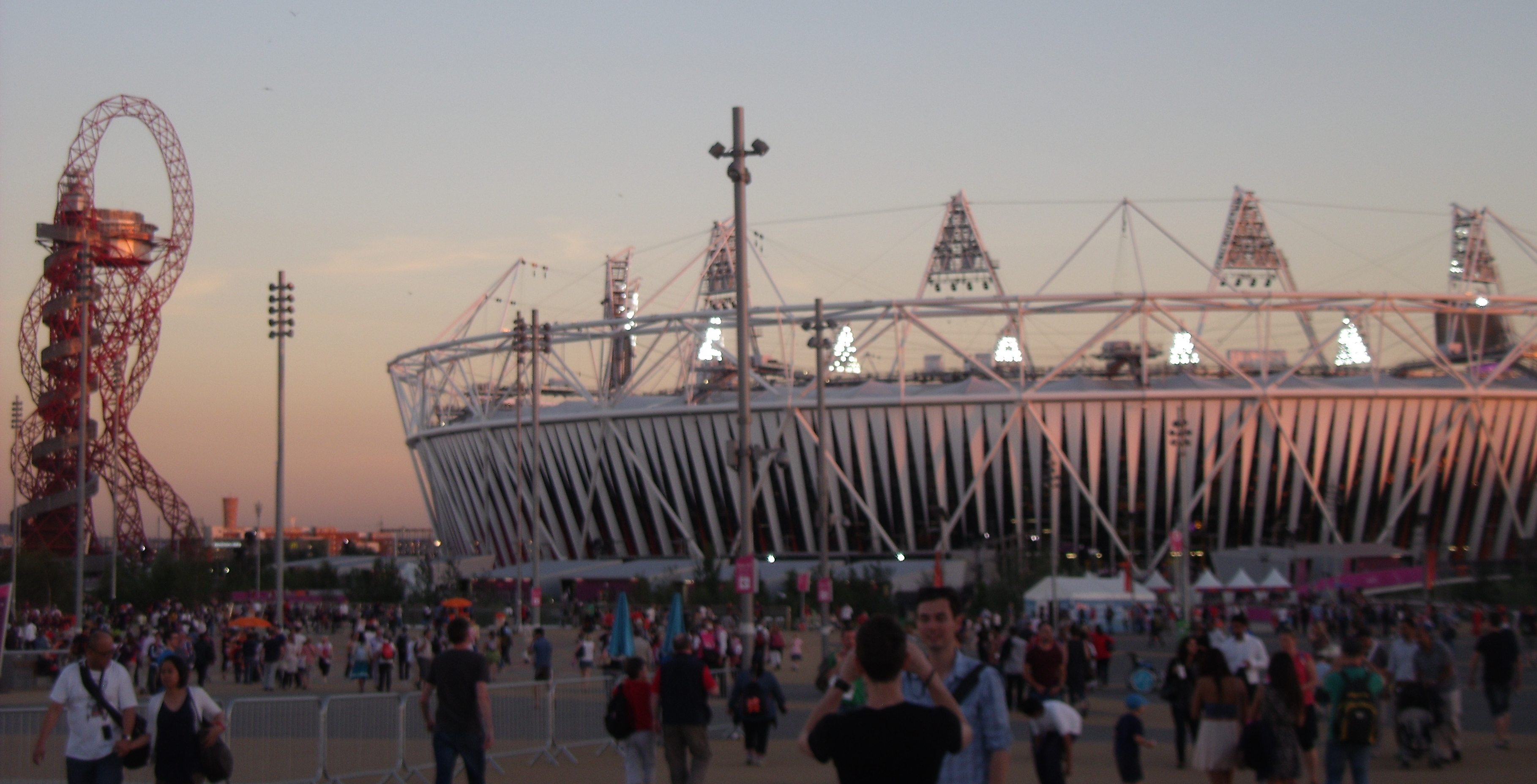
Britain sprints for the line

We did it.

Yes it was the athletes with their astonishing acts of human endeavour. It was the stories of triumph over adversity. It was the legion of volunteer Gamesmakers who sacrificed time to ensure everything ran smoothly. It was the staff, even the G4S security staff, and the armed forces who as so often stepped into the breach. It was the politicians who aimed high: Tony Blair, Ken Livingstone, Boris Johnson, Lord Coe. But it was also something more collective than all that.

We did it. Whether we were spectators in the park, or on our screens. Whether we shone with pride at the wraparound covers on each day’s Times newspaper, or nearly broke down in tears as the final act was played out last night. Great Briton dipped for the line and took the crown.

But it didn’t have to happen this way. There was no guarantee that putting thousands of elite athletes in a corner of East London would provoke such collective euphoria. We could have failed, we could have gambled high and became the laughing stock of the world. We could have been so overcome with cynicism that no matter the achievements on the track we would resent the imposition on our lives. The transport delays, the hiked up prices, the tourists crowding every corner of the place we call home. We even had a sitcom in Twenty Twelve to parody how it would turn out, ready to give us a reference point and a cultural validator when it failed to live up to the hype.

Danny Boyle’s opening ceremony got this perfect. Out of the chaos and melee of ideas, hopes and dreams, emerged something which summed us up. It was self-deprecating in its treatment of our tendency to self-deprecate. It was humble, cautious, loathe to make claims too lofty, reluctant to fuel hopes it could not fulfil.

It was at that point we came together for a summer we will never forget. As if in that moment the cloud of limitation was lifted off us all. Out of chaos came beauty. At the moment when it could have all fallen apart something incredible emerged.

The crowds roared for the favourites and new ones to took up residence in our hearts. On the eve of the Olympics Britain received the shot in its arm to spur us on. How dare Mitt Romney say that we were a little country that never achieved anything? In a master stroke no planner could have dreamt up the country came together.

And together we found our voice. We found who we are.

We did not look on others with envy, wishing the days of the Empire returned. We did not shrink in the shadow of China’s economic growth, America’s military might, or the coming carnival Rio 2016 will bring to the world. We learnt the best is not an imitation of another.

We shrugged off the challenges and sprinted for the line. Achievement can never be taken for granted, but nor is it ever out of reach. Britain learnt this summer that self-deprecation is no alternative to success. We may have a joke at our own expense to mask the fear that we might not make it.

But we made it. Britain, you did good. Very good.