Games of attraction

In the film ‘A Beautiful Mind’ Russell Crowe’s character applies game theory to asking girls out. He explains why it is the best bet to ask out the second best looking girls. Because the best girls will be swamped with offers: guys will be fighting between themselves for a precious commodity and this will leave the way clear for him to go for the next best option.

This all makes sense in a world where beauty and attraction are objective facts, and rational choice prevails. But that is rarely the world we live in. Instead we live in the midst of confusion and uncertainty, of stunning beauty and waning attraction. We are designed to love beauty, and it comes naturally to seek it out.

So just how much weight should be given to our physical attraction to someone?

It has been said that true beauty exists on the edge of chaos, where something magnificent emerges from something that so nearly doesn’t work. The solar system finely tuned to sustain life, works of art that bring together styles, materials and forms.

It was Gustav Klimt that got me thinking about this. As I looked at ‘The Kiss’ I tried to wonder why this was such a magnificent piece. It is one of his most famous, and from the case in which it was housed most expensive paintings. But it shouldn’t be any good, it does not provide a likeness, the colours are all wrong; I don’t even think it holds any deep symbolic value: yet somehow this chaotic collage of gold leaf, silver and oil creates something quite incredible.

Some time ago Portsmouth University advertised its courses with the slogan, ‘What Comes After The Internet?’ Unfortunately the answer does not lie in any of their courses; innovation cannot be taught, only inspired. Likewise beauty is not located on a map, there is no guidebook, no ‘x’ marks the spot. Beauty may be captured, but it cannot be controlled. Something that is truly brilliant and beautiful, that exists on the very brink of chaos, has an equilibrium, it is so finely tuned that the faintest shift can lead to disruption and failure.

So when I find a girl attractive, what cue should I take from it? Is it the indication of a deep soul connection, or a momentary infatuation?

That’s why attraction alone is never enough. Because beauty does not always win the day. The search for physical perfection leaves us hollow, it suggests that we can attain something which will not last. I have no idea who first said it but, ‘Real girls aren’t perfect and perfect girls aren’t real’.

It also lets lust win us over. If we are guided by what we find attractive we will find ourselves liking something new. Novelty too often attracts us. We grow bored by what we have and want something new. I remember hearing Pete Greig talk about materialism, and how in fact materialism as we understand it deeply rejects material goods, because it always wants to move onto the next thing. To really value something is to commit to it, to stay with it, and not be sidetracked when the big new thing comes along.

It is preposterous to think that if we are married we will never be attracted to another person. That doesn’t mean that the person is not beautiful, but this thought should change the way we respond to attraction.

So we should also be wary of our attraction if we are single. The options are more open, but if we are only ever guided by what we find beautiful we will be drawn in countless directions.

But physical attraction does play a role. I might like to think that I am only attracted to someone because of their godly character, virtuous actions or biblical wisdom. It might be more convenient to sideline my thoughts of who is good looking and who is not, and instead choose a girl based on more holy criteria.

Except, God created all of me. He created my emotions and my mind, he created my brain and my heart, he created my spirit and my body. The task is not to be ruled by our body, and this is not done by ignoring it. If we shut off our desires we are letting them win.

There’s one other interesting thing in play here: avoiding complementing someone on their looks because you don’t want to appear superficial, or just interested in them because of their physical attributes. But then what are we trying to achieve by side-lining these feelings? Are we trying to deny something that is intrinsic to who we are, or are we appropriately managing a desire within us that needs to be checked?

When love and life collide

Friends are the people we want to be around. But it is not always that easy, it’s not all about a smooth road which veers to our every whim. Because maybe, friendship is fundamentally about conflict.

I want to do something. Someone else wants to do something else. We search for harmony in our relationships, but the life we live pays testament that it is conflict and not harmony that usually wins the day.

It can be mundane, it can be trivial, it can be easy and it can be hard. It could be what to do with a final Saturday in the summer sun. Or maybe who we include in certain activities.

The practicalities will often be verbalised, the differences clear. But many of the areas of conflict will go unspoken, they will simmer under the surface. We will continue as though there is no disagreement, that everything is hunky dory.

But I am committed to getting through it. And I am determined to not let my tendency for isolation to let me flee from challenging situations.

I’ve been away with my friends a couple of times over the summer and each time the fun and harmony was sprinkled with a dose of conflict. And perhaps I was more to blame than most for the disruption. While I may not have handled the specific situations particularly well, they did cause me to think about how much space we allow for conflict in our friendships.

There’s a memorable line in the film “Good Will Hunting” when Sean is telling Will about his relationship with his wife: ‘The little idiosyncrasies that only I know about: that’s what made her my wife. Oh she had the goods on me too, she knew all about my little peccadilloes. People call these things imperfections, but they’re not. Ah, that’s the good stuff.’

We think that the best a relationship can be is one with complete harmony and an absence of problems. This simply misses the point. We live in a world where relationships are broken and we are fuelled by selfishness and greed. If our pursuit of relationships, both romantic and platonic does not take this into account we will end up both disappointed and spurred on to build a facade of perfection that does not exist.

Maybe because we have a certain intentionality in romantic relationships we accept the need to ‘get through conflict’, but even this misses the point that it is a never ending challenge. Things do not get better once you’ve argued and made up once. But in friendships there is rarely the acknowledgement of the need for hard graft.

It also seems a bit too eager, to go into a group of friends and start off the conversation. And you can come across as the fun police, especially if you want to say something unpopular. But sometimes these things need to be said, there needs to be room for the dissenting opinion to be voiced. Because it is just in the circumstances that it is not given space that peer pressure takes its toll. When other people are doing something or saying something and you just go along for the ride.

There’s two different categories of conflict here, there are those which are based on subjective preferences, where some form of compromise needs to be found between people with myriad different opinions and views. There’s often not a solid right or a wrong thing to be done. Should we go to the beach or the park on a sunny day?

But there is a second category, and within the church sometimes we consider ourselves exempt from this. We live under the assumption that in our interaction with the wider world we have to be on our guard against temptation, but among our church friends all is fine.

I think I am more tempted to behave in a manner dishonouring to God around Christians. Maybe it is because I don’t take such care, but also because to suggest that something is wrong is not only about my beliefs and values, but I am explicitly questioning theirs.

So how do we create the space for these kind of conversations to take place? How do we let ourselves be challenged when we are behaving in an inconsiderate way, are we too protective of being in the right that we squash any challenges before they are spoken?

Friends with benefits

Except, what sort of friends don’t come with benefits?

If they don’t are they really your friends? I’ve talked a lot about romance and relationships over recent weeks, but I want to pop across the fence to explore emotions of perhaps a more challenging, and certainly less spoken of, kind. Those you share with your friends.

I give a lot of time in my head to thinking about someone who I might be interested in and rarely a second thought about who I class as my friends. And while romance is a messy business at least it has a clarity and definition that is largely missing with friendship.

A romantic relationship can be clouded with confusion and aching with fragile emotions, but the emotions are identified and the parties to the relationship are hopefully limited. And although people talk about falling in love and stumbling into something as though it happens by accident, I suspect there is always an element of intentionality involved.

I recently read “Safe People” by Henry McCloud and John Townsend. I was slightly suspicious as it is what I would class as a ‘counselling book’. And it is. But all the same they make some very challenging points. How much thought do we really give to the affect the people around us have, do they help us grow, do they stretch us, force us to be better, do they cause us to love ourselves or love each other? Do they ask for our service or help us serve?

I’m aware that I’m probably not what they would describe as a Safe Person. I am too self centred, I am too concerned about getting everything right. I use friendships for what I can get out of them rather than what I can give. On occasion I want to rescue, and on others I am the one in need of help.

But then again, I’m not sure any of us are completely safe. I think each of us tend towards narcissism at times. Each of us lack the strength of character to love completely and selflessly.

Friendship is too accidental, too often it’s just the people we happen to be around. For me it sometimes comes down to who will have me. And that’s not left me feeling able to be picky.

I don’t think it’s about dumping our current crop and trading them in for better models. Otherwise the scrapheap would be overflowing.

So how do we grow safe together?

We write a story together. We learn that we are not just living for the moment, that it’s not just about the enjoyment of now, but about the place where we are heading.

I want my friends to make me a better person. I want them to call me out when I am an idiot, and love me when I am falling to pieces. I want to laugh with them, I want them to cry with me, I want to know that even when my worst sides turn to face the world they will not walk away.

But what is the destination? What is the script of the story we write? And perhaps most challenging of all, who are we letting do the writing? Throw me your thoughts, we’ve got a little way to travel with this topic. Next time I’ll pick back up on the idea of conflict, and how this comes into play.

So guys like girls…

I’ve discovered something remarkable in the course of writing about relationships. It has sparked a lot of interest and a lot of conversations, I’ve found myself in the absurd position of offering counsel and hearing stories that range from the comic to the heart warming. I’ve heard from guys who have no idea what they should do and girls who know exactly what the guys should do.

But I’ve learnt one immutable fact, guys like girls and girls like guys.

Sounds ridiculous doesn’t it, that this is what I’ve learnt? Sounds like I’ve been on another planet for the past 27 years. Except we often think that we are the exception. That we are experiencing something that no one else is. So when we hear from others that they face the same challenges and feel the same, it wakes us up that something is going on.

And I have come to two conclusions. The first I’ve already mentioned, and that is that this is a big issue, it gets people thinking and talking, and considering, it evokes lively emotions and painful decisions.

The second is that we have to get talking about it. I speak only for my situation, in a church of 500-600 people, most of whom are young and single. And in that situation I’ve taken a bit of a straw poll. I’ve inquired as to people’s dating experience, who they’ve asked out, who has asked them out. And I’ve tested a little hypothesis, and I didn’t expect to get as much agreement as I did.

The hypothesis is this, speaking of the single people in my church, most of them at most times are interested in someone of the opposite sex. And usually the person they are interested in is likely to be someone who they spend time around. So take any group of people from the church and it is to be expected that there are a lot of emotions lingering in the ether. Some of these feelings will be tentative, others will be unrequited, occasionally they will be obviously reciprocated. But all the time they will affect the group.

Except that’s not how we act. We act as though we are all just friends, and we push the romantic attraction below the surface, sometimes to preserve our own frail facade, sometimes to steer clear of awkwardness, but I think most of the time because we are happy living in the now. We are happy with what we have got, and we want to make the most of it. In a crowd of singles we share a common bond, an unspoken rebellion against the cultural norm.

It’s never that intentional, most would say they are looking for a partner, it’s just they don’t say much about it. It exists as a backdrop to our community and it affects it in two parallel ways, it inhibits the formation of strong non-romantic friendships and it stifles the open pursuit of romance. So back to my little straw poll, how much dating goes on, not much. It does take place and it usually happens quietly and discreetly in a most respectful way.

But go back to my premise, if most people like someone most of the time, and the people I surveyed had asked or been asked out between zero and three times. That leaves a lot of affection that goes unspoken.

I’ve also been asked for some solutions as I’ve written, the truth is I’m all out of those.

So let me offer one other consequence if we repress our feelings too much, we are living double lives.

Harsh? Yes.

But if we like someone and continue to act around them as though we are just friends we are deceiving them and deluding ourselves.

Please talk among yourselves…

Because I’m leaving on a jet plane.

20110823-045955.jpg
I’m off on holiday, and I need it. A week in the sun, with little else to do but read and relax, and maybe play a few overly competitive family board games.

I’ve got a couple of posts lined up on handling conflict, especially between friends. However, bus diversions, flying haribo and Jungle Speed conspired last night to prevent me finishing them up and scheduling them for while I’m away. Instead I’m jotting a few thoughts as I hurtle towards Gatwick amid the awakening dawn.

Friendships are tough. I touched on a similar theme in relation to our expectations of romantic relationships, but friendships will not always be easy going. And if they are you’re probably not giving enough to them. I struggle with that, I want things to fall into place without disagreement or discord. But the melee of emotions and personalities will always bring differences to the surface.

So the question to ponder while I’m away, and that’s a hint to offer your thoughts in the comments below, is where do we go from there?

Do we flee from conflict, either to perpetually form new friendships or retreat into ourselves offering less of ourselves to each nascent friendship that emerges?

Do we fight for what is right, and can we ever know where subjective differences and objective rights and wrongs start and end? To put that another way, are we standing up for personal preference or something of value which is shared?

I like things nice and ordered, I prefer to calculate cost and benefit, but should such equations ever be applied to friendships? Isn’t that a bit too clinical, lacking in compassion? But I also get the idea that some people are good for you and others less so.

So where does fighting for friendship and forbearing with others give way staying in a situation that is unhealthy? I’m taking McCould and Townsend’s book ‘Safe People’ with me and it’s all about this, so I’m sure I’ll have some thoughts to share on my return but for now, I’ll just say it’s a tough one.

For someone inclined not to invest in friendships enough I shudder at the thought of pulling away because I know it would just exacerbate my introversion. I got cross with some friends on Sunday, maybe I had a point, I still think I do, but I obscured any valid comment with my aggression and undue personal hostility. The challenge for me is to continue to give more to friendships despite the challenges, but I want to know when it is also necessary to withdraw, maybe for the good of multiple people.

So there you go, the thoughts that hit the keyboard on a train at 4.30am. I cannot say enough how much your comments are a vital part of this blog, so talk among yourselves for the next week…

Postscript: I accidentally picked up the wrong bottle when going for some apple juice, and I discovered the wonder that is Copella apple and mint juice.

Coffee shop theology: Conflict and Cover-ups

Sometimes things don’t quite add up. At first glance everything looks okay, perfectly normal, but when you gaze a little longer, study in more detail, the order becomes disrupted.

As so often I sit alone trying to make sense of the world in which I live, the life I inhabit. In my comfortable leather armchair in a chain coffee shop I sink my double macchiato rather too quickly.

These corporate entities, they’re all the same. The same chairs and tables, artwork on the walls. I could be in any of so many, but there is something different, a hint that this re-creation had to make compromises, that the prefabricated balustrades and floor tiles had to come to an arrangement with the longer lasting historic fabric of the building it inhabits. The walls are not straight, the room is not square, the timbers that hold up the ceiling intersect with walls painted in corporate tones.

So little of our lives happen in isolation, very rarely can we create something without an external influence. We are constantly needing to find accommodation within existing realities, and prepared to negotiate our way through changes that will come along. Put simply we do not live alone.

As my Caffe Nero store in Stratford-upon-Avon sits uncomfortably beneath the Tudor beams, I come to terms with the inconsistencies that plague me. Trying to grasp why things don’t work in the way that I might chose. Reluctantly admitting that it is not feasible to plot all eventualities on a spreadsheet, comprehend the costs and benefits, and devise an appropriate strategy.

But nor is it always possible to paper over the cracks. Without careful attention I would not have noticed that the ceiling rose in one corner, or that the angles of the walls were anything but regular. Likewise I can walk through life paying only passing interest in the lives of those whose paths intersect with mine. And hope that they do not notice where my walls do not quite meet. Or where the veneer has begun to peel away at the edges or that my facade is, in fact, just paper thin.

Because when these inconsistencies rise to the surface, when they get noticed. That is when life gets difficult. The point when I accept that what I want, or think, or feel, is not the same or matched by someone who for whatever period of time joins in my story. Disagreement over plans, frustration at actions, anger over feelings. The emotions that emerge from conflict. The inevitable consequence of two or more people doing just about anything. You can embark on a task with a common cause, an arrangement of convenience, but before long differences emerge. Sometimes these can be confronted, they can be challenged or accepted, but all too often they are simply ignored.

And after a while these little niggles, these things that we do not like, and do not add up simply become part of the fabric of our lives. We accept and acknowledge our imperfections with seeming grace but which is in fact carefully shrouded resentment. I don’t like conflict, so I pretend it is not there. I stay away from challenging people, and shy away from difficult situations. Sometimes, I deny that conflict exists, but more often I just withdraw so that I do not have to face the crevice that I would rather not see.

I view conflict as a sign that something has gone wrong. And I would rather not accept that anything has. So I perpetuate the pretence that everything is okay. I cling onto the hope that if I don’t say anything the other person, other people, might never know anything was wrong.

Alpine Disruption

© Museum der Moderne

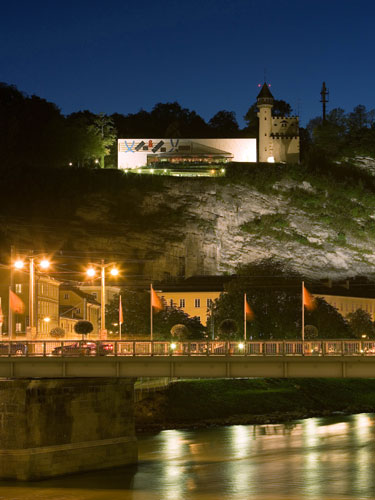
As I stared across the night-time vista of Salzburg and gazed between the spires and domes of a plethora of churches to find the turrets and parapets of castles and fortresses, my eyes fixed on a rather large white box. The garish sign blazoned across its entrance reminded me of an out of town sportswear supermarket. That it is not, it is the Museum of Modern Art.

Before you get worried I am not about to embark on a rant against planning decisions, or provide a comprehensive review of Salzburg’s architecture. Instead this was something that got me thinking. It disrupted my thoughts and sent them on an entirely different track.

Perhaps I should set the scene. I had gone away on holiday on my own with a train pass purchased and a return flight booked from nearly 1000 miles away. The first stop on my tour was Salzburg in Austria and I had only allocated 22 hours before moving onto Vienna.

I started off determined to do everything that there was to do in Salzburg, yet by mid afternoon, my flight had only landed at 10.45, I was a little worried that I would run out of places to visit. Being a tourist isn’t just about doing things, it is about enjoying the ambience of a place, breathing the air that the locals breathe and other such nonsense.

So my slightly revised action plan kicked into gear. I decided to enjoy some wheat beer while sat in a tavern in Fortress Hohensalzburg, and in the evening went into the 300 year old Cafe Tomaselli to savour some cake and coffee while watching the world go by. Oh, and I read a book. I like to read.

As I visit different places and am not numbed by familiarity, thoughts that had previously been dry and academic come to life. Sometimes it is self-reflection, probably a bit too much of that, and at other times the things around me. I have found God in some of the most unusual places, and other times I long to have something profound to say and nothing comes. Yet I see God at work all over the place. And that most unusual place, well that’s me. The fact that God chooses to work in my life astounds me.

This is the start of me trying to explain what Broken Cameras and Gustav Klimt is, it’s going to take a while, I’ll pop in and out, and hopefully you’ll start to get the picture. Some of the examples from my life you may find just down right quirky. I may have some explaining to do to a few people. But in at least some I hope the lessons are universal.

Anyway, back to Salzburg. Before I went back to the Youth Hostel I thought there was plenty of time left for a little more sightseeing. I wandered along a magnificent little street where the houses on one side are built into the cliff face. Actually, I walked along it one and a half times as I realised I had joined halfway along so went back to the start to do it from the beginning.

The final item on that day’s itinerary (Yes, I had made itineraries for each of the eleven days I was to be away.) was a walk up a hill on the opposite side of town to a convent to catch a night-time panorama of Salzburg. It was when I reached the summit and sat on a convenient park bench on a specially located viewing platform that I was confronted with this glaring floodlight white building.

It had struck me as I was walking (for the second time) down this quaint street and up the hill that you just cannot ‘do’ ambience. And when you try, annoying little things like modern architecture shatter the pretence. Something can seem real enough but really it is just a show.

In the same way that you cannot just do ambience, can we ‘do’ God?

I don’t think you can. And when you try, you generally sell either yourself or God short, and usually both.

Because God is not something that can be summed up in a whistle stop visit or captured on a postcard. There is no one-hour audio guide available in ten different languages with special versions for children in German, Italian and English.

God is not sanitised, convenient, or marketed to the masses.

If Jesus is my girlfriend, does my girlfriend become my god?

You know that ‘it girl’? The one with the long legs, glamorous looks and stylish make-up.

No, neither do I.

She rarely exists except on the TV screen or the fertile lands of our imagination. But the image is pervasive, it is what we think we are supposed to want.

Lust is love gone wrong. It is when we become a slave to our desires. Yet lust is usually the lens through which we try and assess love. We are drawn to those we are attracted to, and want more what we cannot have. Lust objectifies our desires. It makes what we want abstract and generalised. It means that we want something, and the nearest fit will do.

A little bit of philosophy

It turns what I want into an it. I-it, as Martin Buber would put it. We place ourselves in relation to an it. What this does is to ignore the complex reciprocal emotions that are in play and turn relationships into what ‘I’ want. I do what I can to possess and obtain, I perceive myself as alone with a universe of objects orbiting around me.

The obvious upshot of this is that we treat people as objects. We use them for ourselves. Every time we interact with people thinking only of our our needs, wants and desires, we are removing a little of their person hood. This fundamentally misses the point and it turns a them into something less than a person, it denies the self. But it also affects the ‘I’. Because I am not a solitary individual living in a world of my own creation. So when I define myself in relation to objects rather than people I settle for less than what I am made for. In my effort to personalise my life around what I want I have in fact depersonalised myself.

In contrast Buber suggests we adopt a posture towards one another as ‘I-thou’, we should accord dignity to those we relate, we must accept that we live in a conflicted space with tension and mystery and the magnitude of emotions that flow between people exercising freedom. And that freedom means that we cannot always have it our way. But as Alan and Debra Hirsch put it: ‘Through my relationships, in which I give of myself, I will become real, more alive’

The ‘I-thou’ relationship is at its most critical as I relate to God. If I treat God as an it, then I relate to him for what I can get out of him, but if I let him be Thou, then I allow him to change and transform me, and I realise that the world does not exist to serve me.

Relationship idol

Lust is bad. That’s what we hear, me must flee from it. We must remove every trace of immorality from among us. And within the church there can be a slightly sneering attitude to a world enthralled by sex, and we say that it is worshipping a false god.

I think it’s time to check our back yard. While we can be loquacious in our criticism of the world’s sexuality, we sometimes seem to be equally obsessed. As Tim Keller puts it: ‘If you are so afraid of love that you cannot have it, you are just as enslaved as if you must have it.’

We can slip into idolising relationships in two ways. Firstly, we build up a picture of a perfect relationship, or often a perfect partner. We treat the other half as an it. Because we are afraid of falling short of this standard we steer clear, we circumvent the contested space where we may discover that a relationship does not match up to our illusion.

The second, and I think bigger problem is that we pray for a girlfriend, (or boyfriend). Bear with me a moment, as that probably sounded slightly heretical. In my last post I criticised the tendency that at least I have of compartmentalising my life and leaving God out of some parts of it, and here I am saying that praying for a partner is somehow wrong. The problem is that this is often the only place we give to God in our relationships, certainly if you’re single.

If we are praying for something constantly, if it is the cornerstone of our prayer life, and importantly, if our trust in God is lessened if we do not get the response we want, then we have created an idol. So if I am praying for a girlfriend and one does not drop out of the sky, or I seek God about asking a girl out and then she turns me down, and if this causes me to doubt God then I am placing what I want above Him.

What this also does is remove our faculties, we are deferring to God when really he wants us to do it ourselves. If a guy ever says to a girl that God has told them they are to get married, I’d suggest hitching a ride on the nearest thing passing. This is not because I don’t believe that God can speak into every situation, including who we will marry, but if this is our reason for asking a girl out we are hiding behind God. We are depersonalising ourselves.

The rescue

The myth of the perfect couple is pretty damaging. It is also not countered with sufficient honesty and transparency. For those of us who are not married, life beyond the veil and the vows is a shrouded image. There is not enough acknowledgement and recognition that the problems of life are not solved by marriage. Too many people approach relationships thinking that either the institution of marriage, or the person they are looking to marry will rescue them.

Maybe I seek perfection in a girl. I look for something that is so right, beyond reproach, without anything that I might not like. Until recently I have never given much thought as to the details of this. I have not pondered what the cost of it all is, how much I might have to give to stay in love.

I have thought of love as a one off endeavour, the satisfaction at the end of an infatuation. I have rarely concerned myself with the hard work that it must entail, the dedication and the commitment, the forsaking of so much else, the constant pursuit.

What if true beauty does not ignore the blemishes. What if it is through the cracks of the broken that the light begins to shine?

My autrocious conception of love is brought into stark contrast when I realise that love does not require perfection. In fact it almost demands its absence. How easy would it be to love something that had no faults, what kind of love would that be. If God made us all perfect and unstintingly obedient there would be nothing audacious about his desire and determination to love us every moment of every day. It is that model of love, that he loves us no matter what which must make me look again at how I love, it must force a smile on my face as I realise that just as God loves me, I can love others, and perhaps, most surprising of all, others can love me.

Do I want a rescuer, do I want a girl who will save me from myself. Am I looking in the wrong place for the solution to my problems, investing far too much hope in the ways of a fellow human who I know is also covered in cracks, fragile and close to breaking point. Do I think that I could be her rescuer? That this might be my way in.

There’s an old motivational maxim, don’t let the good get in the way of the best. I think it’s time to turn this on its head. The search for the best can blind you to the good that is right in front of you. And the best you search for, the perfection you desire? Well it’s there, just not in the girl that you’re looking at. That’s God’s job. He has a monopoly on best.

God lives in all our boxes

One of the strange side-effects of taking up blogging is navigating the segues between what I say online, the people who read it and those who I know in real life. I’ve been told off for talking like this in the past, with the insistence that online relationships are also real. Maybe so, but my relationships with those I see in the flesh will, and I would argue should always, take priority over those I only have contact with over cyberspace.

The difficult part are those who fall into both camps. Walking into church at the weekend was a little strange, I’ve written 4 pretty lengthy posts offering my thoughts about relationships, and in small group settings over the past few days talked quite a lot about it. But this was a large gathering with people I know well, those I know a little, and many I do not know at all. And quite a few of them will have read my thoughts. I would really rather keep them in separate camps, as many people can read the blog as they like, but please not those I meet in my daily life (unfortunately I think the ship has sailed on that one). As a side note it’s interesting to see comments from people I haven’t seen in a few years, the internet can do some wonderful things.

I’ve always had a slightly insidious predilection for compartmentalising my life into little boxes, and not really being very comfortable when the edges blur. It lets me determine which picture I paint of myself, specific to the situation and I find it hard when friends, family or colleagues cross from one setting into another. The truth is the boxes we build are always porous, and they have to be, but we often construct them for our own convenience to let us present our best face, which may be different to different people.

Sometimes we forget that God lives in all our boxes.

He is there when we sing songs of worship, when we read the Bible, he’s there when we struggle to get out of bed and when we stagger back in smelling of pilchards. God is there when we love him and when he forget him. God is there when we nervously reach out a hand to touch the palm of the girl before us, he is there in the tears and the heartache. He is there in the ecstasy and the intimacy.

And we do none of these things separate from our relationship with God. A really key contribution to this subject is a chapter towards the end of Alan and Debra Hirsch’s book Untamed called ‘Too sexy for the church?’.

The church has been criticised for taking the language and behaviour of romance and using it for our relationship with God. Particularly stinging criticism has been levelled at some contemporary worship, as ‘Jesus is my girlfriend songs’. What we have not done as much of is consider the depth and the extent of our relationship with God and include within that our romance and relationships.

We deal with sexuality outside of the context of spirituality. And often the only place that it has within discipleship is its prohibition outside of marriage. It is often skipped over with uncommon haste the fact that we are sexual beings. That we have a sexual nature, which while often corrupted, is not in and of itself sinful outside marriage. Let me state this clearly, sexuality in singles is not sinful.

In Untamed the activities of several of the early church fathers is considered as mistaken; Origen, Augustine, and Simon Stylites went to pretty extreme measures to deny their desires because they felt they were incompatible with God’s holiness (including self castration and living on a pole for 40 years).

In the contemporary church there is often a lot of talk about the wonderful gift of sex that married people can enjoy. Following the Hirschs I want to suggest that the marriage covenant in which sexual relationships flourish is the high water mark of the second half the great commandment. To love the lord your God with all your heart soul mind and strength, and to love your neighbour as yourself. We are to grow in relationship with God, and in relationship with people.

Too often we box up the little bits of our life and apply our beliefs to them in isolation, we ensure that our faith is sufficiently malleable to fit our context. So we might talk about marriage in church, we might talk about discipleship and the Lordship of Christ. But we don’t do enough to connect the dots.

While we talk openly and honestly about loving one another in church the purpose of it is a platonic, or perhaps agape, love, it is about building community, about knowing each other deeply. We don’t just leave things to chance, we set aside time, we meet together, we ask tough questions and aren’t satisfied by pat answers. It is not always easy, and often doesn’t work like this but at its best it is deliberate and it is clear.

We show no such clarity or intentionality in how we pursue relationships. It might best be characterised as a hazy fog. As well as the duality that often characterises our handling of sexuality, and detaches it from discipleship, there are a couple of other issues at work here. I’ll mention one briefly now, and the second deserves a post of its own.

We get sucked into a vortex of secrecy and uncertainty. And while we kind of guess that others experience similar dilemmas, we act in our own isolated world. An upshot of all this thinking and writing on relationships is a number of pretty frank conversations about it. I’ve started to try to put together, in my head at least, a definition to what this blog will be about, and if I want to achieve anything, I think it is to get people thinking and talking about areas of their faith which too often go unspoken.

I’m all for discretion in handling sensitive issues, where passions and emotions are in play, but don’t let privacy be an excuse for secrecy.

And the next one, well that would be relationship idolatry…

Rage, riots and redemption

London has become a different place over the past few days. Violence has taken over the streets, the sirens that you become immune to living in the metropolis take on a more sinister tone. As you wait for the bus and 3 riot vans fly through the red lights heading towards the scene of one of last nights trouble spots, there is fear in strangers’ eyes. I know people who live in Brixton and Hackney, my house mate suddenly glad she skipped the cinema last night. This is London, this is my home.

The MP who, somewhat ironically, campaigned against the proliferation of betting shops on Tottenham High Street looks on in dismay as their windows are kicked in. The iconic building housing the carpet shop burnt down on Saturday a symbol of the sheer madness that has taken hold. Not only did it destroy many homes, but the owner, Lord Harris, founded academies in some of the most deprived parts of London. This was senseless violence.

There are grievances, there are reasons, there is rarely such a thing as mindless rage.

The point is, when is this ever the right response? When does a cycle of bullets and bottles and bbm incitement lead anywhere but to more madness. The batons come out, the shields go up, the police coral the crowds, and they have to, just look what they have done. But this provokes more aggression, the police become the enemy.

As I followed the news today, reports of the chaos that had been unleashed and the apprehension about what would come next, the story drifted to the pathology of a riot. Some papers had erroneously suggested that twitter had sparked the mobilisation of disorder. This did not ring true, firstly, most of twitter is public. And although I saw it all unfold on twitter on Saturday and Sunday evening, and photos of burning cars and buildings flooded my stream, this does not mean it was how it started.

Instead, as the post-mortem seemed to confirm it was through Blackberry Messenger that the plans had been orchestrated and broadcast. The disconnect occurred because the media use twitter on their iPhones – and equate this as social media, but the young disaffected looters message constantly in their own private spheres. What struck me was that so much attention was given to how social media played its part. Not so much what was happening, why it happened, and certainly not what could stop it, but how technology played its part.

Maybe crisis leads us to the trivial. Maybe we find comfort in the discussions where we can analyse and dissect, where the answers can fit on index cards and 140 character tweets. And let pass by the far harder dilemma of what could cause such wanton vandalism, and how can we make it stop.

Because we feel as though our hands are empty, and our answers are lacking.

But rage. Rage does not heal wounds. It does not build up. It does not redeem. We can have all the anger and all the rage, and all the deepest desire for retribution and justice but that doesn’t make it better.

I’m left struggling for what might.

Hope. That thing which holds out. The fearless tenacity that tomorrow will be better. The unswerving belief that life is not destined to be like this. That the aches and pains, the scars and suffering are only for a moment. It is hope which spurs us forward, which lets us abandon our baggage, those fears and failures that drag us down.

Hope is said to have two daughters: anger and courage; that force you to see what is wrong and work to make a difference.

We may be angry, as we watch a city drenched in stains, but do we have the courage to fight to make a better world?